


For the highest visual impact with the least effort, start with a single Art Deco chandelier in your foyer or dining room. One well-chosen piece does more for a space than five smaller accents scattered around it. Montreal Lighting & Hardware carries Crystorama, Savoy House, and Maxim lines that bring authentic period character with modern specs and Canadian shipping built in.
Before you shop, run through these three steps:
- Measure first. Note ceiling height, room dimensions, and the mounting box location before browsing.
- Decide the function. Is this fixture your primary ambient light, a decorative accent, or task lighting? That choice drives lumen count and fixture type.
- Verify electrical specs. Confirm CSA compliance for any fixture you install in Canada, especially for antique or imported pieces.
Table of Contents
- What types of art deco lighting work best in each room?
- Antique vs. reproduction: which should you choose?
- What materials and finishes define the Art Deco look?
- How do you pick the right fixture for your room?
- What should you expect to pay in Canada?
- Where can you source Art Deco lighting in Canada?
- How do you layer Art Deco lighting into a modern interior?
- Recommended Canadian suppliers and brands for quality Art Deco lighting
- How to authenticate Art Deco lighting and avoid fakes
- Key Takeaways
- The fixture that changes a room
- Find your Art Deco fixture at Montreal Lighting & Hardware
- Further reading and authoritative sources
What types of art deco lighting work best in each room?
Art Deco fixtures fall into five main categories, and each one brings a different kind of presence to a room.
Chandeliers are the natural showpiece of the style. Their geometric silhouettes, stepped metalwork, and opal or crystal glass shades were designed to command attention. A foyer or dining room is the obvious home, but a bold Arcadia chandelier works just as well over a kitchen island when ceiling height allows.
Pendants offer a scaled-down version of that same drama. A single pendant over a reading nook or a trio over a kitchen counter gives you the geometric lines without overwhelming a smaller space.
Wall sconces are where Art Deco really earns its keep in hallways, bathrooms, and flanking a fireplace. Symmetrical pairs create the kind of formal balance the style is known for. The Crystorama Channing wall mount is a good example of how a three-light sconce can anchor a bathroom vanity with period character.
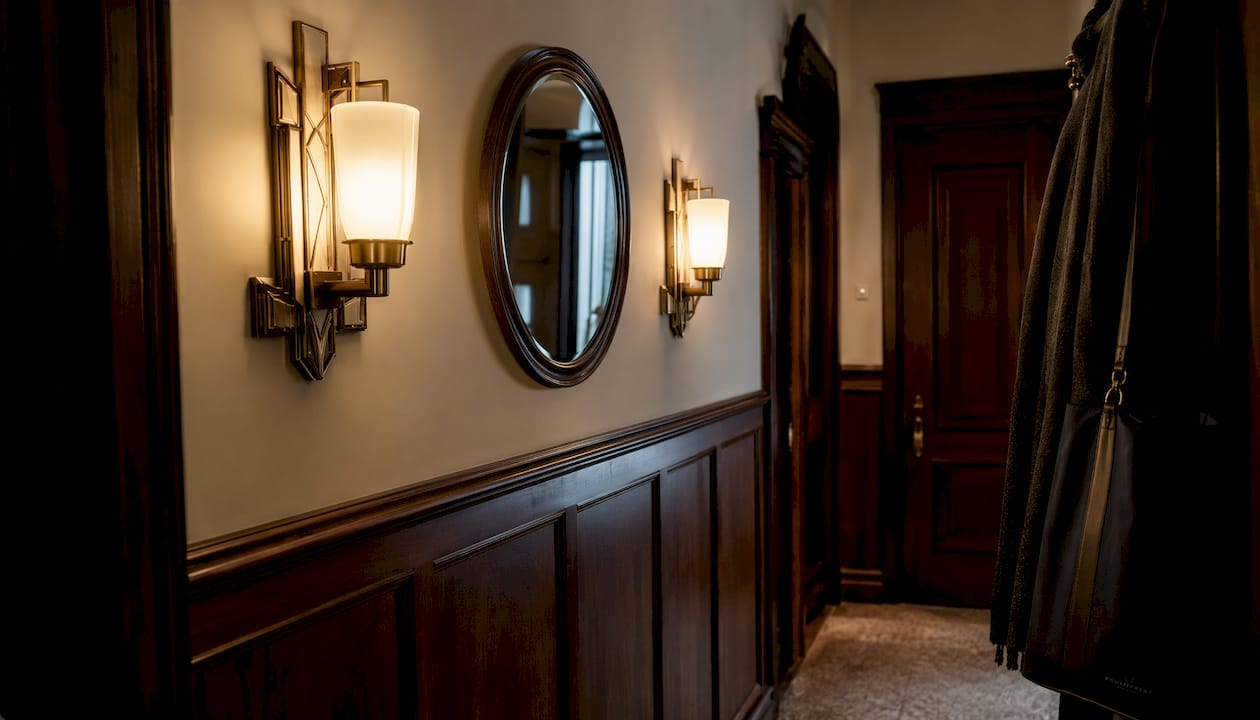
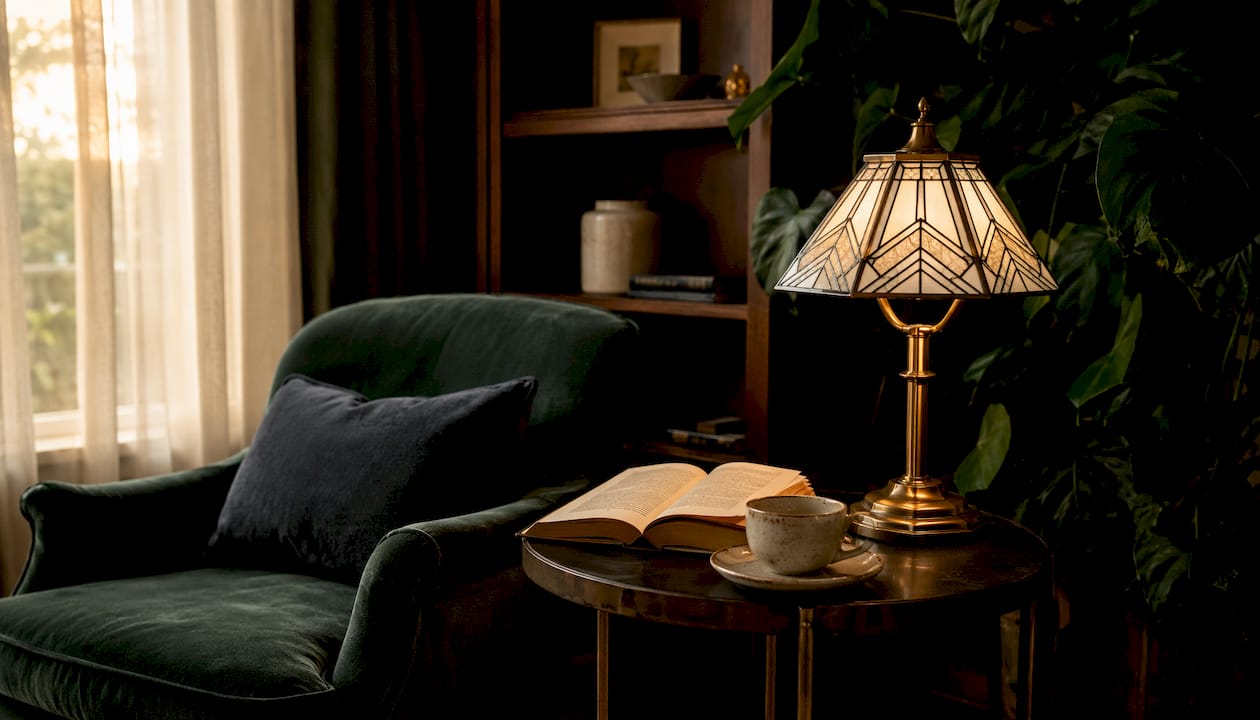
Table lamps add warmth and patina at eye level. They work in living rooms and bedrooms where you want the Deco geometry without committing to a ceiling fixture.
Floor lamps are the most flexible option. A torchière with an opal glass shade can fill a corner of an open-plan living room with soft, diffused light while reading as a sculptural object during the day.
| Category | Best Room | Typical Span / Height |
|---|---|---|
| Chandelier | Foyer, dining room, kitchen island | 36 inches diameter |
| Pendant | Kitchen, reading nook, stairwell | 14 inches diameter |
| Wall sconce | Hallway, bathroom, flanking fireplace | 12 inches wide |
| Table lamp | Living room, bedroom, side table | 32 inches tall |
| Floor lamp | Living room corner, reading area | — |
Design professionals recommend layering these types — combining a chandelier with sconces and a table lamp — to create flexibility and depth in multi-functional spaces. A single fixture category rarely does the whole job.
Pro Tip: Treat one Deco fixture as the room’s sculptural jewelry. It does not need to match every other element. A polished nickel chandelier over a linen sofa and raw-wood coffee table reads as intentional, not mismatched.
Antique vs. reproduction: which should you choose?
Both paths lead to beautiful results. The choice comes down to budget, patience, and how much you want to manage.
Antiques carry genuine patina and craftsmanship that mass-produced pieces simply cannot replicate. Vintage lighting adds a lived-in quality that feels earned rather than applied. The trade-off is cost, condition uncertainty, and the near-certain need for rewiring before installation in a Canadian home.
Reproductions give you consistent dimensions, modern lamping, warranty coverage, and specs you can verify before buying. Brands like Crystorama and Savoy House design fixtures that draw on Deco geometry and finishes without the provenance puzzle.
Here is a quick checklist for evaluating either option:
- Maker marks and signatures. Authentic pieces from French glass houses like Muller Frères carry etched or molded signatures on the glass. No mark does not automatically mean fake, but a mark adds value and verifiability.
- Wiring evidence. Original cloth-wrapped wiring, Bakelite sockets, and two-pin plugs are signs of age. Budget for professional rewiring before installation.
- CSA compliance. Canada requires CSA or equivalent certification for installed fixtures. Antique European pieces almost never arrive CSA-compliant; rewiring to current standards is not optional.
- Documented provenance. Auction records, dealer invoices, or gallery certificates add authenticity and protect resale value.
- Mounting hardware integrity. Check canopy condition, mounting screws, and any ceiling medallion for cracks or repairs.
Factor rewiring costs into your total cost before comparing antique prices with reproduction prices. An antique sconce that needs rewiring and a new canopy may end up costing more than a reproduction with a warranty.
What materials and finishes define the Art Deco look?
The materials are as important as the silhouette. Get the finish wrong and even a well-proportioned fixture reads as generic.
Polished nickel and chrome deliver the sleek, modernist edge that defined 1920s and 1930s urban interiors. They read as crisp and cool, pairing naturally with white walls and dark wood. Chrome and nickel finishes are among the most common on original period pieces and on quality reproductions alike.
Brass and bronze bring warmth. An oil-rubbed bronze or gilded brass finish gives a fixture a richer, more period-appropriate feel, especially in rooms with warm wood tones or jewel-colored walls. If you are pairing your lighting with tile or millwork, Deco-inspired bronze tile can tie the whole scheme together beautifully.
Opal and pressed glass soften the geometry. A frosted or opal shade diffuses the light source and creates that characteristic warm glow without harsh glare.
Pâte de verre and acid-etched glass are the hallmarks of high-end original pieces. Makers like Gabriel Argy-Rousseau produced pâte de verre lamps that now command collector prices. On reproductions, look for acid-etched detailing rather than printed or applied patterns.
Crystal adds sparkle and formality. Deco crystal tends toward geometric cuts rather than the floral forms of earlier Victorian styles.
Maintenance varies by material. Wipe polished nickel with a damp cloth and dry immediately; avoid abrasive cleaners that strip plating. Brass patina is part of the appeal on antiques — clean gently with mild soap and water, and never use brass polish on a piece you want to age naturally. Etched glass responds well to a soft cloth and glass cleaner; avoid anything abrasive.
Pro Tip: On reproductions, ask about plating thickness and substrate. Thin chrome over zinc alloy will pit and flake within a few years. Polished nickel or bronze over a solid brass substrate holds its finish far longer and is worth the price difference.
How do you pick the right fixture for your room?
Function first, then form. Deciding whether a fixture is for task or ambient lighting before you fall in love with a shape prevents the common mistake of buying something beautiful that fails to light the room properly.
- Measure the room. Note length, width, and ceiling height. For a chandelier, a simple rule: add the room’s length and width in feet, and that sum in inches gives you a reasonable starting diameter. A 12 × 14 ft. dining room suits a 26-inch chandelier.
- Choose the fixture type. Use the category table above to match type to room and function.
- Calculate the drop. For dining chandeliers, the bottom of the fixture should hang 30–36 inches above the tabletop. For foyer chandeliers in two-story entries, allow 2.5–3 inches of chandelier height per foot of ceiling.
- Choose lamping and brightness. Warm white (2700–3000K) suits Deco’s rich materials. For ambient dining, aim for 150–200 lumens per square meter; for task areas, 300–500 lumens per square meter.
- Verify mounting specs. Check the fixture’s weight against your mounting box rating (standard boxes handle up to 35 lbs.; fan-rated boxes handle 50 lbs. or more). Confirm canopy diameter covers your ceiling opening.
| Situation | Sizing Rule |
|---|---|
| Chandelier over dining table | Diameter = table width minus 12 in. |
| Chandelier in foyer | Diameter = room L + W (ft.) expressed in inches |
| Pendant over island | One pendant per 2 ft. of island length |
| Sconce beside mirror | Center sconce at 60–65 in. from floor |
| Floor lamp beside seating | Shade bottom at seated eye level |
For antiques, always ask the seller: exact dimensions, lamping type, weight, rewiring status, mounting hardware included, shipping protection method, and return policy. Product pages for brands like Crystorama show configurable light counts and clear dimensions — that level of spec detail is the standard you should hold every seller to.
What should you expect to pay in Canada?
Price ranges vary widely depending on whether you are buying a reproduction, a mid-range vintage find, or a gallery-quality antique.
| Category | Typical Canadian Price Range | Key Cost Drivers |
|---|---|---|
| Reproduction (entry to mid) | A broad range based on brand and finish quality | Brand, finish quality, light count |
| Mid-range vintage | Variable cost depending on condition and provenance | Condition, provenance, rewiring status |
| High-end antique / collectible | Premium pricing reflecting maker, glass technique, and documentation | Maker, glass technique, documentation |
Beyond the base price, budget for rewiring, professional installation, and import duties if buying from a U.S. or European seller. Well-chosen vintage pieces can be more affordable than new luxury reproductions and sometimes arrive faster, but only when you factor restoration costs in honestly.
Auction pricing tends to run lower than gallery pricing for comparable pieces, but auctions offer less recourse if condition surprises you. Trade showroom pricing often includes warranty, installation support, and clearer specs, which can justify a modest premium.
Where can you source Art Deco lighting in Canada?
Canadian buyers have more options than most realize, and each channel has a distinct trade-off.
- Specialist lighting showrooms and trade retailers (like Montreal Lighting & Hardware) offer the clearest specs, warranty coverage, fast Canadian shipping, and access to a trade program for designers and contractors. Specialist retailers and showrooms provide installation support that most online marketplaces cannot match.
- Vintage dealers and antique markets are the place to find genuinely one-off pieces. Cities like Montreal, Toronto, and Vancouver have strong antique dealer communities. Expect to negotiate, and always ask about provenance documentation.
- Auction houses (both in-person and online) surface interesting pieces at competitive prices. Factor buyer’s premiums (typically 20–25% on top of the hammer price) into your budget.
- Online marketplaces offer broad selection but inconsistent quality control. Verify seller return policies carefully, and never buy an antique without asking for additional photos of wiring, sockets, and any maker marks.
For Canadian buyers purchasing from U.S. sellers, de minimis thresholds and CUSMA provisions can reduce or eliminate duties on many lighting fixtures, but confirm with the seller before ordering. Fragile glass fixtures should ship double-boxed with foam suspension; ask for photos of the packed item before it leaves the seller.
How do you layer Art Deco lighting into a modern interior?
The goal is not to recreate a 1930s hotel lobby. It is to bring one or two pieces of that era’s confidence and geometry into a home that feels current.
- Pick one focal Deco piece per room. A chandelier, a statement floor lamp, or a matched pair of sconces. One strong anchor reads as intentional; five competing pieces read as a theme park.
- Mix metals deliberately. Polished nickel and warm brass can coexist when one is dominant and the other is an accent. Avoid three or more different metal finishes in the same room.
- Balance with neutral modern furnishings. Linen, concrete, raw wood, and matte plaster all let a Deco fixture breathe. Busy wallpaper or heavily patterned upholstery competes with the geometry.
- Use pairs for symmetry in open-plan spaces. Original Deco pieces were often designed for smaller, more formal rooms. In a contemporary open-plan home, a single small sconce can look lost. A matched pair of wall mounts flanking a sofa or fireplace gives the style the visual weight it needs.
- Layer fixture types. A chandelier overhead, sconces at mid-height, and a table lamp at eye level create depth and flexibility. Designers consistently recommend this layered approach for multi-functional living spaces.
Pro Tip: Scale up rather than down when in doubt. Many original Deco pieces were designed for grander rooms than most Canadian homes. In a contemporary open-plan space, oversizing a chandelier by one size category gives it the presence it was designed to have.
Montreal Lighting & Hardware’s showroom lets you see fixture scale in person before committing, and the trade program gives designers and contractors access to pricing and installation guidance that makes layering projects much smoother.
For a coordinated look, pairing your lighting finish with period-appropriate surfaces helps. Deco-style tile options in geometric patterns can reinforce the style without requiring a full period renovation.
Recommended Canadian suppliers and brands for quality Art Deco lighting
Montreal Lighting & Hardware is the most practical starting point for Canadian buyers. The retailer carries Crystorama, Savoy House, and Maxim, all of which offer fixtures with genuine Deco character, modern lamping, and specs that are clearly documented. The Arcadia series from Crystorama is a strong example: geometric metalwork, configurable light counts, and dimensions listed clearly so you can size before you buy.
Crystorama has built a reputation for decorative fixtures that draw on historical styles without feeling like reproductions. Their Deco-influenced lines use quality metal finishes and glass that hold up over time.
Savoy House brings a slightly warmer, more residential sensibility. Their fixtures tend toward the warmer brass and bronze end of the Deco palette, which suits Canadian interiors with wood floors and warm-toned walls.
Maxim offers strong value at the mid-range price point, with a broad selection of period-style fixtures that work well in both residential and light commercial settings.
For genuine antiques, established Canadian auction houses and specialist vintage dealers remain the most reliable source, particularly for documented French or American pieces from the 1920s and 1930s.
How to authenticate Art Deco lighting and avoid fakes
Reproductions sold as originals are the most common problem in the antique lighting market. A few checks protect you.
Examine the glass closely. Authentic pâte de verre and acid-etched glass have depth and irregularity that pressed or molded reproductions lack. Look for slight variations in thickness, color, and surface texture. Printed or applied patterns on glass are a clear sign of a modern reproduction.
Check the metal construction. Original Deco metalwork was cast, stamped, or hand-formed. Look for seams, casting marks, and the weight of solid metal versus hollow or thin-walled construction. Cheap zinc alloy feels noticeably lighter than brass or bronze.
Look for maker signatures. French glass houses like Muller Frères signed their work on the glass itself. American makers often used paper labels or stamped metal tags. The absence of a signature is not disqualifying, but its presence is a strong positive signal.
Review the wiring. Cloth-wrapped or rubber-insulated wiring, Bakelite sockets, and period-appropriate plugs are consistent with genuine age. Modern plastic wiring on a piece claimed to be from the 1920s is a red flag.
Ask for provenance documentation. Auction records, dealer invoices, estate sale documentation, or gallery certificates all add credibility. A seller who cannot provide any paper trail for a high-value piece deserves extra scrutiny.
Get a second opinion on high-value pieces. For anything above $1,500 CAD, a consultation with a specialist dealer or appraiser is worth the cost.
Key Takeaways
Authentic Art Deco lighting rewards buyers who measure carefully, verify electrical specs for Canada, and choose one strong focal fixture rather than scattering smaller accents across a room.
| Point | Details |
|---|---|
| Start with one focal piece | A chandelier or matched sconce pair delivers more impact than multiple small accents. |
| Verify CSA compliance | Antique European fixtures almost never arrive CSA-compliant; budget for professional rewiring. |
| Match finish to room tone | Polished nickel suits cool, modern palettes; brass and bronze work with warmer wood tones. |
| Factor total cost | Add rewiring, installation, and any import duties to the base price before comparing antique vs. reproduction. |
| Shop Montreal Lighting & Hardware | Crystorama, Savoy House, and Maxim lines with clear specs, trade pricing, and fast Canadian shipping. |
The fixture that changes a room
The most common mistake buyers make is choosing a fixture that is too small. It happens because lighting is usually the last decision in a renovation, made when the budget is tight and the room is already furnished. A chandelier that looks substantial in a product photo can disappear entirely in a 10-foot ceiling once the furniture is in place.
The second mistake is buying purely for aesthetics without checking the light output. A gorgeous pâte de verre table lamp that produces 200 lumens is a beautiful object, but it will not light a reading chair. Decide what the fixture needs to do before you decide what it needs to look like.
What we find at Montreal Lighting & Hardware is that buyers who come in with measurements and a clear function in mind leave with something they are genuinely happy with. The ones who browse without a plan often end up with a piece that is either too small, too dim, or both. The showroom makes a real difference here: seeing a chandelier hanging at actual height, in actual light, tells you things a product photo simply cannot.
Find your Art Deco fixture at Montreal Lighting & Hardware
The single sharpest advantage of shopping with Montreal Lighting & Hardware is getting detailed specs, trade pricing, and fast Canadian shipping in one place, without the guesswork of online marketplaces or the uncertainty of buying antiques without recourse.
The Crystorama Arcadia and Brielle chandelier lines, Savoy House pendants, and Maxim sconces are all available with clear dimensions, lamping specs, and finish options. The Bolton 12 Light Chandelier and the Danbury Four Light Chandelier are strong starting points for dining rooms and foyers. Trade clients get exclusive pricing and access to the showroom team for placement and installation guidance. Browse the full collection at Montreal Lighting & Hardware or contact the trade desk to discuss your project.
Further reading and authoritative sources
These sources informed this guide and are worth exploring directly for provenance research, glass techniques, and product specifications.
- House & Garden: How vintage lighting transforms an interior — Designer perspectives on mixing vintage pieces into modern interiors, with practical advice on rewiring and sourcing.
- The Hoarde: How to choose vintage lighting for your home — A function-first buying framework for vintage fixtures, useful for task vs. ambient decisions.
- Art Flagey: Art Deco Table Lamp, Muller Frères — A gallery example of a documented French Art Deco lamp with maker signatures and provenance, useful for understanding authentication standards.
- Macklowe Gallery: Gabriel Argy-Rousseau Pâte de Verre Lamp — Museum-quality example illustrating the technical and artistic value of original pâte de verre glasswork.
- Homes & Gardens: Why vintage lighting endures in modern homes — Covers the cost comparison between vintage and new luxury reproductions, including restoration factors.
- Lighting New York: 1920s Art Deco Lamps — A broad reference for period finishes, color strategies, and fixture types from the 1920s era.
- Montreal Lighting & Hardware: Crystorama Arcadia 12 Light Chandelier — A model product page showing the level of spec detail (dimensions, light count, finish options) buyers should expect from any reputable seller.
Recommended
- Montreal Lighting & Hardware | Canada’s Lighting Experts
- Glacier One Light Outdoor Lantern Post | Crystorama – Montreal Lighting & Hardware
- Glacier Three Light Outdoor Lantern Post | Crystorama – Montreal Lighting & Hardware
- Dakota Eight Light Ceiling Mount | Crystorama – Montreal Lighting & Hardware
