


The right staircase chandelier does two things at once: it creates a moment of genuine drama and it keeps your stair run safely lit. For tall two-story voids with significant clearance, a cascading crystal column or long-drop spiral reads beautifully from every floor. Contemporary landings with lower ceilings suit stacked ring or linear cluster designs. Wide, open runs with irregular geometry often call for sculptural branch forms or modular multi-drop clusters. Whatever style you choose, the bottom of the fixture must sit at least 7 ft above the landing floor, with 7.5–8 ft preferred in busy households. Measure your ceiling height and landing clearance before you browse, and plan from the start to layer the chandelier with wall sconces or step lights so tread faces stay visible and safe.
Montreallighting carries a curated selection of these styles from brands including Savoy House, Maxim Lighting, and Crystorama, all available to Canadian homeowners with trade program pricing and showroom access.
- Measure ceiling height and stair void width before selecting any fixture.
- Confirm at least 7 ft of clearance between the bottom of the fixture and the landing floor.
- Plan supplemental lighting (wall sconces, step lights, or under-tread LEDs) alongside the chandelier.
- Verify the mounting box and ceiling structure can support the fixture’s weight before ordering.
Pro Tip: Tape a piece of cardboard cut to your intended chandelier’s diameter to the ceiling before you order. Step back from the entry and the landing to check scale from both sightlines. It takes ten minutes and can save a costly return.
Table of Contents
- Which staircase chandelier style fits your space?
- How do you size and place a chandelier in a stairwell?
- How do you make a staircase chandelier actually functional?
- How materials and finishes change the look and scale of your fixture
- Which chandelier family suits your staircase type?
- What does installation actually cost in Canada, and how long does it take?
- How to clean and maintain your staircase chandelier safely
- Where to buy a staircase chandelier in Canada
- Key Takeaways
- What retailers see when homeowners choose poorly
- See your options at Montreallighting before you decide
- Useful sources and further reading
Which staircase chandelier style fits your space?
Designers group modern staircase chandeliers into a handful of clear families, each with a distinct visual personality and a preferred stair geometry.

Cascading crystal columns are the most theatrical option. A long vertical drop of crystal or glass elements catches light from every angle and reads as a single luminous sculpture from the entry below. They suit traditional and transitional homes with tall, central voids and formal millwork. Pair them with warm brass or polished chrome hardware for a classic feel.
Stacked ring and hoop chandeliers create a geometric statement visible from both the lower and upper sightlines. From below, the concentric rings read as a graphic composition. From the landing above, they flatten into a clean circular form. These work especially well in contemporary and transitional stairwells with straight runs and neutral palettes. Matte black is the natural finish choice; polished nickel softens the look for transitional spaces.
Linear drop clusters hang multiple pendants at staggered heights along a shared canopy. They suit L-shaped or angled runs where a single central fixture would feel off-axis. The staggered silhouette follows the diagonal of the stair, which makes the whole composition feel intentional rather than awkward.
Sculptural branch forms spread outward from a central stem, filling wide horizontal voids with organic texture. They read well in Scandinavian-influenced interiors with natural wood and stone, and they work beautifully in open-riser staircases where the fixture is visible from an adjacent living area.
Oversized spiral and helical chandeliers wrap a vertical column of light around a central axis. They are the right call for a circular or curved staircase where the fixture can echo the geometry of the rail. In a straight run, they can feel slightly off, so match the form to the stair shape.
Globe-cluster and minimal pendant groups keep the metal framework light and let the bulb or glass globe carry the visual weight. Contemporary practice favors these minimal frameworks in matte black or polished chrome so the light reads clearly against lighter walls without competing with the architecture. They suit modern and industrial interiors and are among the most versatile options for mid-height voids.
Finish shifts the perceived style more than most homeowners expect. The same spiral fixture in matte black reads industrial; in polished gold, it reads glamorous. Matte black is the most versatile modern finish for staircase chandeliers, pairing with almost any wall color or railing material. Polished brass and aged bronze suit warm-traditional and transitional homes. Chrome and brushed nickel belong in cool, contemporary schemes.
How do you size and place a chandelier in a stairwell?
Getting the drop and diameter right is the single most important step before you shop. A fixture that is too small disappears in a tall void; one that hangs too low creates a hazard.
Clearance rules
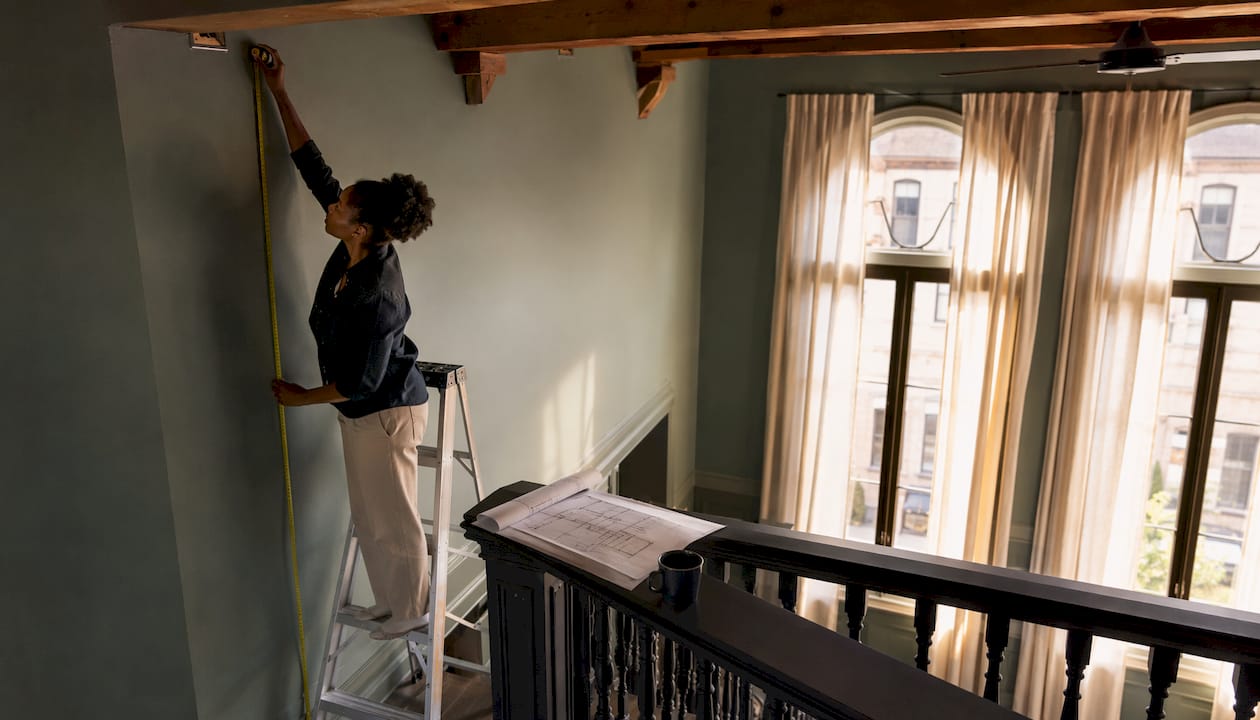
The bottom of your chandelier must sit at least 7 ft above the landing floor. For households with tall occupants or heavy foot traffic, 7.5–8 ft is more comfortable. Along the stair run itself, the fixture must clear the highest point of the stair path, which is typically the top tread near the upper landing. For two-story open voids with tall ceiling height, long-drop linear pendants or stacked chandeliers are the right choice. Below 8 ft of ceiling clearance, flush or semi-flush mounts are the practical alternative.
Diameter guidelines
A common rule of thumb for stair voids: the chandelier’s diameter should be roughly half to two-thirds of the stair width. For a stair void around five feet wide, a fixture sized proportionally usually reads well without crowding the space. You can also use the room-dimensions method: add the length and width of the stair void in feet, then convert that sum to inches for an approximate diameter. A 6 ft × 4 ft void suggests a fixture around 10 inches in diameter by this method, which is better suited to a landing pendant than a grand stairwell chandelier. In practice, most designers size up slightly for tall voids because the vertical distance reduces perceived scale.
Calculating drop length
| Stair configuration | Typical void height | Recommended fixture type | Suggested drop |
|---|---|---|---|
| Straight two-story open run | — | Long-drop column or spiral | 10 ft total drop |
| L-shaped with mid-landing | 12 ft | Stacked rings or linear cluster | 6–10 ft total drop |
| Split-foyer / raised ranch | 12 ft | Ring stack or globe cluster | 4–7 ft total drop |
| Single-story landing | 8–10 ft | Mini chandelier or pendant | 2–4 ft total drop |
Measure from the ceiling mounting point to the anticipated lowest point of the fixture, then subtract your required clearance height to confirm you have room. Always account for the canopy and chain or cable length when ordering, since many fixtures ship with a standard chain that may need to be shortened or extended.
- Measure ceiling height at the mounting point, not at the landing.
- Note the height of the highest stair tread that falls within the fixture’s footprint.
- Subtract 7–8 ft from the mounting height to find your maximum allowable drop.
- Order adjustable-drop fixtures when possible so you can fine-tune on installation day.
How do you make a staircase chandelier actually functional?
A chandelier is primary ambient light. It sets the mood and anchors the space, but it cannot adequately illuminate tread faces on its own. Relying on a single overhead source is the most common mistake homeowners make, and it creates high-contrast zones that leave individual steps in unsafe shadow.
The solution is a three-layer plan: ambient light from the chandelier, task and safety light from wall sconces or step lights, and accent light from under-rail LEDs or wall washing. Wall sconces mounted at 60–66 inches above the stair tread track the rise of the stairs and push light down onto tread faces. Under-tread LED strips, recessed wall step lights, or illuminated handrails fill the gaps the chandelier cannot reach.
Lighting layer at a glance: Chandelier (ambient) + wall sconces at 60–66 in. (safety) + under-tread LEDs or step lights (task) = a staircase that is both beautiful and safe to use at any hour.
For bulb and color temperature choices, warm white at 2700K–3000K suits wood-warm interiors and traditional homes. Neutral white at 3500K–4000K works well in contemporary white and gray schemes. Cool white above 4000K is rarely appropriate in a residential stairwell. Lumen output in the 800–3000 lm range covers most ambient stair applications, with the higher end reserved for very tall voids.
Glare control matters as much as output. Choose fixtures with diffusers or frosted glass shades, and install a dimmer on the chandelier circuit so you can dial down intensity in the evening. Multi-circuit switching lets you run the chandelier and the step lights on separate controls, which is especially useful when you want a low-level safety glow overnight without running the full fixture. Motion sensors on step lights add convenience and reduce energy use without any sacrifice in safety.
How materials and finishes change the look and scale of your fixture
The material of a chandelier shapes both its silhouette and the quality of light it throws. Metal-frame fixtures with open geometry cast defined shadow patterns on surrounding walls, which can add depth to a plain stairwell. Crystal and glass elements scatter light softly in multiple directions, warming the space. Wood accents and woven elements bring organic texture that suits coastal, Scandinavian, or transitional interiors. Integrated LED diffusers in frosted acrylic give a clean, even glow with no visible bulb, which reads well in minimalist schemes.
When coordinating with your staircase materials, think about the finish of your railing, newel posts, and interior door hardware. A matte black chandelier against white oak treads and black iron balusters creates a cohesive, architectural look. Polished brass over a painted white stair with warm wood accents feels collected and layered. Chrome or brushed nickel belongs in spaces with cool-toned stone, glass railings, and white or gray walls.
- Matte black: high contrast, architectural clarity, pairs with almost any wall color; shows dust on horizontal surfaces but wipes clean easily.
- Polished brass / aged bronze: warm and inviting, suits traditional and transitional homes; requires occasional polishing to maintain luster.
- Chrome / brushed nickel: cool and contemporary, pairs with stone and glass; fingerprints show on polished chrome, so brushed finishes are more forgiving.
- Crystal and glass: scatter light beautifully but require more frequent cleaning; use a lint-free cloth and a mild glass cleaner, working from the top down.
- Matte painted metal: low maintenance and fingerprint-resistant; spot-clean with a damp cloth and avoid abrasive cleaners that strip the finish.
For crystal fixtures specifically, plan a thorough cleaning once or twice a year. Remove individual drops to a flat surface and soak them in warm water with a small amount of dish soap, then dry with a lint-free cloth before rehanging. Spot-cleaning in place with a spray-and-wipe method works for light dust between deep cleans.
Which chandelier family suits your staircase type?
Not every fixture works in every stair configuration. The geometry of your stair run determines which families will look intentional and which will feel forced.
| Staircase type | Recommended fixture family | Why it works | Finish suggestion |
|---|---|---|---|
| Straight two-story open run | Cascading column, long-drop spiral | Central void allows full vertical drop; fixture reads from both floors | Polished brass, matte black |
| Curved or circular stair | Helical spiral, cascading column | Fixture echoes the curve of the rail from above | Polished chrome, aged bronze |
| L-shaped with landing | Linear cluster, stacked rings | Multiple-drop cluster follows the angled run; rings suit the landing focal point | Matte black, brushed nickel |
| Split-foyer / raised ranch | Globe cluster, ring stack | Lower void height suits compact, graphic forms | Matte black, polished nickel |
| Open-riser floating stair | Sculptural branch, globe cluster | Fixture visible from adjacent living area; open form complements floating treads | Natural metal, matte black |
| Enclosed / traditional stair | Cascading crystal, traditional multi-arm | Enclosed walls frame the fixture; traditional forms suit formal millwork | Polished brass, antique bronze |
For angled or L-shaped runs, a modular pendant cluster hung from a shared canopy lets you stagger drop lengths to follow the diagonal of the stair. A single long-drop column works best when the mounting point sits directly above the center of the void, which is most common in straight runs and circular staircases.
What does installation actually cost in Canada, and how long does it take?
Installation checklist
- Confirm the ceiling mounting box is rated for the fixture’s weight; heavy chandeliers (over 50 lbs) typically require a reinforced mounting plate or a secondary structural support.
- Determine canopy type and chain or cable length before ordering; adjustable-drop fixtures give you flexibility on installation day.
- Plan the wiring route and confirm the circuit capacity with a licensed electrician before the fixture arrives.
- Obtain at least two quotes from licensed electricians; ask specifically about experience with tall-void chandelier installations.
- For voids above 12 ft, arrange a chandelier hoist, scaffolding, or a tall ladder system before installation day.
Typical Canadian cost ranges
Fixture prices in Canada span a wide range depending on scale and brand. Budget-tier chandeliers suitable for lower stair voids typically start around $200–$600 CAD. Mid-range fixtures from brands like Crystorama, Maxim Lighting, and Savoy House generally fall in the $600–$2,500 CAD range. Premium and large-scale statement pieces for grand two-story voids can run $2,500–$8,000 CAD or more. Electrician labor for a standard chandelier swap runs roughly $150–$300 CAD per hour, with tall-void installations often requiring two to four hours plus rigging time. Scaffolding or hoist rental adds $200–$600 CAD depending on height and duration.
Timeline
Stock fixtures from Canadian suppliers typically ship within one to two weeks. Special-order or custom-finish pieces can take six to twelve weeks, so plan accordingly if you are working toward a renovation deadline. Installation itself usually takes a half to full day for a tall-void chandelier when scaffolding is involved. Permits are not always required for a like-for-like fixture replacement, but new wiring or circuit work may trigger an inspection under the Canadian Electrical Code. Confirm permit requirements with your local municipality and your electrician before work begins.
Pro Tip: Ask your electrician to install a chandelier lift or motorized hoist at the same time as the fixture. The upfront cost is modest, and it makes every future bulb change or cleaning session dramatically safer and easier.
How to clean and maintain your staircase chandelier safely
Regular dusting every four to six weeks prevents buildup that dulls crystal and glass over time. Use a long-handled duster with a microfiber head, working from the top of the fixture downward so loosened dust falls away from already-cleaned surfaces. Always switch off power at the breaker before touching any part of the fixture, not just at the wall switch.
For a deeper clean, remove individual glass or crystal elements to a padded flat surface. Soak them briefly in warm water with a small amount of mild dish soap, rinse thoroughly, and dry with a lint-free cloth before rehanging. Metal frames can be wiped with a slightly damp cloth; avoid abrasive pads that scratch matte or painted finishes.
Bulb replacement in a tall-void chandelier requires the same scaffolding or hoist setup as the original installation. LED sources in quality modern fixtures last significantly longer than incandescent bulbs, which reduces how often you need to go up. When an integrated LED module reaches end of life, consult the manufacturer or your electrician, since some modules are field-replaceable and others require a full fixture service.
One firm safety rule: never stand on balusters, railings, or stair treads to reach a fixture. For any chandelier mounted above 10 ft, hire a professional for cleaning and bulb service. The cost of a service call is far less than the cost of a fall.
Where to buy a staircase chandelier in Canada
Finding the right fixture is easier when you know what to ask before you commit. Whether you are visiting a showroom or browsing online, these questions will save you from a costly mismatch.
- Weight and mounting: What is the maximum fixture weight the standard canopy supports, and does the supplier offer a reinforced mounting kit for heavier pieces?
- Adjustable drop: Can the chain or cable length be customized, and what is the minimum and maximum drop available?
- Canopy options: Is a sloped-ceiling canopy available if your mounting surface is angled?
- Return and warranty: What is the return window for an unopened fixture, and what does the warranty cover for finish and electrical components?
- Lead time: Is the fixture in stock in Canada, or is it a special order? What are the estimated shipping and duties for delivery to your province?
- Installation support: Does the supplier offer installer referrals or a trade program that connects you with local electricians familiar with their products?
Montreallighting is a Canada-based supplier stocking chandeliers from Crystorama, Savoy House, and Maxim Lighting, with showroom access and a trade program for design professionals and contractors. Their team can help you match fixture dimensions to your measured stair geometry and connect you with installation resources. Bring your stair measurements, ceiling height, railing and ceiling photos, and a note of your preferred finish when you visit or reach out online. Coordinating your chandelier finish with nearby door and trim finishes at the same time makes the whole entry feel considered rather than assembled piece by piece.
For stock items, Montreallighting typically ships within Canada in one to two weeks. Special-order finishes or large-scale fixtures may require additional lead time, so confirm availability before finalizing your installation date.
Key Takeaways
Match your chandelier style to your stair geometry, size it by clearance and void width, layer it with supplemental lighting for safety, and buy from a Canada-aware supplier who can support installation.
| Point | Details |
|---|---|
| Match style to geometry | Cascading columns suit tall straight voids; ring stacks and clusters suit L-shaped or lower-clearance runs. |
| Measure clearance first | Bottom of fixture must sit at least 7 ft above the landing floor; 7.5–8 ft is safer for busy households. |
| Layer light for safety | A chandelier alone leaves tread faces in shadow; add wall sconces at 60–66 in. and step or under-tread lights. |
| Verify weight and support | Fixtures over 50 lbs need a reinforced mounting plate; very heavy pieces may require a structural engineer sign-off. |
| Buy from Montreallighting | Montreallighting stocks Crystorama, Savoy House, and Maxim Lighting with Canadian shipping, trade pricing, and showroom access. |
What retailers see when homeowners choose poorly
The most common mistake I see is a fixture that is simply too small for the void. A homeowner measures the ceiling height, picks a chandelier that looks proportional in a product photo, and ends up with something that floats in the middle of a two-story space like a forgotten ornament. The fix is almost always to size up by at least one step and to use the cardboard mockup method before ordering. Designers use this trick routinely, and it costs nothing.
The second pattern is skipping the supplemental lighting entirely. A grand crystal column looks stunning in photos, but if the tread faces are in shadow, the staircase becomes a hazard at night. Wall sconces are not optional decoration; they are a functional safety layer. The Chatham One Light Wall Mount and the Channing Three Light Wall Mount are two options that coordinate naturally with a range of chandelier styles and add the safety layer without competing with the main fixture.
Finish mismatches are the third issue. A homeowner falls in love with a polished chrome chandelier, installs it above warm oak treads and oil-rubbed bronze hardware, and the result feels disconnected. Spend ten minutes pulling the finish tones from your railing, newel posts, and door hardware before you commit to a fixture. That single step eliminates most regrets.
On the installation side, the surprise that catches people off guard most often is the rigging requirement for tall voids. A two-story chandelier is not a weekend DIY project. Budget for scaffolding or a hoist, and factor that into your timeline. Trade pricing through a supplier like Montreallighting often includes guidance on installer referrals, which can shorten the coordination time considerably.
See your options at Montreallighting before you decide
Choosing a staircase chandelier is much easier when you can see scale, finish, and proportion in person rather than guessing from a screen. Montreallighting’s showroom carries fixtures from Crystorama, Savoy House, and Maxim Lighting across a range of styles and price points, and the team is set up to help you match a fixture to your specific stair measurements.

The trade program offers exclusive pricing for designers and contractors, and the team can connect you with licensed electricians familiar with tall-void installations across Canada. If you prefer to start online, the Fulton Six Light Ceiling Mount is a strong mid-to-large-scale option for open stair voids, and the Arcadia 12 Light Chandelier suits grand two-story staircases where scale and presence matter. Bring your ceiling height, stair width, and a few photos of your railing and existing finishes, and the team will help you narrow the field quickly. Visit the showroom, browse online at montreallighting.com, or reach out to request a site measurement quote.
Useful sources and further reading
The following sources informed the sizing, safety, and style guidance throughout this article. They are worth bookmarking if you want to dig deeper into any specific area.
- Portfolio Staircase Lighting Guide — the most thorough publicly available guide to stair lighting safety, clearance rules, and layering principles.
- Modern Staircase Chandelier Ideas — North Penn Now — design taxonomy for contemporary chandelier families and finish guidance.
- 8 Great Ways to Light Up Stairs — Houzz — practical overview of supplemental stair lighting techniques including treadlights, illuminated handrails, and step lights.
- 19 Staircase Lighting Ideas — My Modern Cave — broad inspiration gallery covering layered lighting approaches for a range of stair styles.
- Staircase Chandeliers — Montreallighting — Canadian product selection including crystal and contemporary chandelier options available for Canadian delivery.
