


The best laundry room lighting layers three things: ambient LED coverage at roughly 50–80 lumens per square foot, a neutral 3500–4000K colour temperature with a high color rendering index, and a dedicated task light near the counter for spotting stains. If you want the fastest upgrade, swap your old fixture for an integrated LED flush mount and add an under-cabinet strip above the folding counter. That single move solves most of the shadows, dimness, and colour distortion that make laundry rooms feel like an afterthought.
TL;DR:
- Effective laundry room lighting requires layering ambient, task, and possibly accent lights to eliminate shadows and ensure visibility.
- A total lumen output between 2,500 and 9,600 lumens is necessary, depending on room size, with brighter, well-distributed fixtures preferred.
- Neutral to cool white light in the 3500K to 4000K range with a CRI of 90 or higher best renders colors and highlights stains accurately.
- Small, moisture-rated fixtures like slim LED panels or surface mounts suit tight or moisture-prone spaces, with damp-rated fixtures near sinks or water sources.
- Control of lighting should include compatibility checks for dimmers, occupancy sensors for convenience, and regular cleaning to maintain brightness over time.
Table of Contents
- Laundry room light fixtures: which type fits your space
- How many lumens does a laundry room actually need?
- Layering your light: ambient, task and accent placement
- Matching fixtures to tricky laundry layouts
- LEDs, dimmers and sensors: getting the controls right
- Professional guidance for a safe, solid installation
- Keeping your laundry lighting bright for years
- Why most laundry rooms are lit wrong
- Upgrade your laundry room with Montreal Lighting & Hardware
- Sources
- FAQ
Laundry room light fixtures: which type fits your space
The right fixture depends less on style and more on ceiling height, room shape, and where you actually stand while working. A gorgeous pendant over a six-foot ceiling looks charming in a photo and terrible in real life once you’re ducking under it to load the dryer.
Here’s how the main fixture types sort themselves out by laundry room layout:
- Flush mount or semi-flush fixtures work best in low-clearance rooms and compact closets, since they hug the ceiling and still throw a wide, even wash of light.
- Recessed downlights suit larger, open laundry rooms where you want consistent coverage without visual clutter. Recessed 4-inch or 6-inch cans spaced several feet apart give even illumination across a standard-sized room.
- Linear LED panels and strip lights are the workhorses for counters and folding islands, delivering a long, even band of light exactly where you sort and fold.
- Under-cabinet strips and puck lights tuck beneath upper cabinets and light the counter directly below, which matters more than people expect once you’re checking a shirt for a missed stain.
- Track heads and directional fixtures solve narrow, oddly shaped rooms or laundry closets that also double as mudrooms, letting you aim light at specific zones instead of flooding the whole ceiling.
- Small accents like sconces or slim pendants add personality once the functional layer is handled, but they should never be the only light source in the room.
Homeowners with a laundry closet or a narrow galley-style room tend to overbuy on style and underbuy on lumens. A slim LED surface mount can deliver both: a low profile that fits tight clearance, with enough output to actually work. If you’re near a utility sink, function should always win the argument over a fixture’s finish, since moisture-prone laundry areas need better-sealed lighting than a dry hallway.
How many lumens does a laundry room actually need?
A lumen measures the total light output from a bulb or fixture. Lumens per square foot tells you how much of that light actually lands in your room, which is the number that matters when you’re picking fixtures rather than just comparing bulb packaging.
For laundry spaces, aim for a recommended range of lumens per square foot, layered between ambient ceiling light and dedicated task lighting at the counter. That range comes from practical installation guidance built specifically around laundry-room tasks, and it lines up with what building codes treat as a baseline: the BC Building Code sets minimum illumination for service rooms and laundry areas at 200 lux, roughly 18.6 footcandles. That’s a floor, not a target. Most laundry rooms feel genuinely bright once you’re well above it.
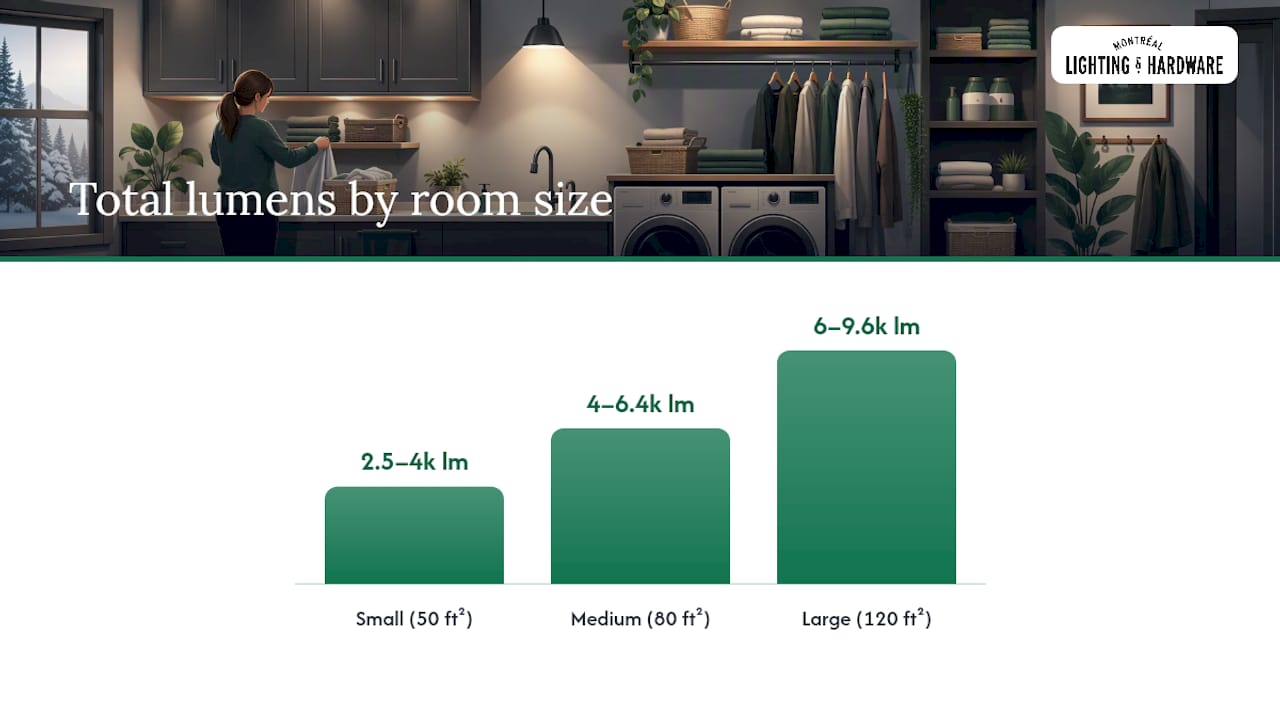
Here’s what that translates to for total lumens across common room sizes:
| Room size | Square footage | Target total lumens (50–80 lm/ft²) |
|---|---|---|
| Small closet or stacked unit | 50 ft² | 2,500–4,000 lumens |
| Medium laundry room | 80 ft² | 4,000–6,400 lumens |
| Large utility room | 120 ft² | 6,000–9,600 lumens |
A large laundry room needs a bright total light output split across ambient and task fixtures to hit the recommended range — split that across a flush mount, a strip light, and a task light rather than one oversized fixture.
Colour temperature matters just as much as brightness. Neutral to cool white in the 3500K to 4000K range works best for general laundry visibility, while 5000K suits a focused task light for close stain-checking. Pair either range with a CRI of 90 or higher. CRI measures how accurately a light source renders colour, and a low-CRI bulb can make a grey sock look navy or a coffee stain look invisible until it’s already dried into the fabric.
Layering your light: ambient, task and accent placement
Layering works in a specific order: ambient light fills the room, task light targets the work surface, and accent light (if you use it at all) adds warmth without doing any real work. Skip a layer and you’ll get shadows exactly where you need to see clearly, like right over the folding counter or inside the washer drum.
- Start with ambient coverage. A central flush mount or a run of recessed cans spaced 4 to 6 feet apart gives you the base layer every other light builds on.
- Add task lighting at the work zones. Position under-cabinet strips along the front edge of the cabinet, 18 to 24 inches above the counter, so light falls directly on folded clothes and stain spots instead of bouncing off your own shadow.
- Layer in accent lighting only if the room calls for it. A pendant over a folding table works well hung 30 to 36 inches above the surface, low enough to feel intentional but high enough to avoid bumping it with a laundry basket.
Three layouts show how this plays out in real rooms. A stacked closet unit usually only needs one strong overhead LED puck plus a slim strip tucked above the machines, since there’s no separate counter to light. A galley-style narrow room benefits from a single row of recessed cans down the centre paired with an under-cabinet strip along one wall, which avoids the tunnel-like dimness narrow rooms tend to get. A full utility room with a counter and sink needs the full three-layer approach: ceiling coverage, a dedicated strip over the counter, and a moisture-rated fixture near the sink.
Pro Tip: Don’t mix Kelvin ranges between your ambient and task fixtures. A 4000K ceiling light next to a 5000K task strip creates a visible colour clash, and it makes it harder to judge whether a stain is actually gone or just hidden in mismatched light.
Matching fixtures to tricky laundry layouts
Not every laundry room gets the luxury of a full-size floor plan. Most homeowners are working around a stacked unit, a shallow closet, or a shared space that also holds a treadmill, a litter box, or the water heater. The fixture decision changes accordingly.
- Low-clearance rooms do best with slim integrated LED panels or frosted-diffuser flush mounts, both of which spread light evenly without a bulky housing that eats into headroom.
- Closet-style laundry setups benefit from a strip light or a single high-lumen surface mount positioned so the washer and dryer don’t block light from reaching the space between them, which is exactly where you’re reaching in to grab a dropped sock.
- Multipurpose rooms call for dimmable fixtures, since a laundry-and-home-gym combo needs full brightness for sorting and a softer setting for everything else. Position the task light so it still serves the laundry zone specifically, rather than centring it for the room’s other use.
- Anywhere near a sink or exterior door needs a genuine damp-rated fixture, not just a fixture that looks sealed. Design guidance for laundry spaces recommends IP44 or better near any water source, and Technical Safety BC’s guidance on residential luminaires reinforces that switched, properly rated fixtures aren’t optional in these rooms.
If your laundry room has no window, a tubular skylight or small daylighting device can soften the space, but it won’t replace a dependable task light. Even the sunniest laundry room still needs artificial light for evening loads and cloudy days.
LEDs, dimmers and sensors: getting the controls right
LEDs are the obvious choice for laundry room lighting because they run cooler, last longer, and cost far less to operate than incandescent or halogen bulbs, which matters in a room that often runs several hours a week.
A few control choices are worth getting right before you install anything:
- Check dimmer compatibility before you buy one. Not every dimmer plays nicely with LED drivers, and a mismatched pair causes flickering or a limited dimming range that makes the fixture feel broken.
- Use occupancy sensors for rooms you walk into with an armload of laundry. A hands-free sensor switch means you’re not fumbling for a light switch while balancing a basket.
- Add a timer or smart plug for rooms with less foot traffic, like a basement laundry area you only visit a few times a week.
- Skip smart bulbs unless you’ll actually use the features. A smart bulb tied into a lighting schedule makes sense if you’re already running a connected home; otherwise a simple switch and a good dimmer solve the problem just as well.
Professional guidance for a safe, solid installation
A laundry room lighting upgrade is one of the more forgiving DIY electrical projects, but a few steps separate a clean job from a callback to an electrician.
- Cut power at the breaker, not just the switch, before touching any wiring.
- Confirm your mounting box can support the new fixture’s weight, especially if you’re upgrading from a lightweight builder-grade fixture to something heavier.
- Match the driver and dimmer before installation, not after you’ve already mounted the fixture and discovered it flickers.
- Test the circuit before closing up the ceiling or wall, so you catch wiring issues while they’re still easy to fix.
Specification help is often available to assist homeowners and design professionals so you’re not guessing at lumens or Kelvin on your own. If your laundry room involves rewiring, a new circuit, or anything near a water source, book a licensed electrician. Simple fixture swaps on existing wiring are well within reach for most confident DIYers, though.
Keeping your laundry lighting bright for years
LED fixtures need far less upkeep than older bulbs, but a laundry room’s humidity and lint mean they still need attention a couple of times a year.
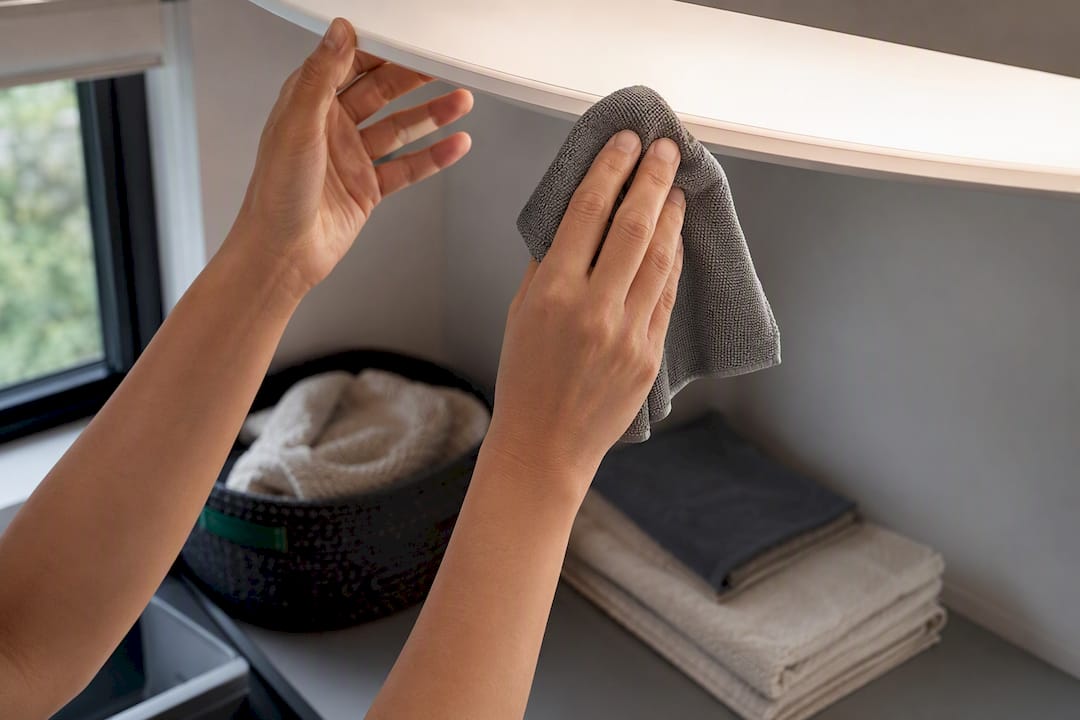
Dust and lint settle on diffusers and lenses faster in a laundry room than almost anywhere else in the house, and that buildup quietly dims output over time even though the bulb itself is fine. Wipe down flush-mount covers and under-cabinet lenses with a dry microfibre cloth every few months, and unplug or switch off the fixture first if it’s a plug-in strip light.
Check your dimmer and switch connections periodically too, especially if you’ve noticed flickering. Flickering is usually a driver-dimmer mismatch rather than a failing bulb, so swapping the dimmer often solves it faster than replacing the fixture. For moisture-rated fixtures near a sink, inspect the gasket or seal annually. A cracked seal lets humidity in, which shortens the life of the LED driver well before the diodes themselves wear out.
If a fixture starts cycling on and off on its own, check the breaker and wiring connections before assuming the fixture is defective. Loose wire nuts are a far more common culprit than a failed LED board, and they’re a five-minute fix once the power’s off.
Why most laundry rooms are lit wrong
Most advice on laundry room lighting treats it like a styling problem: pick a fixture that matches your cabinets and call it done. That’s backwards. The room’s job is to help you see stains, match sock pairs, and read tiny care labels, and none of that happens under a pretty fixture putting out 800 lumens in a 100-square-foot room.
The gap we see most often is homeowners choosing a single ceiling fixture and stopping there, when the real fix is almost always a second, closer light source. A counter without its own task light will always feel dim, no matter how bright the ceiling fixture is rated.
If you take one thing from this guide, prioritize the task layer before you worry about style. Get the lumens and Kelvin right at the counter first, then choose a ceiling fixture that complements it. Function first, then the finish you actually like.
— Montreal Lighting & Hardware
Upgrade your laundry room with Montreal Lighting & Hardware
You can find the fixture categories this guide points to, from ceiling lighting and wall lighting to under-cabinet LED strips and dimmer-compatible controls that actually solve laundry room dimness. Instead of piecing together mismatched bulbs from a hardware store aisle, consider choosing from curated selections of premium brands, with specification help available if you’re unsure which lumen output or Kelvin range fits your room.

Start by measuring your room’s square footage and matching it to the lumen targets in this guide, then confirm your dimmer works with your chosen fixture’s driver before you order. Browse ceiling lighting, wall lighting and lamp options to compare fixtures by spec, and reach out through the trade program if you’re a design professional working on a bigger renovation. If nothing on the site matches your exact layout, you can seek in-person guidance to find the right combination before you buy.
Sources
Before you buy or install, verify minimum illumination requirements through the BC Building Code’s Section 9.34, and confirm switched-fixture requirements through Technical Safety BC’s bulletin on residential luminaires. For lumen sizing and Kelvin guidance, the installation and homeowner guides cited throughout this article offer a solid starting point for comparison.
- Section 9.34 Electrical Facilities (Division B — Part 9) — BC Building Code
- Information bulletin: Luminaires in buildings of residential occupancy — Technical Safety BC
- How to install laundry room lighting for maximum efficiency: Step-by-step guide — Engineers and Architects of America
- Dgfloors
FAQ
What color temperature is best for lighting in a laundry room?
A neutral to cool white in the 3500K to 4000K range works best for general laundry visibility, since it renders fabric colours accurately without feeling clinical. For close task work like stain-spotting, switch to 5000K in that specific fixture only, and keep it paired with a CRI of 90 or higher.
What is a good light color for a laundry room?
Warm yellow tones tend to wash out stains and make whites look dingy, so most laundry rooms do better with neutral white light. Stick to the 3500K to 4000K range for ambient light and reserve 5000K for a dedicated task fixture over the counter.
Should a laundry room be bright or dark?
Bright, consistently. Laundry rooms handle detail work like colour-matching and stain-checking, so aim for a recommended range of lumens per square foot rather than the dimmer lighting acceptable in a hallway or closet. That range comfortably clears the 200 lux minimum set by the BC Building Code for service and laundry areas.
What are the trends for laundry rooms in 2026?
Layered lighting with dedicated task fixtures over counters continues to gain ground over single-fixture setups, alongside a shift toward dimmable LEDs that adjust for multipurpose rooms. Slim integrated panels and under-cabinet strips remain popular for stacked and closet-style units where ceiling clearance is tight, and Montreal Lighting & Hardware’s current lineup reflects that shift toward flexible, layered fixtures.
How many lumens does a small laundry closet need?
A 50-square-foot laundry closet needs roughly 2,500 to 4,000 total lumens to hit the recommended range of lumens per square foot range. Split that between a strong overhead LED and a slim task strip rather than relying on one fixture to do both jobs.
