


Use a layered lighting plan, ambient plus task plus accent, with warm dimmable LEDs and vanity lights positioned at eye level. That combination consistently produces the most flattering powder room lighting for small, mirror-heavy spaces. Skip the single overhead bulb approach that leaves faces shadowed and corners dark.
Here’s your starting checklist:
- Ambient layer: a flush mount, semi-flush fixture, or small chandelier for overall room glow
- Task layer: wall sconces flanking the mirror at roughly eye level, or a linear bar mounted above it
- Accent layer: a subtle LED strip or backlit mirror for depth and mood
- Bulb choice: 2700K to 3000K, dimmable, and ideally 90+ CRI so skin tones and finishes read true
- Controls: separate dimmers for each layer so the room can shift from bright and functional to soft and inviting
Get those five pieces right and the room works for both a quick morning check and a dinner party. Everything below explains why.
Key Takeaways
Layered lighting with warm, dimmable LEDs and eye-level vanity fixtures produces the most flattering, functional powder room lighting in any small space.
| Point | Details |
|---|---|
| Use three layers | Combine ambient, task, and accent lighting instead of relying on one ceiling fixture. |
| Mount sconces correctly | Center sconces roughly at eye level and space them a comfortable distance apart suitable for typical vanity widths. |
| Choose warm, high-CRI bulbs | Pick 2700K to 3000K bulbs with 90+ CRI for accurate, flattering color at the mirror. |
| Target moderate brightness | Aim for 800 to 1,000 total lumens and let dimmers handle mood adjustments. |
| Shop Montreal Lighting & Hardware | Explore Crystorama vanity lights and Sonneman pendants and bath bars built for powder room scale. |
Table of Contents
- Powder Room Lighting Ideas Built on Three Layers
- Vanity Lighting Placement That Prevents Shadows
- Which Fixture Style Fits a Small Powder Room
- Bulb Color, CRI, and Dimming Decisions
- Sizing Fixtures and Lumens for Tight Spaces
- Controlling Glare on Mirrors and Reflective Tile
- Product Picks From Montreal Lighting & Hardware
- What Most Powder Room Advice Gets Backward
- Find the Right Fixtures at Montreal Lighting & Hardware
- Sources
Powder Room Lighting Ideas Built on Three Layers
Every well-lit powder room, no matter its style, relies on the same three-layer structure: ambient, task, and accent. Skip one, and the room feels flat or fights against itself.
Ambient light fills the room with general illumination. It’s the foundation, usually delivered by a flush mount, semi-flush fixture, or a compact chandelier hung from the ceiling. Task light does the real work at the mirror, where you actually need to see your face clearly to shave, apply makeup, or fix a collar. Accent light adds personality and depth, often through an LED strip behind a mirror or a small decorative pendant that doesn’t need to do any functional heavy lifting.
In a powder room, these layers sometimes double up. A well-placed pair of sconces can supply both task light at the mirror and enough ambient spread to skip a ceiling fixture entirely in a truly tiny room. A three-layer approach also means chandeliers or semi-flush mounts can add ambient presence without overwhelming the space, since the sconces are already carrying the functional load.
Here’s how to sequence the planning:
- Start with task lighting at the vanity. This is non-negotiable and drives every other decision.
- Add ambient light from the ceiling, sized to the room rather than borrowed from a larger space.
- Layer in one accent element, an LED strip, a backlit mirror, or a small pendant, for mood and visual interest.
- Wire each layer to its own switch or dimmer wherever your electrical setup allows it.
A two-circuit layout, one for the vanity sconces and one for the ceiling fixture, gives you the most control for the least cost. If you’re stuck with a single circuit, put everything on one high-quality dimmer rather than skipping dimming altogether.
Pro Tip: If your powder room only has one switch, choose sconces and a ceiling fixture on the same warm color temperature. Mismatched bulb tones under a single dimmer look worse than a slightly dimmer room with consistent color.
Vanity Lighting Placement That Prevents Shadows
Overhead-only lighting is the single biggest reason powder room mirrors look unflattering. Light coming straight down casts shadows under the eyes, nose, and chin, the opposite of what you want in a room built for a quick mirror check.
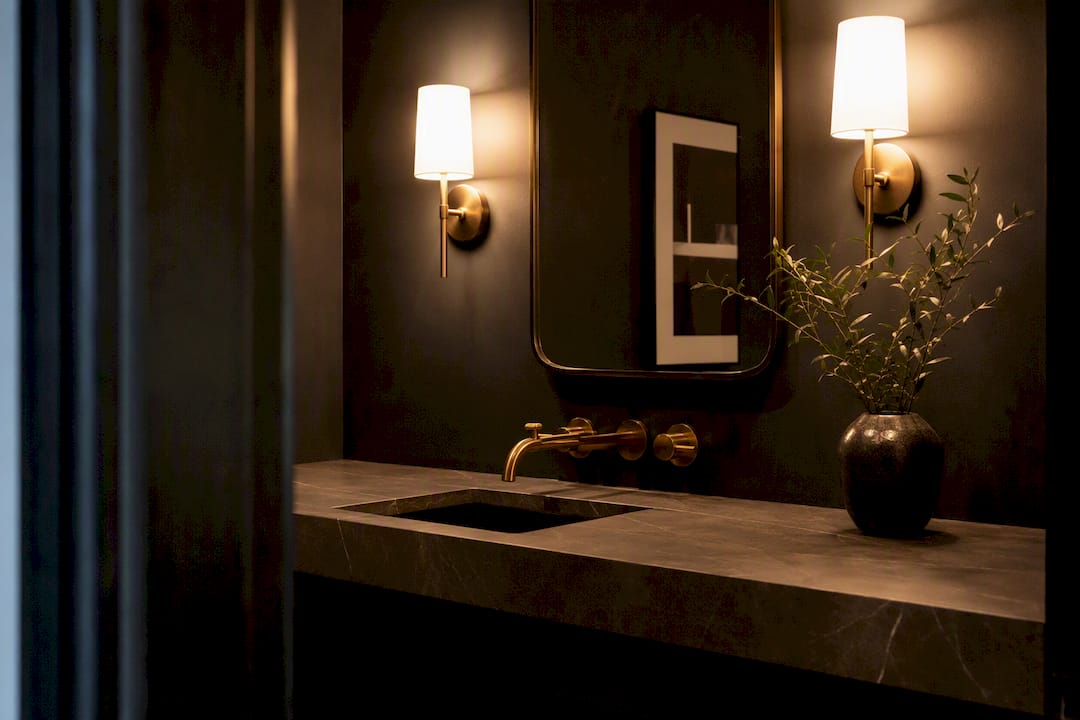
Side-mounted sconces at roughly eye level solve this by lighting the face from the sides instead of from above, filling in those shadows evenly. This is why designers reach for sconces before almost any other fixture in a powder room.
The measurements matter more than most homeowners expect:
- Mount sconce centers roughly at eye level, which usually falls in the mid adult height range
- Space the two fixtures a comfortable distance apart suitable for typical vanity widths without crowding the mirror
- Keep sconces roughly even with the outer edges of the mirror, not tucked in tight to the glass
Those figures come from Golden Lighting’s placement guidance, and they hold up across most standard vanity setups, though a taller household or an oversized mirror may need slight adjustment.
If your powder room is too narrow for side sconces, an over-mirror LED bar is the better call. A bar that’s too short creates a bright hot spot in the middle and dim edges, which does the opposite of what even lighting is supposed to do.
Getting this wrong is common: a single flush mount centered on the ceiling puts the light source directly above the head, which is precisely the angle that causes harsh under-eye shadows. Moving even one sconce to the side of the mirror fixes most of that problem instantly.
For a deeper dive into sizing, our guide on choosing the right vanity light size walks through proportion rules for mirrors of different widths.
Which Fixture Style Fits a Small Powder Room
Powder rooms are one of the few rooms in the house where a bold fixture choice rarely backfires, since the space is small enough that even a statement piece stays proportionate. That freedom is worth using.
Start with the basics of what each fixture type does well:
- Flush and semi-flush mounts work in rooms with low ceilings or where a hanging fixture would sit too close to head height
- Small chandeliers or mini-pendants add drama and are a favorite for powder rooms specifically because the room is small enough to make a chandelier feel special rather than oversized
- Recessed lights provide clean, unobtrusive ambient fill, especially useful as a supplement to a decorative ceiling piece
- LED strips tuck behind mirrors or under a floating vanity shelf for a soft glow with almost no visual footprint
Design coverage from outlets like Architectural Digest consistently points to pendants, sconces, and backlit mirrors as the go-to combination for powder rooms that punch above their square footage.
For styling direction, four looks come up again and again:
Glam or Hollywood glow pairs warm 2700K LEDs with crystal or opal glass shades, echoing classic backstage vanity lighting without the exposed bulb strip. Modern minimalist leans on matte black fixtures and clean geometric lines, often a single linear bar or a slim pendant. Vintage or industrial uses an exposed-filament look softened by a diffuser so the bulb itself doesn’t glare. Classic or transitional favors brass or nickel sconces with fabric or glass shades that read timeless rather than trendy.
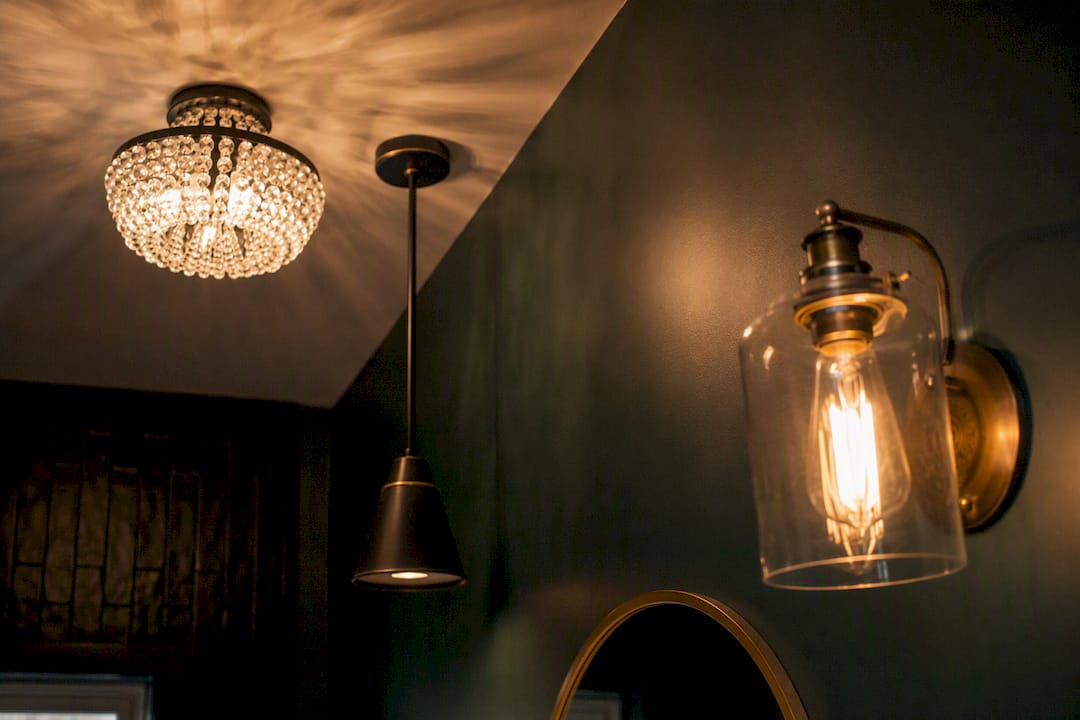
A small chandelier or an architectural pendant is appropriate here precisely because the room is small. Save the truly oversized statement piece for a room where scale actually demands it.
Bulb Color, CRI, and Dimming Decisions
The bulb inside the fixture does more to determine how flattering a powder room feels than the fixture itself. Get the color temperature wrong, and even a beautifully placed sconce will make skin look sallow or washed out.
Stick to 2700K to 3000K. This warm range flatters skin tones and gives the room a welcoming glow instead of the clinical feel of daylight bulbs. A flattering Hollywood-style glow depends specifically on warm bulbs around 2700K combined with balanced front and back illumination, not on novelty pink-tinted bulbs that some retailers market for bathrooms.
Check the CRI rating. CRI, or Color Rendering Index, measures how accurately a bulb reveals true colors compared to natural daylight. A bulb with 90+ CRI is worth seeking out for any fixture near a mirror, since it renders skin tones and makeup colors accurately rather than shifting them slightly warm, cool, or gray. Design sources consistently recommend that 90+ threshold specifically for bathroom vanity applications.
Install dimmers on every circuit you can. A powder room needs to flex between full brightness for guests fixing their makeup and a softer glow for evening entertaining, and dimmers make that shift possible without swapping fixtures. Confirm your LED bulbs or drivers are dimmer-compatible before installing, since not every LED dims smoothly on every dimmer switch.
Smart bulbs add one more layer of flexibility. Tunable white bulbs let you shift from 2700K in the evening to a slightly cooler tone in the morning, all from the same fixture, which is a nice option if you’re not ready to commit to a fixed color temperature.
Sizing Fixtures and Lumens for Tight Spaces
A fixture that looks perfectly sized in a showroom can overwhelm a five-by-seven-foot powder room. Scale matters as much as style here, and the math is simpler than it sounds.
- Match fixture diameter to the room, not the mirror. A flush mount or small chandelier should generally span no more than a third of the room’s shorter wall dimension.
- Give pendants and mini-chandeliers real clearance. Keep at least 7 feet from the floor to the bottom of any hanging fixture, and confirm the door swing doesn’t clip it when the fixture hangs anywhere near the entry sightline.
- Target 800 to 1,000 total lumens for the room’s overall output. That range provides enough brightness for task needs without the harsh overkill a single high-output fixture can create in a confined space.
- Use dimming to fine-tune, rather than under-lighting or over-lighting the fixed output. It’s easier to dim down a slightly bright fixture than to add light to a dim one after installation.
Sightlines matter too. If the powder room door opens directly into view from a hallway or living space, a pendant or chandelier becomes part of the visual experience the moment guests walk by, not just a fixture inside a closed room. That’s worth factoring into how bold you go with the ceiling piece. Door style plays into this as well, and choosing the right interior door for sightlines and swing clearance is worth considering alongside the lighting plan.
For more on scaling fixtures to small footprints generally, see our guide to small bathroom lighting.
Controlling Glare on Mirrors and Reflective Tile
Powder rooms are often the most reflective room in the house: glossy tile, a large mirror, polished faucet hardware. That combination amplifies glare fast if you choose the wrong fixture finish or bulb exposure.
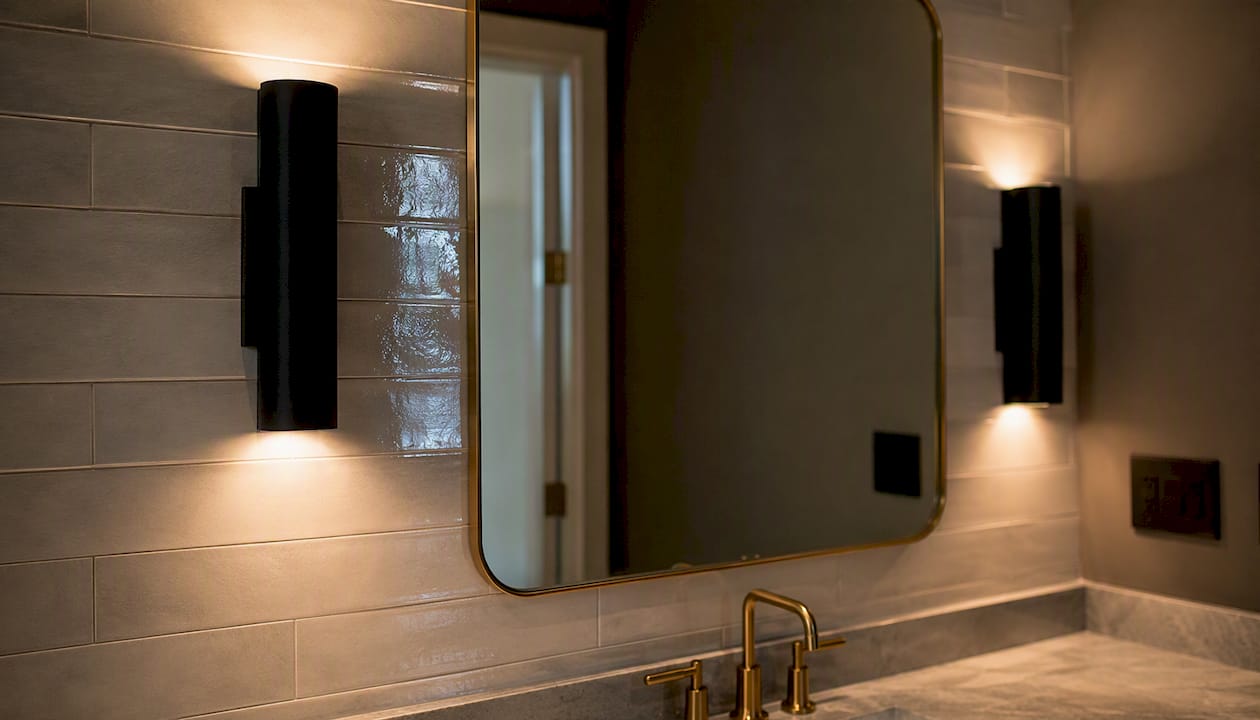
Any fixture visible in the mirror’s reflection should use a diffuser, frosted glass, or an opal shade rather than an exposed bulb. An exposed filament bulb might look great in a hallway, but reflected twice in a mirrored powder room, it becomes a distracting hot spot every time someone glances up. Design practitioners point to this same glare-and-reflection issue as one of the most common mistakes in small, mirror-heavy rooms.
Finish choice matters at close range too, since powder room fixtures sit only a few feet from where guests stand. Warm brass and matte black both hold up well against reflective tile, while polished chrome can occasionally double the glare it’s meant to control.
- Choose frosted or opal glass over clear glass for any fixture near a mirror
- Match sconce finish to your faucet and hardware finish for a cohesive look
- Downscale a fixture’s brightness or size if the room has floor-to-ceiling mirror or high-gloss tile, since reflections effectively double the light output
Pro Tip: If you’re unsure how a fixture will look reflected, hold a photo of it up to the bathroom mirror at the height you plan to mount it. You’ll spot glare problems before they’re permanent.
Product Picks From Montreal Lighting & Hardware
Choosing the right fixture is easier with real examples in front of you, especially ones built for exactly this application.
The Crystorama Palla Four Light Bathroom Vanity suits a glam or classic powder room that wants real presence over the mirror, with four lamping points that spread light evenly across a wider vanity. The Crystorama Sylvan Three Light Bathroom Vanity works better in a more compact layout, offering the same layered, decorative glow in a smaller footprint. For a modern room, the Sonneman Stiletto LED pendant delivers a slim profile that reads as a design statement without crowding a small ceiling. And where wall space is too tight for side sconces, the Sonneman SQ-bar LED bath bar mounts directly above the mirror as a dimmable, even alternative.
A powder room’s lighting plan succeeds or fails on placement and color temperature long before style enters the conversation.
Montreal Lighting & Hardware stocks dimmable LED options across these lines and works with a trade program that gives designers and contractors exclusive pricing on fixtures like these, backed by fast shipping and showroom access for anyone who wants to see finishes in person before buying.
What Most Powder Room Advice Gets Backward
Most guides treat fixture style as the first decision and placement as an afterthought. That order is backward. A gorgeous pendant hung at the wrong height, or sconces mounted too high because a mirror got centered on the wall first, will make a room feel worse than a plain fixture placed correctly.
The conventional advice to “choose one statement piece” also undersells how much a powder room benefits from combining two or three modest fixtures instead. A single chandelier with no task lighting still leaves shadowed faces at the mirror, no matter how expensive the fixture.
If you take one thing from this guide, prioritize the sconce height and spacing measurements before you shop for style. Once placement is locked in, almost any fixture aesthetic, glam, modern, or vintage, will read as intentional rather than accidental. Function first, then let the room’s personality follow.
— Montreal Lighting & Hardware
Find the Right Fixtures at Montreal Lighting & Hardware
Getting the measurements right is only half the job. You still need fixtures that actually deliver 2700K warmth, dimmer compatibility, and the compact scale a powder room demands, and that’s where sourcing from a specialty lighting retailer beats hunting through a general home store’s limited bathroom aisle. Montreal Lighting & Hardware carries the Crystorama and Sonneman lines referenced throughout this guide, plus a trade program that gives designers and contractors exclusive pricing on exactly these fixtures.

If you’re a homeowner outfitting one powder room, browse Montreal Lighting & Hardware’s collection for dimmable LED vanity lights and pendants sized for small spaces. If you’re a designer or contractor sourcing for multiple projects, the trade program adds preferred pricing and showroom access on top of fast shipping. Either way, start by matching a fixture from this guide to your mirror width and vanity height, then check availability on the Stiletto LED pendant or SQ-bar bath bar for your next powder room update.
Sources
- Lighting Tips To Make Your Powder Room Glow For Every Guest
- How to Install and Style Powder Room Lighting for Maximum Impact – Engineers and Architects of America
Recommended
- Small Bathroom Lighting: Space-Saving Layered Ideas – Montreal Lighting & Hardware
- Vaulted Ceiling Lighting: Ideas, Sizing, and How to Get It Right – Montreal Lighting & Hardware
- Palla Four Light Bathroom Vanity | Crystorama – Montreal Lighting & Hardware
- High Ceiling Lighting: Best Fixtures for Tall Rooms – Montreal Lighting & Hardware
