

For most bathrooms, 3000K is the color temperature to buy. It’s warm enough to feel calm, neutral enough to flatter skin, and versatile enough for a full renovation or a single bulb swap. The exception is your vanity mirror, where 3500K to 4000K with a CRI of 90 or higher gives you the true color accuracy shaving and makeup demand require. If you don’t want to choose, a tunable or dimmable bulb lets one fixture do both jobs.
TL;DR:
- CRI 90+ at the vanity is essential for true color accuracy, especially when applying makeup or judging skin tones.
- Use 3000K for general bathroom lighting, but opt for 3500K to 4000K with high CRI for vanity areas requiring precise color rendering.
- Match the Kelvin difference within 500K across zones to avoid color inconsistencies, and avoid mixing widely different temperature bulbs in sightlines.
- Consider tunable or dimmable fixtures for multi-use zones to switch between relaxing and grooming lighting without installing multiple bulbs.
Table of Contents
- Recommended Kelvin, CRI, and Lumens by Bathroom Zone
- What Do Kelvin and CRI Actually Measure?
- How Many Lumens Does a Bathroom Actually Need?
- Should You Choose Tunable White or a Simple Dimmer?
- How to Choose and Install Bathroom Lighting Without Regret
- Where to Find Fixtures That Match These Specs
- Why the “Just Buy Warm White” Advice Falls Short
- Find the Right Fixtures for Every Bathroom Zone
- Sources
- FAQ
Recommended Kelvin, CRI, and Lumens by Bathroom Zone
Once you know the 3000K default, the real work is matching each zone in your bathroom to its own job. A shower doesn’t need the same light as a soaking tub, and your mirror has requirements that neither of those spaces share.
Here’s how to think about each area, with the Kelvin, CRI, and lumen numbers worth writing down before you shop:
- Vanity/mirror: 3500K to 4000K, CRI 90 or higher, and 800 to 2,000 total lumens depending on mirror size. This is the zone where CRI 90+ matters most, because it’s where you’re judging your own skin tone against a reflection.
- General/ambient lighting: 3000K as your all-purpose default, CRI 80 or higher, with 1,600 to 2,000 total lumens for a typical bathroom.
- Shower: around 4000K for visibility and safety, or matched to your ambient light if you’d rather keep things consistent. CRI 80+ is fine here, but skip anything at 5000K or above.
- Soaking tub or relaxation corner: 2700K to 3000K for a spa feel, paired with lower lumens and a dimmer.
- Accent or nightlight: 2700K at 200 to 400 lumens, dim enough to avoid jolting you awake at 2 a.m.
Before you buy, check the packaging for four numbers: Kelvin, CRI, lumens, and whether the bulb is dimmable or tunable. Manufacturers print all four, but they’re often in small type on the side panel, not the front of the box.
What Do Kelvin and CRI Actually Measure?
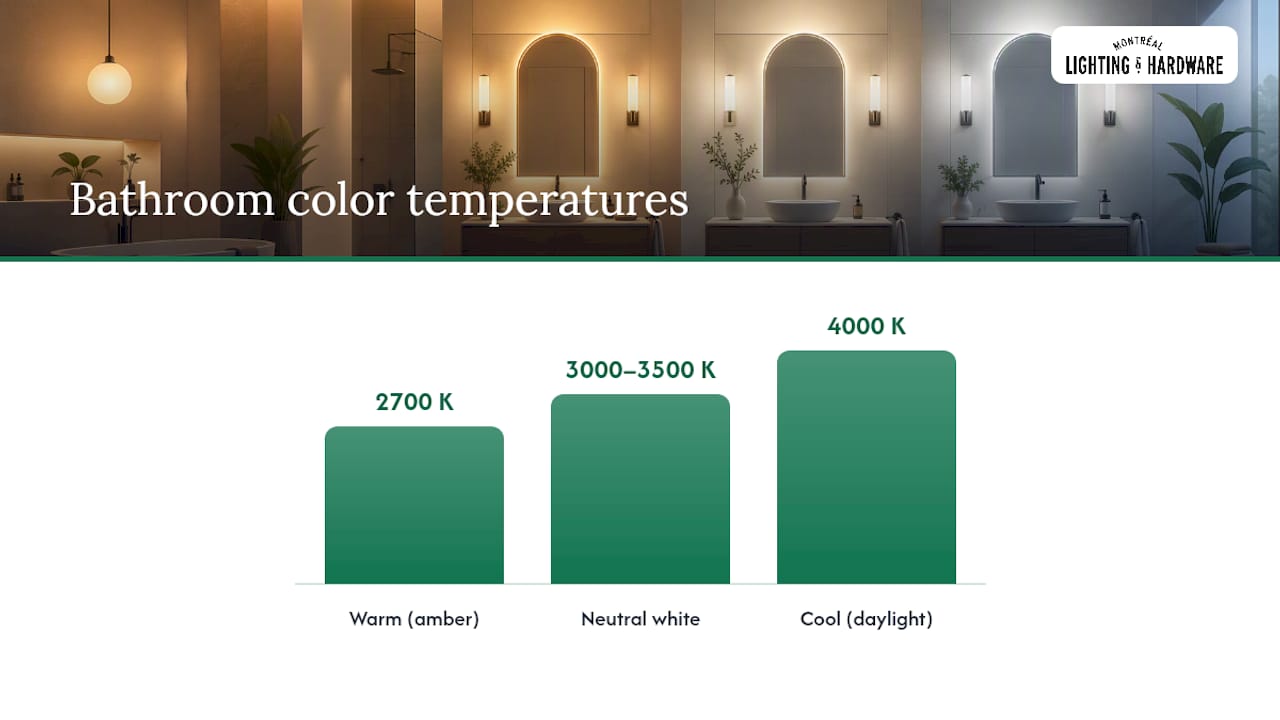
Kelvin describes the color of the light itself, not its brightness. At 2700K, light leans amber and cozy, similar to an old incandescent bulb. At 3000K to 3500K, it reads as neutral white, the sweet spot most homeowners land on. Push past 4000K and light shifts cool and blue, closer to daylight, which is why color temperatures in the 2700K to 4000K range cover nearly every practical bathroom need.
CRI, or Color Rendering Index, measures something different: how accurately a light source reveals true color, on a scale up to 100. A bulb rated CRI 95 will show your skin tone, your towels, and your tile the way they actually look. A bulb rated CRI 70 will mute and flatten those same colors, even if the Kelvin number is identical.
Quick fact: CRI 90 or higher is the standard for vanity lighting, while CRI 80+ is acceptable for general ambient light where color accuracy matters less.
A few rules worth keeping in mind:
- Low CRI bulbs make makeup shades and fabric colors look off, even under the “right” Kelvin.
- If you’re zoning your bathroom with two temperatures, keep the gap under about 500K.
- Never mix a 2700K bulb next to a 4000K one and the same sightline. Random mixing is one of the most common, most visible lighting mistakes homeowners make, and it’s an easy one to avoid.
How Many Lumens Does a Bathroom Actually Need?
Lumens measure how much light a bulb puts out. Watts measure how much power it draws. Once you’re shopping LEDs, watts tell you almost nothing about brightness, so buy by lumens and ignore the wattage entirely.
When choosing brightness, select lumen levels appropriate to each area, generally moderate brightness for vanities and general lighting, and lower lumens for accent or nightlighting to prevent disturbing sleep.
Fixture placement matters as much as the number on the box. Sconces mounted at face height reduce the harsh shadows that an overhead-only setup can’t fix, since a single ceiling fixture tends to flatten and shadow the face at the same time. If you’re mapping out a vanity, our guide to vanity light sizing walks through matching fixture width to mirror size, and our lumens per room breakdown covers targets for the rest of the house too.
Should You Choose Tunable White or a Simple Dimmer?
Tunable white bulbs shift across a range, typically 2700K to 5000K, from a single fixture. That’s the practical fix if your bathroom only has one light source but needs to handle both a relaxing soak and a precise shave. Tunable and dimmable LEDs give you that flexibility without requiring two separate fixtures.
If you’d rather stick with a fixed Kelvin, make sure any dimmer you install is rated for LEDs. TRIAC dimmers work with some LED bulbs, while ELV dimmers suit others, and mismatching the two causes flickering or a limited dim range. Smart bulbs add another layer of dependency: they need steady Wi-Fi or a hub to hold their settings reliably.
- Tunable white fixtures now often reach CRI 90+ in higher-end models, closing the gap with dedicated single-temperature bulbs.
- A tri-temp mirror or tunable fixture makes sense in a small bathroom with one light source; a zoned, multi-fixture approach makes more sense in a larger one.
Pro Tip: If you’re torn between a tunable bulb and separate fixtures, measure your bathroom’s square footage first. Under about 40 square feet, one good tunable fixture usually beats installing two.
How to Choose and Install Bathroom Lighting Without Regret
Getting this right comes down to a short, ordered process rather than a hunt for the “perfect” bulb.
- Decide your priority first. Is this bathroom mostly for relaxing soaks, quick grooming, or both? Write down your target Kelvin, CRI, and lumen numbers before you open a single product page.
- Shop fixtures rated for damp or wet locations. Check the spec sheet for CRI and dimmability, not just the Kelvin number on the front label.
- Test before you commit. Buy one bulb, install it, and evaluate it at the mirror in the morning and again at night. Light that looks great at noon can look flat and gray after dark.
- Confirm the wiring and ratings before installation. Verify dimmer compatibility, neutral wiring where required, and an IP rating suited for shower enclosures. Keep a couple of matched spare bulbs from the same product line so a future replacement doesn’t throw off your whole setup.
Pro Tip: Test your vanity bulb at the exact time of day you actually get ready. A bulb that looks perfect at 2 p.m. under natural daylight can look muddy at 7 a.m. before sunrise.
Where to Find Fixtures That Match These Specs
Various lighting stores carry ceiling, wall, and vanity fixtures from curated brands like Savoy House and Maxim, which makes comparing CRI, lumens, and Kelvin across product lines straightforward rather than guesswork. Our guide to the best bathroom vanity lights breaks down fixture types by exactly these specs. For a real-world example of what a spec sheet should show, the Chelsea Three Light Bath Bar by Sonneman lists its Kelvin and lumen output clearly, which is the standard to look for on any vanity fixture you’re considering.
Why the “Just Buy Warm White” Advice Falls Short
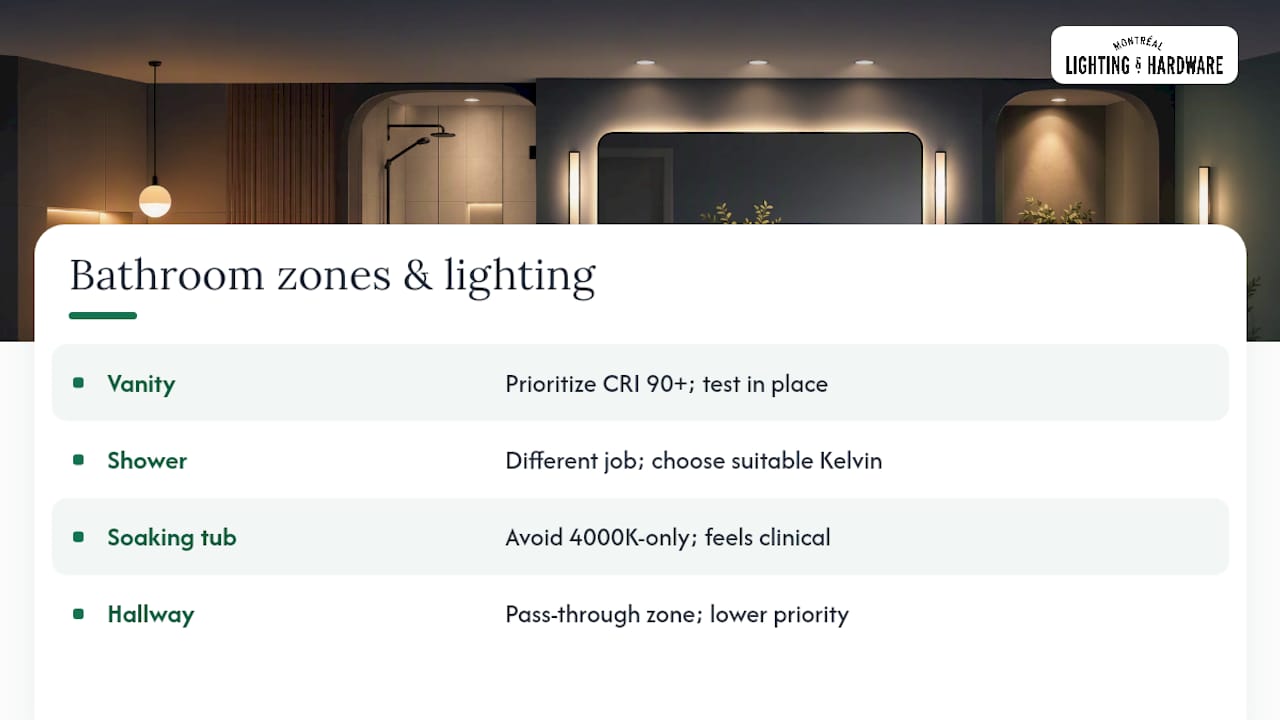
Most lighting advice treats the bathroom as one room with one correct temperature, and that’s the part we’d push back on. A bathroom is really three or four small rooms stacked together: a grooming station, a shower, sometimes a soaking tub, and a hallway you pass through half asleep. Each one has a different job, so treating 3000K as the only answer misses the vanity entirely, and treating 4000K as the only answer turns a relaxing soak into something that feels like an exam room.
The number that gets overlooked most is CRI, not Kelvin. Two bulbs can share the same 4000K rating and look completely different at the mirror if one is CRI 82 and the other is CRI 95. If you take one thing from this guide, prioritize CRI 90+ at the vanity before you even think about the exact Kelvin number. Test the bulb in your own bathroom, at the time of day you’ll actually use it, before buying enough to fill every socket. That five-minute habit prevents more lighting regret than any spec sheet ever will.
— Montreal Lighting & Hardware
Find the Right Fixtures for Every Bathroom Zone
Some lighting retailers offer a curated lineup of premium brands where CRI, Kelvin, and lumen specs are listed clearly, so you’re not guessing from a blurry photo. Whether you’re outfitting a vanity with a CRI 90+ sconce or hunting for a tunable fixture that handles both mood lighting and grooming, our lighting collection is organized so you can filter by exactly the specs this guide covers.

If your renovation includes matching hardware, our bathroom hardware category rounds out the project in one stop. Larger or trickier installations, like tri-temp mirrors or multi-zone wiring, are exactly what our trade program and showroom staff handle daily for design professionals and homeowners alike. And once you find a fixture you like, buy a couple of matched spare bulbs from the same line now, so a bulb failure in two years doesn’t leave you hunting for a discontinued color match. Browse the current lighting selection and bring your Kelvin, CRI, and lumen notes with you.
Sources
- Bathroom Lighting Color Temperature: 2700K–4000K
- How to Choose Bathroom Light Bulbs: Color Temperature, Brightness, and Fixture Compatibility
FAQ
Is 3000K or 4000K Better for a Bathroom?
3000K works best as your all-purpose bathroom light, while 4000K is better reserved for the vanity or shower where you need sharper visibility and color accuracy.
Is 3000K Bright Enough for a Bathroom?
Yes, as long as you hit the lumen target, not just the Kelvin number. Pair 3000K with 1,600 to 2,000 total lumens for general lighting, since Kelvin and brightness are two separate specs.
Is Daylight or Cool White Better for a Bathroom?
Cool white in the 4000K range suits task areas like the shower or vanity, but full daylight above 5000K tends to look clinical and is rarely the right call for a residential bathroom.
Is 2700K OK for a Bathroom?
Yes, 2700K is a great choice for a soaking tub, relaxation corner, or nighttime accent light, though it’s too warm and dim for precise grooming at the vanity.
What CRI Should I Look for in Bathroom Bulbs?
Aim for CRI 90 or higher at the vanity for accurate skin tone and makeup rendering, and CRI 80 or higher for general ambient lighting elsewhere in the room.
