

Hang your island pendants 30 to 36 inches above the countertop, measured from the surface to the bottom of the fixture. That is the range that keeps light where you cook without anyone ducking around a glowing glass shade. Push toward the higher end of the recommended range if your ceiling runs tall or your island doubles as a breakfast bar, and always measure to the lowest point of the pendant, not the canopy.
TL;DR:
- Hanging pendants 30 to 36 inches above the countertop suits standard ceilings, with adjustments of approximately 3 inches for each additional foot in height.
- For islands over 8 feet long, install three pendants or a linear fixture, spacing smaller fixtures 20 to 24 inches apart, larger ones 30 to 36 inches.
- Pendant diameter should be about one-fifth of the island’s width, with larger fixtures under 8 inches generally unsuitable for islands over five feet long.
- When seating is involved, hang pendants slightly higher to prevent glare at eye level, and use diffusers or frosted shades to soften light for seated diners.
- Always measure ceiling height, counter height, and desired clearance first, then confirm fixture adjustability and order extra cord to ensure an optimal fit.
Table of Contents
- Why 30 to 36 Inches Is the Benchmark (and How to Adjust for Ceiling Height)
- How Many Pendants and How Far Apart They Should Sit
- Pendant Size and Scale: Matching Diameter to Your Island
- Seating and Glare: Adjusting Height When People Sit at the Island
- How to Measure and Calculate Pendant Drop for Installation
- Bulb, Shade, and Lighting Controls That Affect Usable Light
- Installer and Trade Tips From Montreal Lighting & Hardware
- Why We Point Canadian Clients Toward Samples and Trade Support
- Adjustable Pendants and Trade Support for Your Island
- Sources
Why 30 to 36 Inches Is the Benchmark (and How to Adjust for Ceiling Height)
That 30 to 36 inch window exists because it splits the difference between two competing needs: light close enough to the counter to do real work, and clearance tall enough that nobody clips a pendant reaching for the olive oil. Drop a fixture below 30 inches and it starts blocking sightlines across the island, which matters if you’re chatting with someone while you chop. Push it past 36 inches and the light spreads too wide, washing out the task area instead of focusing on it.
Standard Canadian counters sit around 36 inches high, so this range puts the bottom of your pendant roughly 66 to 72 inches off the floor in a typical kitchen. Ceiling height changes that math. The Philips Hue sizing guidance recommends adding about 3 inches of clearance for every foot of ceiling height beyond the standard 8 feet, so taller rooms get proportionally more breathing room above the fixture.
Quick reference for common Canadian ceiling heights:
- 8 ft ceiling: 30 to 34 in clearance (bottom of pendant sits at roughly 66 to 70 in from the floor)
- 9 ft ceiling: 33 to 37 in clearance (bottom of pendant around 69 to 73 in from the floor)
- 10 ft ceiling: 36 to 40 in clearance (bottom of pendant near 72 to 76 in from the floor)
Standard rule: keep 30–36 inches from countertop to the bottom of the fixture, adding roughly 3 inches per extra foot of ceiling height. A kitchen with soaring 10 foot ceilings that still hangs pendants at the standard 30 inches will look like the fixtures got lost on their way down.
How Many Pendants and How Far Apart They Should Sit
Fixture count and spacing follow the length of your island more than any design instinct. Here’s how it typically breaks down, based on guidance from the Glowryte lighting guide:
- Under 5 feet: one pendant, centered over the island.
- 5 to 8 feet: two pendants, occasionally three if the fixtures are on the smaller side.
- 6 to 7 feet: often lands right at the edge case. Two larger pendants or three smaller ones both work, depending on how much visual weight you want.
- Over 8 to 9 feet: three pendants, or one continuous linear fixture that reads as a single gesture instead of a row.
To find the actual spacing, divide the island length by the number of fixtures to locate center points, then keep each pendant 12 to 15 inches from the island’s ends. For a 54 inch island with two pendants, that puts centers around 18 inches from each end, roughly 27 to 30 inches apart. A 72 inch island with three pendants spaces out to about 24 inches center-to-center. A 96 inch island, often paired with three larger pendants or a linear fixture, lands closer to 30 to 36 inches between centers. Smaller pendants under 10 inches wide can sit tighter, around 20 to 24 inches apart, while anything 18 inches or larger needs the fuller 30 to 36 inch gap to avoid looking cramped.
Pendant Size and Scale: Matching Diameter to Your Island
Two quick formulas save you from ordering fixtures that look like an afterthought. First, pendant diameter should land close to your island width divided by 5. An island that’s 40 inches wide, for instance, points toward pendants around 8 inches in diameter for a single fixture, or smaller multiples in a group. Second, the “rule of four” checks proportion from the other direction: take your island’s length in inches and divide by 4 to get a rough ceiling on maximum pendant width, which keeps a trio of fixtures from crowding each other visually.
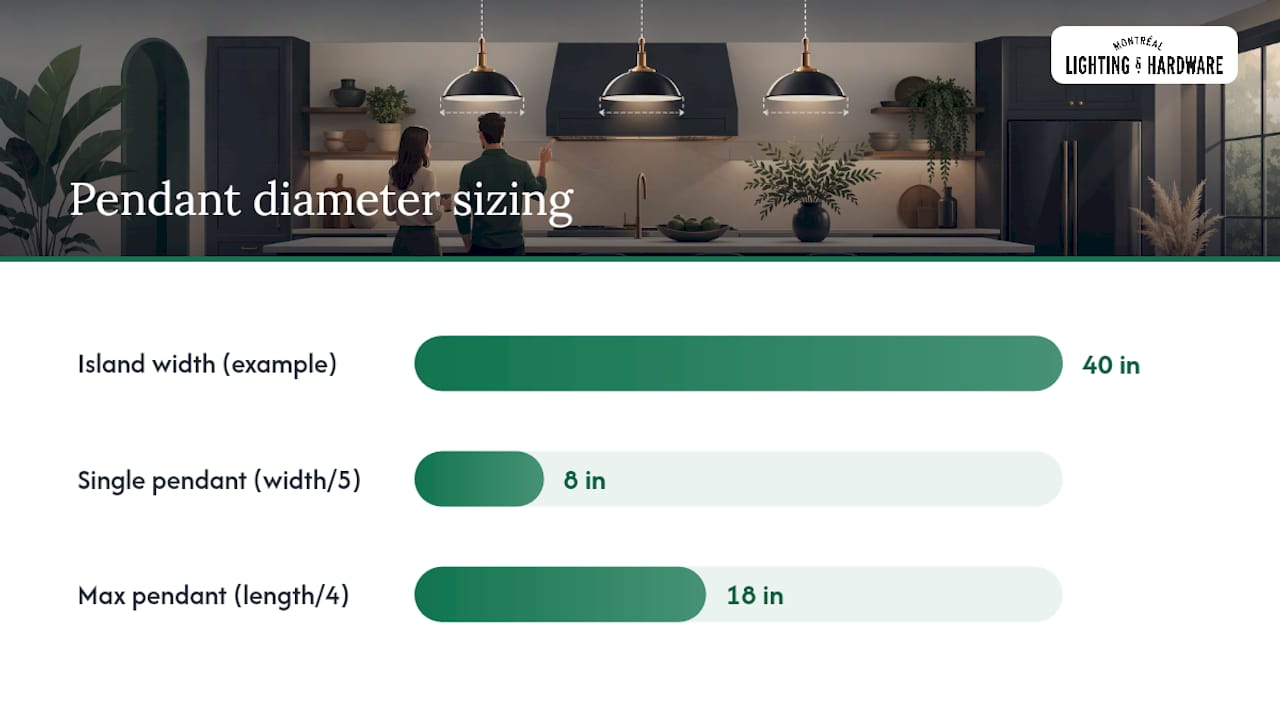
Undersized pendants are the more common mistake. A 10 inch pendant that looks fine in a product photo can disappear over a 72 inch island once it’s actually installed, which is exactly why showroom or sample checks matter before you commit.
A few sizing guardrails worth keeping on hand:
- Treat anything under 8 inches in diameter as too small for an island longer than 5 feet unless you’re grouping three or more.
- For a single statement pendant, aim for a fixture that reads as a clear focal point, not a decorative afterthought floating in space.
- For multiple smaller pendants, the combined visual width across the group should cover roughly two-thirds of the island length so the coverage looks intentional rather than scattered.
Pro Tip: If you’re torn between one dramatic pendant and a row of three, think about how the island functions. A single statement fixture pulls focus toward the island as a centerpiece, similar to how a striking art piece anchors a room, while multiples spread light more evenly across a long prep surface.
Seating and Glare: Adjusting Height When People Sit at the Island
Islands with stools or a raised breakfast bar change the glare calculation, because now you have eye lines to protect, not just counter space to light. When the island includes seating, the Votatec design guidance recommends pushing pendant height toward the higher end of the 30 to 36 inch range, or slightly above it, so a seated adult isn’t staring straight into an exposed bulb.
A practical way to check this: have someone sit at the counter and note where their eye level lands relative to the fixture. If the bare bulb or light source is visible at that eye line, either raise the pendant or switch to a shade style that hides the source.
Fixture features that cut glare for seated diners:
- Opaque or frosted shades that diffuse rather than expose the bulb.
- Downward-facing diffusers that direct light onto the counter instead of outward.
- Internal baffles or recessed light sources that stay hidden from a seated sightline.
How to Measure and Calculate Pendant Drop for Installation
Getting the drop length right (the distance from ceiling to the bottom of the fixture) takes three steps, and the math is simple enough to do on a phone before you call your electrician.
- Measure your counter height and decide on your clearance, typically 30 to 36 inches.
- Calculate bottom-from-floor: counter height plus clearance.
- Calculate drop length: ceiling height minus bottom-from-floor. This is the number your fixture’s cord or rod needs to cover.
This is the same workflow behind the HOULTE pendant height calculator, which is worth running your numbers through if you want a second check before ordering.
Before you hand these numbers to an installer, confirm your fixture’s adjustable range actually covers the drop length you need, and give the electrician the ceiling height, counter height, and desired clearance so they can set the junction box precisely rather than guessing.
Bulb, Shade, and Lighting Controls That Affect Usable Light
The right pendant height means little if the bulb inside is wrong for the job. Kitchen islands generally perform best with light in the 2700K to 3000K range, the warm white band that renders food colors accurately without feeling clinical. For brightness, aim for enough combined lumen output across your fixtures to properly light a food-prep surface, not just create ambiance.
Shade material changes both how bright the light feels and how large the fixture looks. Clear glass lets more raw light through and shows off the bulb, which can read as more delicate or industrial depending on the frame. Fabric or opaque shades diffuse the light more softly and tend to make a pendant look visually larger and more substantial from across the room.
A few controls worth adding at install:
- Dimmers on every island pendant circuit, so task lighting at dinner prep can drop down for evening ambiance.
- A second light layer, like under-cabinet strips, so the island isn’t relying on pendants alone for every task.
- Bulbs rated for the same color temperature across all fixtures to avoid mismatched warm and cool tones side by side.
Installer and Trade Tips From Montreal Lighting & Hardware
We’ve fielded enough measurement calls to know where projects go sideways, and it’s rarely the fixture itself. It’s almost always the cord.
Order more cord or rod length than your calculation says you need. Shortening a cord on site takes an electrician a few minutes; lengthening one after installation usually means reordering the whole fixture. Always confirm the adjustable range listed on a product page before you buy, since not every pendant extends or shortens the same amount.
A few habits that save a second trip:
- Request finish samples before committing, especially on metals like brass or bronze that photograph differently than they look in person.
- Visit a showroom if you can. A 12 inch pendant can look correct in a photo and noticeably small once it’s hanging over a 72 inch island.
- Coordinate delivery timing with your cabinet installer and electrician so the fixture arrives when the rough-in is actually ready.
Pro Tip: If you’re ordering a custom finish, ask about lead times up front. Custom runs can add weeks to a schedule that’s already tight around cabinetry and countertop installation.
Why We Point Canadian Clients Toward Samples and Trade Support
Canadian kitchens vary a lot in ceiling height and island size, which is exactly why we push clients to see a pendant at real scale before committing to a full order. Photos flatten proportion in ways that surprise even experienced designers. If you’re mid-renovation, our trade team can help confirm your specific measurements and get sample finishes into your hands before the fixture ships. And whatever the calculator or spec sheet tells you, have your installer verify final drop length against your actual ceiling and counter before the last cut is made.
— Montreal Lighting & Hardware
Adjustable Pendants and Trade Support for Your Island
Getting pendant height right on paper is one thing. Getting a fixture that actually adjusts to your ceiling without a special order is another, and that’s where most online lighting retailers fall short on selection. Montreal Lighting & Hardware carries Sonneman pendants built with wide adjustable ranges specifically so one fixture can work across different ceiling heights, instead of forcing you to special-order a shorter or longer version.

The Light Guide Ring LED Pendant is a strong fit for islands where you want a clean, modern circle of light with real adjustability built in. For a slimmer profile that suits grouping two or three across a longer island, the Stiletto LED Pendant keeps the visual footprint narrow while still delivering enough light for prep work. If you’d rather let a single fixture carry more visual weight as a centerpiece, the Grapes LED Pendant offers that statement scale without overwhelming a mid-size island.
Measure your counter height and ceiling height first, then contact our trade team or request finish samples before you place a full order. It’s the fastest way to confirm a pendant will actually fit your kitchen the way it looked in the photo.
Sources
- Pendant light size guide | Philips Hue
- Pendant Height Over Island Calculator - HOULTE
- How many pendant lights over a kitchen island? – Votatec
