


A layered lighting strategy with dimmable guest controls and commercial-grade fixtures is the fastest, highest-impact upgrade available to Canadian hotels today. Pair ambient, task, and accent layers with a control system like Lutron and fixtures that hold to a CRI of 90 or higher, and you get warmer guest reviews, lower energy bills, and fewer late-night maintenance calls. This combination pays off across properties of every size.
TL;DR:
- Layered lighting with high-CRI fixtures and sophisticated controls can significantly improve guest reviews, energy efficiency, and maintenance efficiency across Canadian hotels.
- Proper lighting design requires separate sources for each guest room zone, with specific attention to CRI in bathrooms and independent dimming for user comfort.
- Public spaces benefit from statement fixtures scaled appropriately, indirect corridor lighting, and scene-based dimming for restaurants to enhance ambiance and revenue.
- Exterior lighting must include control over facade washes, pathway illumination, and fixtures rated for damp or wet environments to withstand harsh Canadian climates.
- Prioritizing high-quality fixtures with accessible drivers, proper ratings, and detailed photometric data ensures long-term durability and easier maintenance, supported by comprehensive project phases and staff training.
Table of Contents
- What Are the Core Principles of Hotel Lighting Design?
- How Should You Light Each Guest Room Zone?
- How Do You Light Lobbies, Corridors, and Restaurants?
- What Controls and Energy Features Should Canadian Hotels Ask For?
- What Should You Look for When Specifying Fixtures?
- What Does Implementation Actually Look Like?
- Why Lighting Deserves More Budget Than Most Owners Give It
- How Montreal Lighting & Hardware Supports Canadian Hotel Projects
- Ready to Spec Your Property? Start With the Right Fixtures
- Sources
- FAQ
What Are the Core Principles of Hotel Lighting Design?
Hospitality lighting works differently than lighting a house, because a hotel room has to perform for hundreds of different guests a year under nightly commercial wear. That reality is why layered lighting design remains the backbone of five-star hospitality spaces, and why residential fixtures rarely survive the job.
Four layers do the work in any well-lit hotel space:
- Ambient light fills the room evenly, usually from recessed or cove fixtures, and sets the baseline brightness.
- Task light supports specific activities, like reading a menu or applying makeup at a vanity.
- Accent light draws the eye to art, architecture, or a bar display, usually with a narrower beam spread.
- Decorative light is the fixture itself as a design statement, like a sculptural pendant over a lobby desk.
For color, guest-facing spaces should sit between 2700K and 3000K with a CRI of 90 or above, a target a 2025 hospitality spec guide backs for rooms, lobbies, and bathrooms alike. Skin tones and food both look better under that range than under the cooler, flatter light many budget fixtures default to. Glare control matters just as much as color: a lobby chandelier with exposed bulbs looks dramatic in a rendering and irritating in person if nobody thought about sightlines from the seating area.
How Should You Light Each Guest Room Zone?
A guest room has five functional zones, and each one needs its own light source rather than a single ceiling fixture trying to do everything:
- Entry and closet area, lit for orientation the moment a guest opens the door.
- Bed and headboard zone, where reading lamps or integrated headboard lighting need independent dimming.
- Desk or workspace, which needs brighter, cooler task light without spilling glare across the room.
- Seating area, usually softer and warmer, built for relaxing rather than working.
- Bathroom and vanity, where CRI matters most. A CRI below 95 at the mirror shows up instantly in a guest’s makeup application or shaving, and it is one of the fastest ways to generate a complaint.
Bedside controls work best when they stay simple: independent dimmers for each zone, universal icons instead of text labels, and minimal reliance on an app a jet-lagged guest has to download. Cvent’s hospitality guidance stresses smooth transitions between zones because a sudden jump from warm bedside light to cold overhead brightness disorients guests more than owners expect.
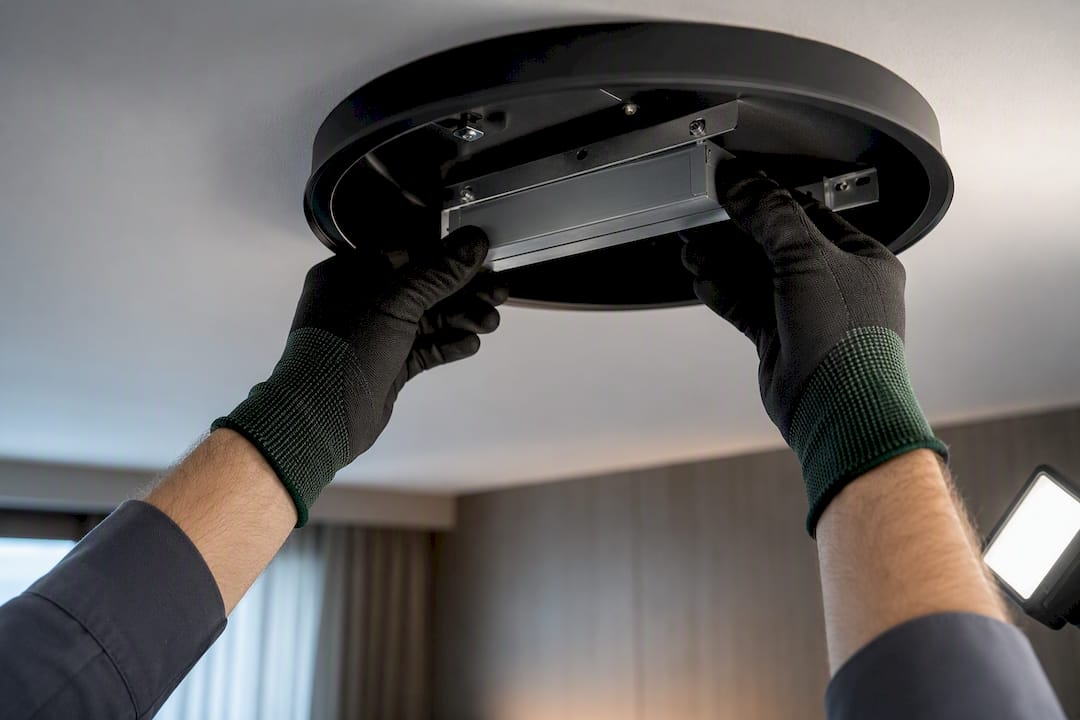
Pro Tip: Spec fixtures with replaceable drivers and accessible mounting hardware. Hotel fixtures run far more nightly hours than a home fixture ever will, and a driver failure that requires ceiling demolition costs far more than the part itself. For deeper zone-by-zone fixture ideas, Montreal Lighting & Hardware’s bedroom lighting guide walks through layering options room by room.
How Do You Light Lobbies, Corridors, and Restaurants?
Public spaces carry the brand. A lobby with a statement fixture, scaled to the ceiling height and layered with ambient wall washes and accent spotlights on art or reception, sets the tone before a guest even checks in. Undersized pendants in a soaring atrium are one of the most common mistakes owners make; a fixture needs real presence to hold a double-height space.
Corridors do better with even, indirect lighting rather than a row of identical downlights, punctuated by an occasional accent at a doorway or piece of art to break the monotony of a long hallway. Restaurants and bars benefit most from scene-based dimming tied to service periods: bright and efficient for breakfast service, warm and low for dinner, adjusted again for late-night bar hours. Layering and high color rendering directly affect how food and materials read to guests, which makes CRI a revenue consideration in F&B spaces, not just an aesthetic one.
Exterior lighting needs its own checklist for Canadian climates:
- Controlled facade washes that reinforce the building’s architecture without spilling light onto neighboring properties.
- Pathway and entry lighting for safety and wayfinding, especially through winter months with early sunsets.
- Damp or wet-rated fixtures wherever exposure to snow, salt spray, or coastal humidity is a factor, since under-rated fixtures corrode fast in those conditions.
Montreal Lighting & Hardware’s entryway lighting guide covers scale and fixture choices for arrival areas in more depth, and the high ceiling lighting guide is worth a look before specifying a lobby centerpiece.
What Controls and Energy Features Should Canadian Hotels Ask For?
Scene programming is where lighting design turns into operational savings. A well-built control system runs distinct scenes for arrival, daytime housekeeping, evening ambiance, and event setups, all switchable from a single keypad instead of a maintenance staffer adjusting fixtures by hand.
The energy case is straightforward:
- Occupancy sensors cut lighting load in unoccupied corridors and back-of-house spaces automatically.
- Daylight harvesting dims perimeter fixtures when natural light is already doing part of the job.
- Setbacks lower brightness overnight in low-traffic zones without shutting lights off entirely.
Lutron’s myRoom hospitality platform supports dimming down to 0.1% and includes guest presence detection that helps housekeeping know which rooms are occupied while trimming energy use in empty ones. That kind of granular control used to require a full rewire; wireless systems now let many Canadian retrofit projects add scene control without opening every wall, which matters in older properties where rewiring costs can kill a renovation budget before it starts.
What Should You Look for When Specifying Fixtures?
Commercial-grade fixtures separate a hotel that relights its corridors every three years from one that does it every ten. The checklist procurement teams should insist on:
- Replaceable drivers and accessible mounting, so a failure means a five-minute swap instead of a ceiling repair.
- IP and IK ratings matched to exposure. Exterior and near-coastal Canadian sites need damp or wet-rated fixtures, and any area exposed to impact (loading docks, stairwells) needs an appropriate IK rating.
- Color consistency, specified as SDCM of 3 or lower, so fixtures installed a year apart still match instead of creating visible color patches down a corridor.
- Photometric data on request, including IES files and R9 values alongside CRI, since a fixture’s CRI number alone does not guarantee good red rendering for skin tones and food.
Cleaning and access matter too: a fixture that requires a scissor lift for a $2 lamp swap will get neglected, and neglected lighting is the fastest way for a renovated lobby to look tired within two years.
What Does Implementation Actually Look Like?
A hotel lighting project moves through six phases: concept, specification, procurement, install, commissioning, and staff training. Skipping commissioning is the single most common mistake owners make, because a project that looks finished on install day often has scenes that do not match, dimmers that flicker at low levels, or color temperatures that clash room to room.
Before handover, run through this commissioning checklist:
- Verify every programmed scene fires correctly from each keypad and control point.
- Test dimming across the full range, watching for flicker or dead zones near 0%.
- Confirm color match across fixtures from the same run using the SDCM target set at specification.
- Collect IES files and photometric records for future maintenance and any future expansion.
- Walk the property with housekeeping staff so they understand override switches and reset procedures.
Pro Tip: Ask your supplier for a written lighting schedule at handover, listing every fixture, driver, and spare part by room type. When a fixture fails at 11 p.m. on a Saturday, that document is what turns a guest complaint into a five-minute fix. Montreal Lighting & Hardware’s lighting schedule guide offers a practical template to build from.
Why Lighting Deserves More Budget Than Most Owners Give It
Most renovation budgets treat lighting as a line item under electrical, somewhere below flooring and finishes on the priority list. That is backwards. Lighting is the one system that touches every single guest interaction, from the first glimpse of the lobby to the last glance at a bedside lamp before sleep, and it is also one of the cheapest systems to get catastrophically wrong.
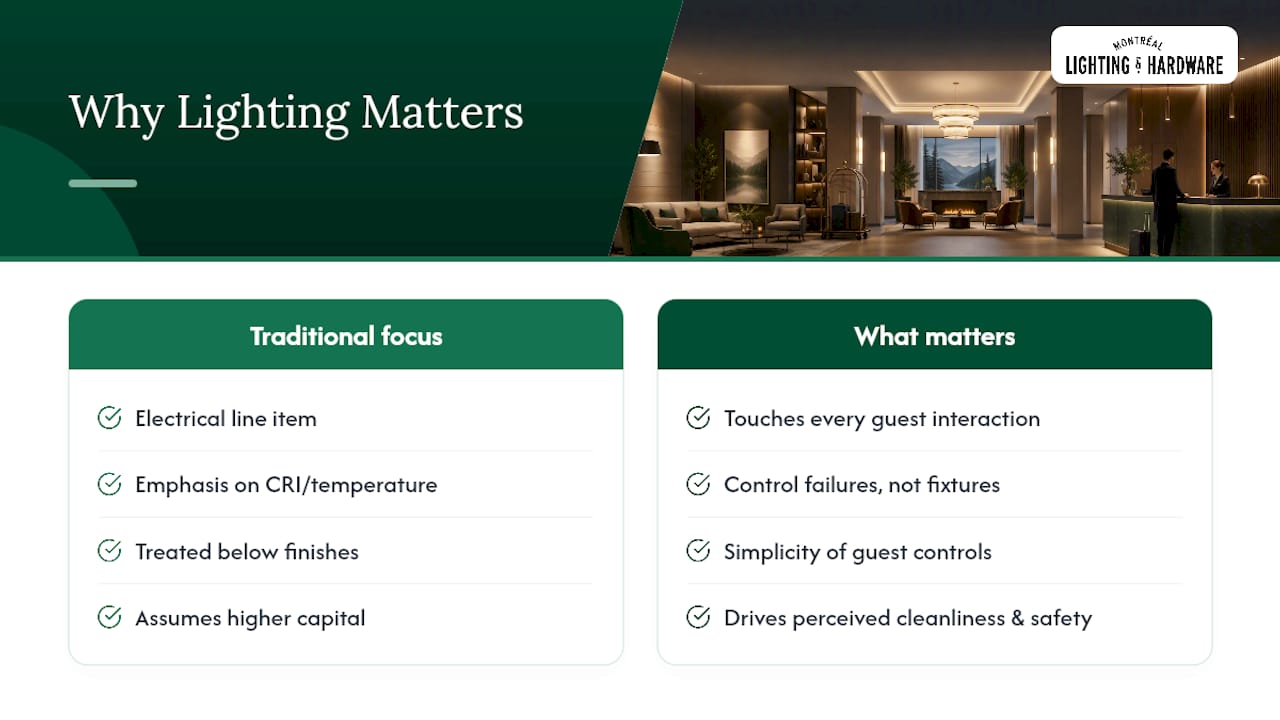
The industry’s obsession with CRI numbers and color temperature charts, while useful, misses the bigger issue: most lighting failures in hotels are control failures, not fixture failures. A beautifully specified 2700K guest room with perfect CRI still fails if the guest cannot find the right switch for the right lamp without hunting through four unlabeled buttons. Simplicity in the guest-facing controls matters as much as the photometrics behind them, and it is the part most spec sheets never mention.
Owners also underestimate how much lighting drives perceived cleanliness and safety, particularly in corridors and stairwells where even, glare-free light does double duty as both ambiance and a security signal. A property that gets this right does not just look better in photos. It reduces the friction that turns a good stay into a mediocre review, and it does so for less capital than most owners assume walking into the project.
— Montreal Lighting & Hardware
How Montreal Lighting & Hardware Supports Canadian Hotel Projects
Some suppliers work with hotel owners and designers through trade programs built for this kind of project, offering showroom access to see fixtures in person before committing to an order, assistance with product selection against CRI and CCT targets, spare-parts planning for maintenance, and shipment timelines for phased renovations. It is a similar model to the trade programs many design professionals already rely on for procurement support. For specifics on F&B and guest room specs, the restaurant lighting guide is a useful next stop.
Ready to Spec Your Property? Start With the Right Fixtures
Some suppliers offer designer and commercial-grade fixtures with trade pricing for hotel owners and hospitality managers, backed by project support rather than just a catalog. For a lobby or restaurant statement piece, the Light Guide Ring LED Pendant scales well over reception desks and bars.
For guest rooms or intimate F&B seating, the Meclisse LED Pendant delivers a decorative layer without overwhelming a smaller space, and the Box LED Wall Sconce holds up well in corridors that see heavy nightly traffic. Browse the full range at Montreal Lighting & Hardware, request trade pricing on a project quote, or book a consultation to walk through a lighting schedule for your next renovation phase.
Sources
- myRoom | Lutron Commercial
- Hotel lighting tips and strategies | Cvent blog
- Hotel Lighting: A 2025 Spec Guide for Rooms, Lobbies, and Bathrooms · Diane Erich & Associates LP
- Hotel Lighting Design: How Light Defines the Five-Star Experience | Guocio
FAQ
What Color Temperature Is Best for Hotel Rooms?
Guest rooms perform best between 2700K and 3000K, a range that flatters skin tones and feels residential rather than clinical.
What CRI Should Hotel Lighting Have?
Guest-facing spaces should hit a CRI of 90 or higher, and vanity or bathroom mirrors do better at 95 or above where accurate skin tone rendering matters most.
Do Hotel Guest Rooms Need Dimmers on Every Fixture?
Independent dimmers on each zone, bed, desk, and seating, give guests real control without forcing them to rely on an app, and they support the smooth scene transitions Cvent’s hospitality guidance recommends.
What IP Rating Do Exterior Hotel Fixtures Need in Canada?
Exterior and coastal-exposed fixtures need damp or wet ratings suited to snow, salt spray, and humidity, since under-rated fixtures corrode quickly in those conditions.
Does Montreal Lighting & Hardware Help With Hotel Lighting Projects?
Yes. Montreal Lighting & Hardware offers a trade program, showroom access, and project support for hotel owners specifying fixtures across guest rooms, lobbies, and public spaces.
