


For most Canadian homes, warm 2700K is the color temperature to build around, with 3000K as your fallback if you want a touch more crispness. It flatters brick, cedar, and skin tones alike, keeps evenings feeling calm rather than clinical, and does far less damage to sleep, wildlife, and dark skies than anything above 4000K. Save cooler temperatures for the rare architectural detail that genuinely calls for them.
TL;DR:
- Most outdoor lighting in Canadian homes should use 2700K or 3000K fixtures to flatter materials, skin tones, and reduce glare and wildlife disruption.
- Using 4000K or higher lighting increases sky glow, suppresses melatonin more, and attracts insects and disoriented wildlife, especially near sensitive habitats.
- Always match fixture CRI to the application, with CRI 80+ suitable for general use and CRI 90+ recommended for true color accuracy in planting and architectural details.
- Consistency in Kelvin throughout the property creates a more finished aesthetic, and mixing temperatures should be done with clear separation on different circuits.
- Proper shielding, beam control, and adjusting with timers or dimmers are essential for minimizing sky glow, glare, and ecological impact without sacrificing visibility.
Table of Contents
- What Does Outdoor Lighting Color Temperature Actually Mean?
- Which Kelvin Should You Use for Each Outdoor Zone?
- Why Does Blue-Rich Light Affect Sleep and Wildlife?
- How Do I Choose and Install the Right Fixtures?
- Where Can Canadian Homeowners Test These Recommendations?
- What Homeowners Get Wrong About Outdoor Lighting Temperature
- Ready to Choose Your Fixtures?
- Sources
- FAQ
What Does Outdoor Lighting Color Temperature Actually Mean?
Color temperature is measured in Kelvin, and the number tells you almost everything about how a bulb will feel once it’s mounted outside your front door. Lower Kelvin numbers glow amber and orange, like candlelight or a sunset. Higher numbers shift toward blue-white, the kind of light you’d expect in a hospital hallway or a parking garage. It’s a scale, not a category, so the difference between 2700K and 3000K is subtle, while the jump from 3000K to 5000K is dramatic.
Manufacturers label bulbs with familiar terms that map roughly to Kelvin ranges:
- Warm white or soft white: 2200K to 3000K, amber and inviting
- Bright white or cool white: 3500K to 4100K, neutral with a slight blue cast
- Daylight: 5000K to 6500K, sharp blue-white, closer to midday sun
That amber-to-blue shift changes how outdoor materials actually look. Warm light pulls out the reds and oranges in brick, stone, and cedar siding, and it’s genuinely more flattering to skin tone when you’re hosting people on a patio. Cooler light flattens those warm undertones and can make skin look sallow under direct exposure, which is one reason restaurants and hotels almost never light outdoor seating with daylight bulbs.
Kelvin isn’t the whole story, though. Color Rendering Index, or CRI, measures how accurately a light source reveals true colors compared to natural daylight, on a scale up to 100. A fixture can be a perfect 2700K and still render colors poorly if its CRI is low. For general outdoor use, look for CRI 80 or higher, and step up to CRI 90+ if you’re lighting garden beds, flowering shrubs, or anything where true color matters.
Which Kelvin Should You Use for Each Outdoor Zone?
The right Kelvin depends on what the light needs to do, but the safe default across nearly every zone on a residential property is warm. Design guides from across the landscape lighting industry consistently point to the same 2700K to 3000K range for exteriors, and they warn against reaching for 5000K “daylight” bulbs meant for garages and job sites.
Patios, decks, and seating areas call for 2700K without much debate. This is where people sit, eat, and talk for hours, and warm light is the one temperature that consistently reads as relaxing rather than institutional.
Pathways and steps work well at 2700K to 3000K, prioritizing glare control over raw brightness. A well-shielded, low-glare path light at a modest lumen output does more for safety than a bright, unshielded one, since glare actually reduces your eyes’ ability to adjust to the dark areas around it.
Foliage and architectural accents can go either way inside the warm band. 3000K brings out crisper greens in hedges and lawns, while 2700K gives stonework and wood siding a softer, textured glow. Neither is wrong. It’s a matter of what you’re trying to highlight.
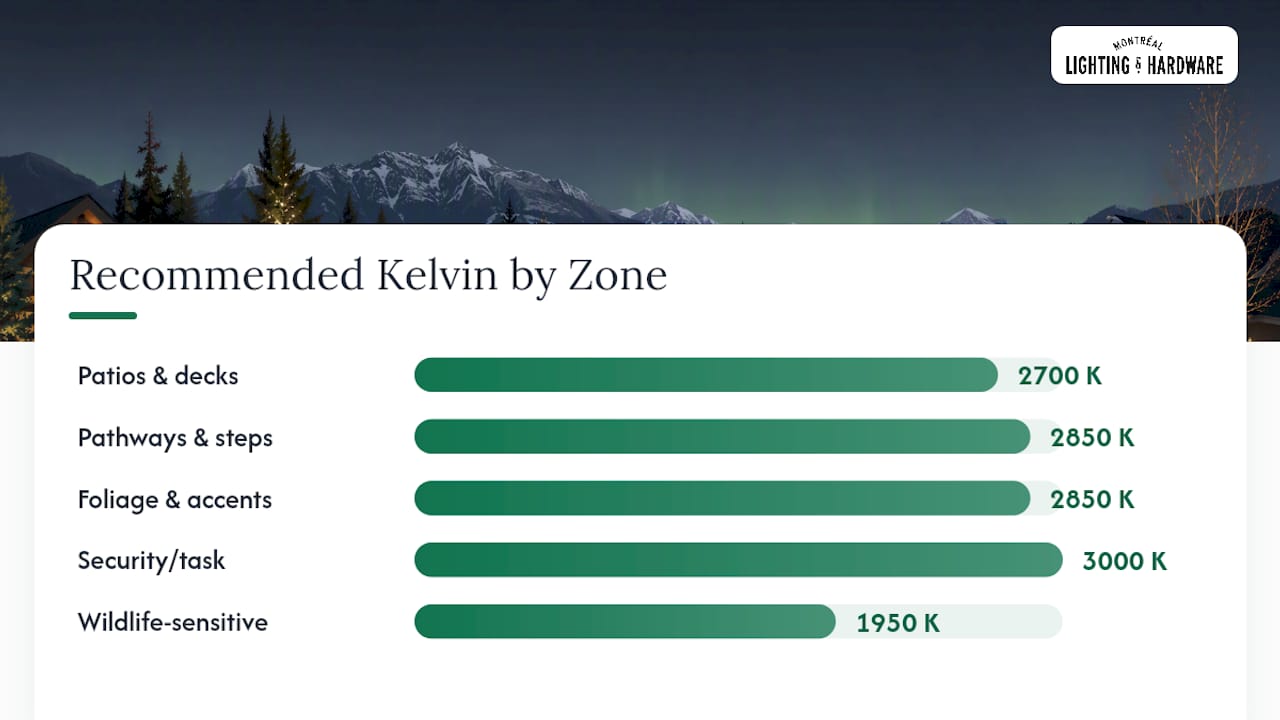
Security and task lighting is where homeowners most often overcorrect toward cold, bright fixtures. A well-shielded 3000K fixture provides plenty of functional visibility. Reserve 4000K or higher for narrowly defined technical needs, like a security camera that performs better under specific spectral conditions, and always pair it with tight shielding to control glare.
Wildlife-sensitive areas, including coastal properties, ravines, or lots backing onto conservation land, deserve special treatment. Amber light around 2200K, or dedicated red or amber fixtures in the 1700K to 2000K range, is the recommended approach near turtle nesting sites or bat corridors.
Here’s how those ranges break down at a glance:
| Zone | Recommended Kelvin | Why |
|---|---|---|
| Patios, decks, seating | 2700K | Warmest, most flattering for skin and materials |
| Pathways, steps | 2700K–3000K | Balances visibility with low glare |
| Foliage, architectural accents | 2700K–3000K | 3000K sharpens greens; 2700K softens texture |
| Security, task lighting | 3000K (shielded) | Functional without harsh glare |
| Wildlife-sensitive zones | 1700K–2200K (amber/red) | Minimizes disruption to sensitive species |
Before you buy anything, check the product listing or box for four details: Kelvin, CRI, IP rating (for moisture resistance), and beam angle. Skipping any one of these is how homeowners end up with a fixture that looks right in the photo and wrong on the wall.
Why Does Blue-Rich Light Affect Sleep and Wildlife?
Light with a strong blue peak, the kind you get from 4000K and up, suppresses melatonin production more than warm light does, and melatonin is the hormone that regulates your sleep cycle. If your bedroom window faces a floodlit driveway lit with a cool white fixture, that spill light is doing more to disrupt your sleep than a warm 2700K fixture would in the same spot, a point backed by research on exterior lighting’s human and environmental impacts.
Cooler LEDs carry a stronger blue peak, and that peak drives two separate problems at once: greater melatonin suppression in humans and disproportionate scattering in the atmosphere, which is what produces sky glow over cities and towns.
Wildlife reacts to spectrum in ways that don’t always match human intuition. Moths and other insects are drawn disproportionately to blue-rich light, which cascades up the food chain since insects are a primary food source for bats and birds. Sea turtle hatchlings and some bird species can become disoriented by white and blue light near shorelines and migration corridors. Amber and red wavelengths, closer to natural firelight, cause far less of this disruption, according to the SoftLights Outdoor Lighting Design Guide, which treats 2700K as a reasonable ceiling for low-impact lighting and recommends amber options at 2200K or below for genuinely sensitive habitats.
Sky glow itself comes down to basic physics. Shorter blue wavelengths scatter more readily in the atmosphere, a phenomenon called Rayleigh scattering, which is the same reason the sky looks blue during the day. Warm light scatters less, staying closer to the ground where it’s actually useful.
You don’t have to choose between a lit yard and a responsible one. A few adjustments cut the impact substantially:
- Stick to 2700K to 3000K for anything visible from a bedroom window or neighboring property
- Choose fully shielded fixtures that direct light downward instead of outward and upward, a principle DarkSky’s lighting guidelines treat as the single most effective sky-glow reducer
- Add timers or dimmers so accent and decorative lighting steps down or shuts off late at night
- Skip decorative uplighting on trees and facades after most of the household is asleep
Warmer light with good shielding also tends to feel more useful at night than a brighter, bluer alternative, since it produces less disability glare, the kind that actually shrinks your ability to see into shadow.
How Do I Choose and Install the Right Fixtures?
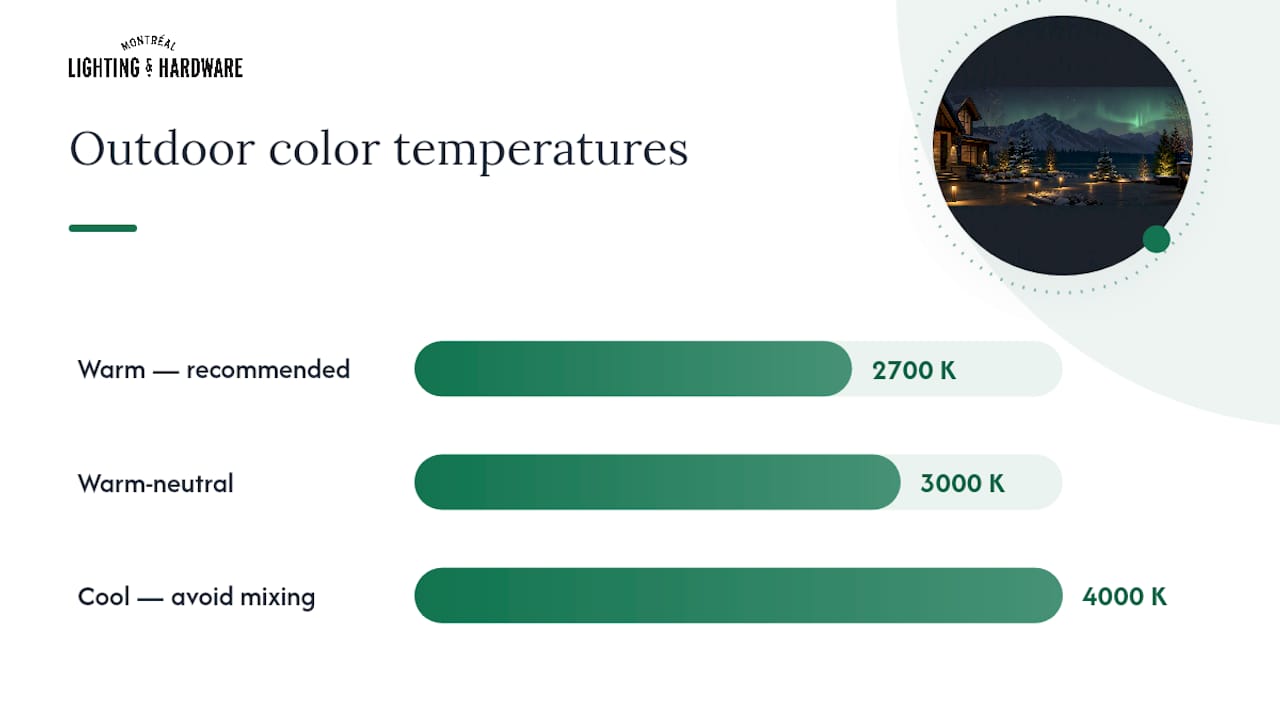
Pick one primary Kelvin for the property and stay with it. Mixing 2700K path lights with 4000K security floods is one of the most common mistakes homeowners make, and it’s the fastest way to make a professionally designed layout look accidental. Consistency reads as intentional; inconsistency reads as leftover fixtures from three different trips to the hardware store.
If you genuinely need two temperatures, for example a warm patio paired with a cooler technical light near a garage, wire them on separate circuits and switch between them at a clear physical boundary, like a fence line or the edge of a driveway. Never let two Kelvin values overlap in the same sightline.
- Decide on your baseline Kelvin (2700K or 3000K) before you shop for a single fixture.
- Check CRI on every product page. CRI 80+ works for general use; go CRI 90+ for true-color rendering on garden beds, flowering plants, or painted trim.
- Confirm shielding and beam angle. A fixture with a narrow, downward beam controls glare far better than an open, upward-facing one.
- Match IP rating to your climate. Canadian winters mean slush, salt spray, and freeze-thaw cycles, so look for IP65 or higher on anything exposed to the elements.
- Add controls at installation. Dimmers rated for LED loads and simple timers let you run full brightness until around 11 p.m., then step down for the rest of the night.
- Confirm mounting height before you drill. Wall-mounted fixtures generally look and function best between 60 and 66 inches from the ground, low enough for scale, high enough to avoid glare at eye level.
Pro Tip: Ask any installer for the exact Kelvin and CRI specs of every fixture they’re quoting, not just wattage and price. A contractor who can’t tell you the Kelvin off the top of their head probably hasn’t thought about consistency across your property.
Where Can Canadian Homeowners Test These Recommendations?
Reading about Kelvin and CRI only gets you so far. Seeing 2700K and 3000K side by side, under real glass and real fixtures, is what actually settles the decision, and it’s worth doing before you commit to a whole property’s worth of hardware.
Montreal Lighting & Hardware’s showroom lets you compare warm-Kelvin fixtures in person, alongside the CRI guidance and mounting-height recommendations referenced throughout this guide. Design professionals and contractors also get access to trade pricing for testing multiple fixture options before finalizing a plan.
A few categories that pair naturally with the 2700K to 3000K range:
- Surface-mounted LED fixtures for entryways and garages
- Shielded path and step lights for walkways
- Directional uplights for trees, columns, and stone facades
- Pendant fixtures for covered porches and outdoor living rooms
What Homeowners Get Wrong About Outdoor Lighting Temperature
Most advice on this topic treats Kelvin like a personal style choice, warm for cozy, cool for modern, and stops there. That framing misses the bigger issue. The real trade-off isn’t aesthetic. It’s biological and ecological, and the evidence on that front is not close. Warm light costs you nothing in visibility and gains you a measurable reduction in glare, sleep disruption, and wildlife impact.
The conventional advice also underrates consistency. Homeowners obsess over picking the “right” single fixture and then ignore whether it matches the fixture they bought two years ago. A property lit entirely in 3000K, even if every individual choice is slightly imperfect, will always look more finished than one mixing 2700K, 3500K, and whatever came in the multipack from a big box store.
If you take one thing from this guide, prioritize the CRI and shielding of your fixtures over chasing the “perfect” Kelvin number. A shielded, well-rendered 3000K fixture will outperform a poorly shielded, low-CRI 2700K one every time. Get those fundamentals right first, then fine-tune the exact Kelvin to taste.
— Montreal Lighting & Hardware
Ready to Choose Your Fixtures?
Big-box hardware stores stock whatever Kelvin happens to be on the shelf that week, which is exactly how so many Canadian properties end up with mismatched lighting in the first place. Certain lighting retailers carry designer lines with consistent, well-documented Kelvin and CRI specs, so you’re not guessing from a vague box label.

Browse fixtures built for warm, low-glare exteriors, including the Zoom LED surface mount and the Pi LED surface mount, both well suited to the 2700K to 3000K range this guide recommends. Design professionals and contractors can also access trade pricing across the full catalog. If you’d rather see finishes and Kelvin options in person before you commit, visit Montreal Lighting & Hardware to plan a showroom visit or get help mapping out a lighting schedule for your property.
Sources
For deeper technical detail, consult the IOP exterior lighting study, DarkSky’s lighting principles, IES lighting education, and the SoftLights Outdoor Lighting Design Guide.
- Optimization of exterior lighting considering human and environmental impacts (IOP Publishing, 2022)
- DarkSky - Lighting principles
- SoftLights — Outdoor Lighting Design Guide (PDF)
FAQ
What Is the Best Color Temperature for Outdoor Lighting?
For most Canadian homes, 2700K is the best all-around choice, with 3000K as a slightly crisper alternative. Both flatter materials and skin tone while limiting glare, sleep disruption, and impact on wildlife.
Is 3000K or 4000K Better for Outdoor Lighting?
3000K is better for nearly all residential applications. 4000K runs cooler and bluer, producing more glare and sky glow, and should be reserved for narrow technical uses like certain security cameras.
Is 3000K Light Warm or Cool?
3000K sits at the warm end of the scale, just slightly crisper than 2700K but still amber-toned rather than blue-white. Anything above roughly 3500K starts reading as neutral to cool.
Can I Mix Different Color Temperatures on One Property?
It’s best to avoid it. Pick one primary Kelvin, and if you must mix, keep each temperature on a separate circuit and switch between them only at a clear physical boundary, like a driveway edge.
Do I Need High CRI for Outdoor Lighting?
CRI 80 or higher works for general outdoor use, but CRI 90+ is worth the upgrade for garden beds, flowering plants, or painted architectural details where true color matters.
