


What is CSA approved lighting and why it matters in Canada
CSA approved lighting refers to fixtures and luminaires independently tested and certified to meet Canadian electrical safety standards by an SCC-accredited body. The Standards Council of Canada (SCC) oversees this accreditation system, authorizing bodies like CSA Group, UL Solutions (cUL), and Intertek (cETL) to issue certification marks that carry equal legal weight across the country.
CSA Group itself brings over a century of experience certifying products to rigorous national standards. That history matters because provincial and territorial Authorities Having Jurisdiction (AHJs) rely on these marks when approving lighting installations. Without a recognized certification mark, a product cannot legally be sold or installed in most Canadian jurisdictions.
Key facts about CSA approved lighting in Canada:
- The SCC accredits certification bodies, not individual products; any mark from an accredited body carries equivalent legal standing.
- CSA Group, UL Solutions/ULC, and Intertek (ETL) are all SCC-accredited and accepted by AHJs nationwide.
- The CSA mark signals compliance with Canadian electrical codes and product safety standards.
- Certification covers the complete product, not just individual components.
- Provincial inspectors hold final authority to accept or reject any mark during an installation inspection.
Table of Contents
- Which lighting products require CSA certification in Canada
- How the testing and compliance process works for lighting manufacturers
- Why CSA certification benefits both manufacturers and buyers
- How to verify that a lighting product is genuinely certified
- An overview of how CSA lighting certification actually works
- What regulations and standards CSA lighting certification covers
- Common safety issues that CSA certification addresses
- How long CSA certification lasts and what renewal involves
- What CSA certification means for importers and retailers in Canada
- Montreallighting carries certified fixtures ready for Canadian homes
- Key Takeaways
Which lighting products require CSA certification in Canada
The scope of CSA certified light fixtures is broader than most people expect. Certification applies to the full range of residential and commercial lighting products sold in Canada.
Covered product categories include:
- Luminaires: General-purpose ceiling fixtures, pendants, and chandeliers for residential and commercial use.
- Household ceiling and wall mounts: Flush mounts, semi-flush mounts, and decorative wall sconces.
- Outdoor lighting: Lanterns, post lights, wall-mounted exterior fixtures, and wet-location rated products.
- LED fixtures and modules: LED lamps, retrofit kits, LED drivers, and LED luminaires tested to standards like UL 1598 and CSA C22.2 No. 250.0.
- Emergency and signage lighting: Exit signs, emergency lighting units, and illuminated safety signage.
- Low-voltage and specialty lighting: Landscape lighting systems, track lighting, and specialized commercial or industrial fixtures.
- Power supply units: Fluorescent ballasts, LED drivers, and lighting control gear.
Each category addresses specific safety concerns: electrical shock protection, fire resistance, mechanical durability, and suitability for the installation environment (dry, damp, or wet locations).
How the testing and compliance process works for lighting manufacturers
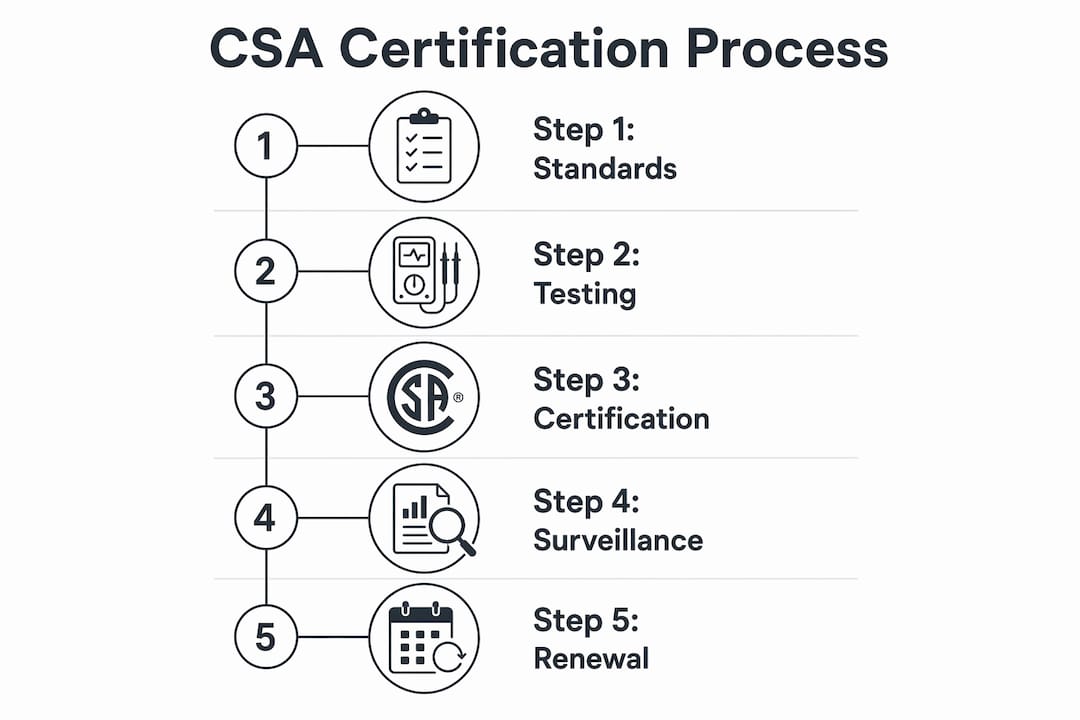
Manufacturers achieve certification through a structured process overseen by an SCC-accredited body. The certification process includes product safety testing, ongoing factory surveillance, and verification against the Canadian Electrical Code and applicable product standards.
The steps look like this:
- Product submission: The manufacturer submits samples and technical documentation to the chosen certification body (CSA Group, UL/ULC, or Intertek).
- Laboratory testing: Products are tested against relevant Canadian standards, such as CSA C22.2 No. 250.0 for luminaires.
- Factory inspection: The certification body audits the manufacturing facility to confirm consistent production quality.
- Mark authorization: Once testing and inspection pass, the manufacturer receives authorization to apply the certification mark.
- Ongoing surveillance: Periodic factory audits and market surveillance continue to verify sustained compliance.
Provincial AHJs enforce these requirements at the installation level. While all SCC-accredited marks are legally equivalent, some municipalities like Toronto have a customary preference for the CSA mark, which can mean smoother inspections in those areas.
Pro Tip: Any modification to a certified lighting product, including rewiring or substituting components, voids the original certification. The modified product requires a new inspection before it can be legally installed.
Why CSA certification benefits both manufacturers and buyers
Certification does more than satisfy a regulatory checkbox. For manufacturers, it opens the door to legal sales across all Canadian provinces and territories without navigating separate provincial approvals. It also reduces liability exposure by providing documented proof that a product met independent safety standards before reaching the market.
For buyers, the benefits are just as concrete:
- Safety assurance: Certified products have been independently tested for electrical shock, fire risk, and mechanical failure.
- Insurance acceptance: Most home and commercial insurers expect certified fixtures; uncertified products can complicate claims.
- Inspection confidence: Electrical inspectors accept CSA, cUL, and cETL marks without additional documentation in most jurisdictions.
- Market flexibility: Because CSA, cUL, and cETL marks carry equivalent legal weight, manufacturers can choose the certification body that best fits their timeline and budget.
A common misconception is that only the CSA mark is valid in Canada. Electrical professionals confirm that any mark from an SCC-accredited body satisfies Canadian requirements. The mark on the fixture matters; the logo on it does not.
How to verify that a lighting product is genuinely certified
Spotting a legitimate certification mark takes only a moment, but knowing exactly where to look saves real headaches later.
- Check the product itself: Look for the mark on the backplate, canopy, label, or driver housing, not just on the packaging or a spec sheet.
- Confirm the Canadian scope: A plain “UL Listed” mark covers the U.S. standard. For Canada, look for “cUL,” “cULus,” “ULC,” or “cETL” to confirm the product was tested to Canadian requirements.
- Use official directories: Cross-check the product in the CSA Product Listing, UL’s Product iQ, or the Intertek ETL Listed Directory.
- Ignore CE marks: The CE mark is a European conformity marking and does not satisfy Canadian approval requirements.
- Watch for component-only marks: A certified driver or ballast inside a fixture does not make the complete assembly certified.
Pro Tip: Before purchasing a fixture for a renovation or new build, ask the retailer to confirm the specific Canadian certification mark. If you plan to modify the fixture after purchase, such as changing the cord or socket, consult an electrical inspector before installation, since modifications void certification validity.
An overview of how CSA lighting certification actually works
CSA Group functions as both a standards development organization and a certification body in Canada. The CSA mark has appeared on billions of products worldwide over the past 75 years, covering LED lamps, decorative luminaires, lighting controls, and more. Regulators, retailers, and electrical contractors across North America recognize it as proof of independent safety evaluation.
The certification framework separates two distinct roles: writing the standard and testing to it. CSA Group writes Canadian standards like CSA C22.2 No. 250.0, but any SCC-accredited body can test a product against those same standards. This separation creates a competitive market for certification services, which benefits manufacturers through faster timelines and cost options.
What regulations and standards CSA lighting certification covers
CSA certified lighting must comply with a layered set of requirements. The primary framework is the Canadian Electrical Code (CEC), which governs how electrical products are installed and used across Canada. Product-specific standards sit on top of that foundation.
For luminaires, the key standard is CSA C22.2 No. 250.0, which addresses general safety requirements for non-hazardous locations. LED-specific products also reference UL 8750 for LED light source safety. Outdoor and wet-location fixtures face additional ingress protection testing. Emergency lighting must meet CSA C22.2 No. 141. Energy efficiency requirements under Natural Resources Canada’s regulations add another layer for certain product categories, particularly LED lamps and ballasts.
Common safety issues that CSA certification addresses
Certification testing targets the failure modes that cause real harm in residential and commercial installations.
- Electrical shock: Insulation integrity, grounding continuity, and creepage distances are tested to prevent contact with live parts.
- Fire hazards: Thermal testing confirms that fixtures do not overheat under normal or fault conditions, protecting surrounding materials.
- Mechanical failure: Stress tests verify that mounting hardware, canopies, and lamp holders hold up under expected loads and vibration.
- Environmental exposure: Outdoor fixtures undergo ingress protection testing to confirm resistance to rain, dust, and humidity.
- Photobiological safety: LED products are evaluated for blue-light hazard and UV emission levels.
How long CSA certification lasts and what renewal involves
CSA certification does not expire on a fixed calendar date. Instead, it remains valid as long as the manufacturer maintains ongoing compliance through periodic factory surveillance audits conducted by the certification body. If a product line changes, even in a minor way, the manufacturer must notify the certification body and may need to retest affected aspects of the design.
Selling a product under a certification mark without maintaining the required surveillance program is a violation of the certification agreement and can result in mark withdrawal. Electrical inspectors and provincial authorities have the authority to pull a product from service if certification is found to be lapsed or invalid.
What CSA certification means for importers and retailers in Canada
Importers bear direct responsibility for ensuring that products they bring into Canada carry valid certification from an SCC-accredited body. A product certified only to U.S. standards, carrying a plain UL Listed mark without the “c” prefix, does not satisfy Canadian requirements and can be rejected at inspection.
Retailers face similar accountability. Stocking uncertified lighting products risks failed inspections for customers, product returns, and potential liability after incidents. The practical guidance is straightforward: verify the Canadian-scope mark before placing a purchase order, not after the shipment arrives. For complex or custom fixtures, a special inspection by an SCC-accredited inspection body is available as an on-site compliance pathway when pre-certified assemblies are not an option.
Montreallighting carries certified fixtures ready for Canadian homes
When you already understand what certification means, the next step is finding fixtures that actually carry it. Montreallighting stocks a curated selection of certified lighting fixtures for Canadian residential and commercial spaces, from indoor chandeliers and ceiling mounts to outdoor wall and ceiling fixtures built for Canadian weather.
Every product in the Montreallighting catalog is sourced from established designer brands, and the team is ready to confirm certification details before you buy. Whether you’re outfitting a new build, refreshing a living space, or specifying fixtures for a commercial project, you can browse the full collection and reach out for guidance at montreallighting.com.
Key Takeaways
CSA approved lighting must carry a mark from an SCC-accredited body like CSA Group, cUL, or cETL to be legally sold and installed across Canada.
| Point | Details |
|---|---|
| SCC accreditation is the standard | CSA, cUL, and cETL marks are legally equivalent; any SCC-accredited mark satisfies Canadian AHJ requirements. |
| Certification covers the full product | Component-level marks do not certify the complete assembly; the whole fixture must carry the mark. |
| Modifications void certification | Rewiring or substituting components invalidates the original mark and requires a new inspection. |
| Verify the Canadian scope | Look for “c” prefixes (cUL, cETL) or the CSA mark directly on the fixture, not just on packaging. |
| Montreallighting for certified options | Montreallighting offers a curated range of certified fixtures for Canadian residential and commercial installations. |
