


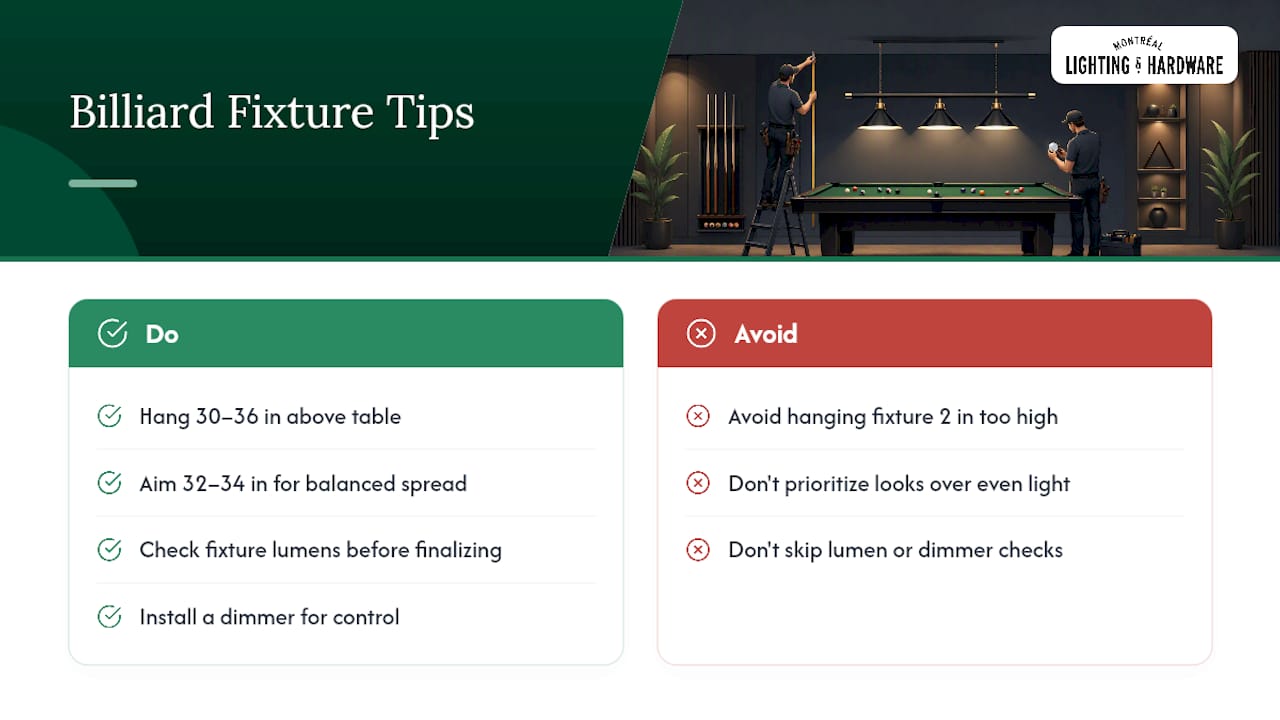
Hang the bottom of the shade about 32 to 34 inches above the playing surface, with an acceptable range of 30 to 36 inches. On a standard table with a 30-inch playing height, that translates to a range around 60 to 66 inches from the floor. Getting this range right matters more than the fixture you choose, because the geometry between light and slate controls whether you get even coverage or a harsh hot spot ringed by shadows.
TL;DR:
- The optimal fixture height for a pool table ranges from 30 to 36 inches above the playing surface, with 32 to 34 inches being ideal for most setups.
- Hanging the light too high causes shadows and softens contrast, while too low creates glare and depth perception issues, especially for longer shots.
- Measure from the felt when the table is in place or from the floor if planning beforehand, aiming for 62 to 66 inches from the floor on a standard 30-inch table.
- Always confirm secure mounting, center the fixture accurately, and include a dimmer to adjust brightness during play and rest periods.
Table of Contents
- What Is the Standard Pool Table Light Height?
- Why Does Fixture Height Change Light Quality?
- How Do You Measure and Hang a Pool Table Light Correctly?
- What Lumen Output and Color Temperature Work Best?
- What Installation Mistakes Should You Avoid?
- A Trade Perspective on Getting the Height Right
- Fixtures and Placement Support From Montreal Lighting & Hardware
- Sources
- FAQ
What Is the Standard Pool Table Light Height?
Most trade guides converge on the same window, even if the exact number shifts a little from source to source. Quarter King Billiards puts the sweet spot at 33 to 34 inches above the slate, inside a broader workable range of 32 to 36 inches. Pearson Cues recommends 31 to 33 inches for even illumination without glare, and Dynamic Billiard cites a similar 31 to 33 inch figure, translating to 61 to 63 inches from the floor for pre-installation planning.
For practical purposes, treat 30 to 36 inches above the slate as your working range and adjust from there based on table size:
- 7-foot tables: stay toward the lower half, around 30 to 32 inches, since the shorter rails need less spread.
- 8-foot tables: the middle of the range works well, 32 to 34 inches.
- 9-foot regulation tables: lean toward 34 to 36 inches so a longer fixture bar still clears the felt evenly from end rail to end rail.
If you’re planning before the table arrives, measure from the floor instead. Assuming a standard 30-inch playing height, aim for 62 to 66 inches from the floor to the bottom of the shade, matching the floor-to-fixture ranges used by installers who hang fixtures before the table is even delivered.
Why Does Fixture Height Change Light Quality?
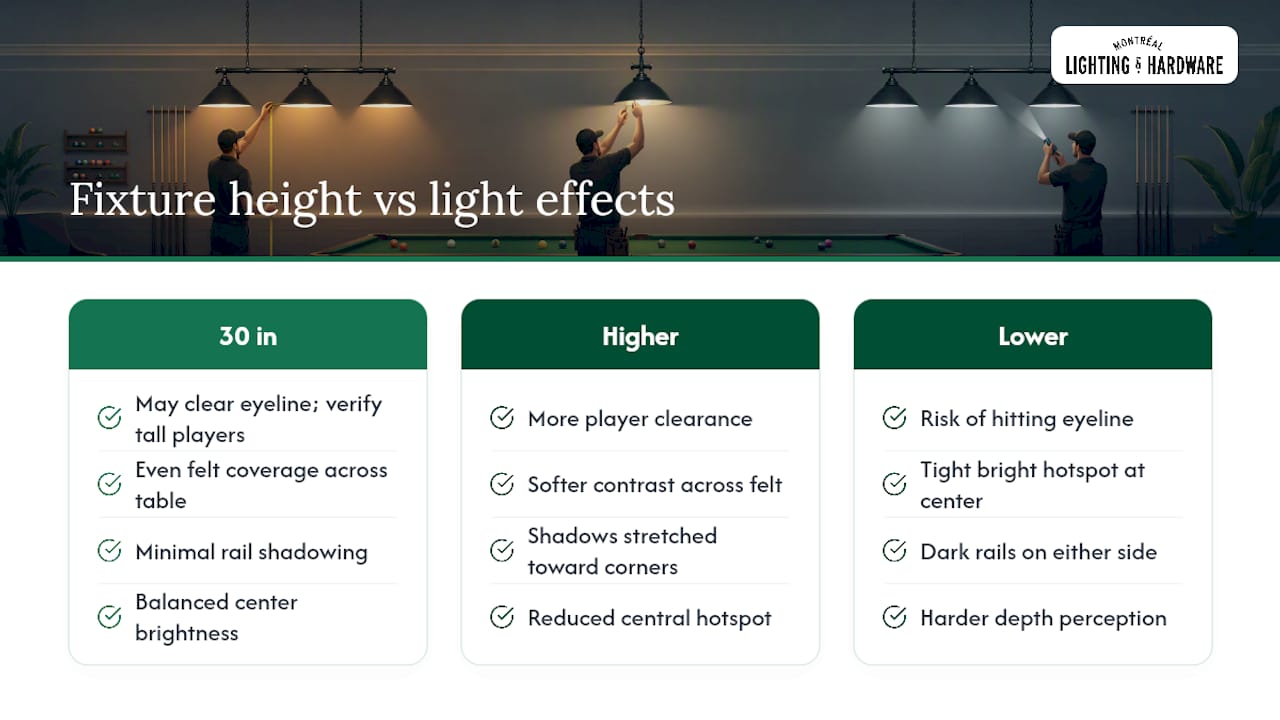
Height controls how light spreads across the felt, and that spread is what separates a table that plays well from one that fights you on every bank shot. Hang the fixture too high, and the light source moves farther from the rails, stretching shadows across the corner pockets and softening the contrast you need to read ball position.
Hang it too low, and you get the opposite problem: a tight, blinding hot spot in the center of the table with dark rails on either side. That combination makes depth perception harder, not easier, especially on long draw shots where you’re tracking the cue ball’s path toward the rail.
Player clearance matters too. A fixture at 30 inches above the slate might look perfect on paper, but if your regular players are tall, check that the shade clears their eyeline during a full break-shot stance. Getting the height right matters more than fixture price. A modest bar hung correctly beats an expensive chandelier hung wrong.
How Do You Measure and Hang a Pool Table Light Correctly?
Getting the number right on paper is one thing. Getting the fixture to actually sit there, level and centered, is another. Here’s the sequence that avoids the most common redo:
- Measure the playing surface height first. If the table is already in place, measure straight up from the felt, not the rail cushion, since the felt is your true reference point.
- Convert to a floor measurement if the table isn’t in yet. Add 30 inches (standard playing height) to your target shade height, landing you in that 62 to 66 inch floor-to-shade range.
- Mark the ceiling centerpoint. Measure the table’s length and width, then find the exact center so the fixture splits the slate evenly on both axes.
- Hang using chain or rod mounting, whichever the fixture calls for, and leave yourself adjustment slack. Chain mounts are more forgiving for fine-tuning height after the fact than fixed rods.
- Test coverage with balls racked on the table. Walk the full perimeter and check for dark corners near the pockets or a blinding center glare.
- Check glare at a normal playing stance, not standing upright. Bend into a shooting position and look down the cue line. If the shade edge is visible in your eyeline, raise it slightly.
- Re-level the bar once you’ve locked in the final height, since even a slight tilt throws off symmetry across the table.
Pro Tip: Hang the fixture a half inch higher than your calculated target on the first pass. It’s much easier to lower a chain-mounted light an inch than to reinstall a ceiling mount because you hung it too close to the felt.
What Lumen Output and Color Temperature Work Best?
Height gets the geometry right, but output and color temperature decide whether the light actually helps you see the table. For a 9-foot regulation table, aim for 2,000 to 4,000 total lumens, spread across the fixture rather than concentrated in a single bulb.
- Use three or more light sources across the bar. A single bright bulb creates the same hot-spot problem as hanging too low, even at the correct height.
- Target 3,000K to 4,000K color temperature. This range renders ball colors accurately without the yellow cast of warmer bulbs or the clinical blue of daylight-balanced ones.
- Install a dimmer. A dimmer lets you run full output during play and drop to ambient levels for a relaxed evening around the table.
A 9-foot table needs 2,000 to 4,000 lumens at 3,000K to 4,000K to hit that balance of clarity and warmth most players prefer.
What Installation Mistakes Should You Avoid?
Most height problems come from a handful of repeat mistakes, and every one of them is fixable before you drill a single hole.
- Hanging at “eye level” instead of measuring. Eyeballing the height feels intuitive but almost always lands too high or too low. Measure from the felt every time.
- Ignoring fixture length relative to table size. A short bar centered over a 9-foot table leaves the end rails dim no matter how well you dial in the height.
- Skipping the centering step. An off-center fixture creates uneven shadows even at a perfect height.
- Leaving out the dimmer. Without one, you’re stuck choosing between glare during play and dimness during downtime.
- Forgetting tall players. Test with a normal shooting stance before finalizing, especially if your regular group includes players over six feet tall.
Secure mounting matters as much as the number on your tape measure. Confirm the ceiling anchor or joist connection can hold the fixture’s weight, and have an electrician check the wiring if you’re not confident working with a dimmer-rated driver yourself.
A Trade Perspective on Getting the Height Right
Lighting specialists work with fixture height calculations across every room in the house, from pendant placement over kitchen islands to chandelier drop above dining tables, and the same principle holds true over a billiard table: the number matters less than the geometry it creates. A 32 to 34 inch hang isn’t a rule someone invented arbitrarily. It’s the point where light spread, shadow length, and player clearance all land in balance at once.
We’d rather see a reader hang a modest three-light bar at the correct height than a striking designer fixture two inches too high. The felt doesn’t care how the fixture looks from the doorway. It cares whether every rail and pocket gets even light. Stick to the 30 to 36 inch range, check your lumens, and add a dimmer, and the fixture will do its job every single time you rack up.
— Montreal Lighting & Hardware
Fixtures and Placement Support From Montreal Lighting & Hardware
Once you know your target height, the next question is which fixture actually delivers 2,000 to 4,000 lumens across three or more sources without looking like it belongs in a garage. A specialized ceiling lighting collection includes multi-light ceiling mounts built for exactly this kind of even, wide-span coverage over a long surface.

If you’re unsure which bar length matches your table size, or you want a fixture that suits the rest of your room instead of looking purely functional, reach out for selection help. Designer lines including Crystorama and Sonneman are available, along with a trade program that offers design professionals and contractors project support and special pricing. Browse the lighting category to see current options, or contact our team directly for guidance on matching fixture length, lumen output, and color temperature to your specific table before you buy.
Sources
Numeric guidance in this article draws on installer-focused resources from Quarter King Billiards, Pearson Cues, and Dynamic Billiard. For related fixture-height guidance, see Montreal Lighting & Hardware’s notes on lumens per room.
- Pool Table Lighting Guide: Heights, Wattage & Fixtures | Quarter King Billiards
- Pool Table Light Placement
FAQ
How Long Should a Light Be for an 8-Foot Pool Table?
An 8-foot table pairs best with a fixture bar sized to evenly cover the length, long enough to cast even light across both end rails without leaving the corners dim. Hang it 32 to 34 inches above the slate, centered over the table’s length and width.
How High Should a Table Light Be Above the Playing Surface?
The bottom of the shade should sit 30 to 36 inches above the playing surface, with 32 to 34 inches as the commonly cited sweet spot. This range balances even spread against glare at normal shooting stances.
What Are the Standard Dimensions of a Pool Table Light?
Dimensions vary by table size, with fixture lengths chosen to match 7 to 9 foot tables, and a shade depth built to sit 30 to 36 inches above the felt. Multi-light bars with three or more sources are standard for even coverage across the full slate.
What Is the Recommended Distance for a Billiard Table Light?
The recommended distance is 30 to 36 inches from the bottom of the shade to the playing surface, or roughly 62 to 66 inches from the floor on a standard 30-inch table. Adjust toward the higher end for 9-foot tables and the lower end for 7-foot tables.
