


For rooms with ceilings above 10 feet, the most effective approach combines a large chandelier or long-drop pendant to anchor the space visually, recessed lighting for even ambient coverage, and lower-level lamps or sconces to keep the room feeling warm and lived-in. According to layered lighting guidance for high-ceiling rooms, this three-layer strategy is the most reliable way to make tall spaces feel both beautiful and genuinely usable.
If you’re ready to shop, Montreal Lighting & Hardware carries a curated selection of chandeliers, Sonneman pendants, Crystorama fixtures, and more, all available to ship across Canada.
The short version of what works:
- Large chandeliers (multi-tier or sculptural): best for foyers, dining rooms, and two-story great rooms
- Long-drop single pendants: ideal over kitchen islands, reading nooks, and stairwells
- Multi-pendant clusters: great for dining tables and open-plan living areas
- Linear suspensions: clean and modern over islands or long dining tables
- Layered recessed lighting: fills ambient gaps that a single fixture can’t cover alone
Key Takeaways
The most effective high ceiling lighting plan combines a scaled statement fixture, layered ambient sources, and lower-level warmth to make tall rooms feel both beautiful and genuinely usable.
| Point | Details |
|---|---|
| Layer your light sources | Pair a statement chandelier or pendant with recessed ambient lighting and lower-level sconces or lamps for warmth. |
| Size to the room’s footprint | Add room length and width in feet; that number in inches is your starting-point fixture diameter, adjusted upward for ceilings above 10 feet. |
| Calculate drop before you order | For every foot of ceiling height above 8 feet, add roughly 3 inches of drop to keep the fixture visually connected to the room. |
| Confirm CSA/UL listing and hire a licensed electrician | Canadian installations require certified fixtures and a licensed electrician; check local permit requirements before scheduling work. |
| Shop Montreal Lighting & Hardware | Sonneman, Crystorama, Savoy House, and Maxim fixtures with full specs, Canadian shipping, and trade pricing are available at montreallighting.com. |
Table of Contents
- What fixture types work best for high ceilings?
- How do you size a chandelier and set the right drop?
- How do you suspend and install fixtures in tall Canadian homes?
- What bulbs and layering strategy work best in tall rooms?
- How should you place and style fixtures by room type?
- What should you check before buying a high-ceiling fixture?
- Curated Montreal Lighting & Hardware picks for tall ceilings
- Why Montreal Lighting & Hardware is a trusted source for tall-ceiling fixtures
- What the right fixture actually does for a tall room
- Light up your tall space with the right fixture
- Sources
What fixture types work best for high ceilings?
Tall rooms reward fixtures with presence. A standard flush mount that looks fine on an 8-foot ceiling simply disappears on a 14-foot one. The categories below each solve a different problem in tall spaces.
- Multi-tier chandeliers: These are the natural anchor for a two-story foyer or a grand dining room. Their vertical mass fills the visual void between the ceiling and the occupied zone. Brands like Crystorama and Savoy House offer multi-light chandeliers with enough diameter and drop to read well at scale.
- Long-drop single pendants: A single pendant with a generous cord or rod length brings focused light down to where people actually are. Sonneman’s LED pendants, for example, pair clean contemporary form with adjustable suspension, making them well suited to tall loft ceilings and open-plan kitchens.
- Multi-pendant clusters: Grouping three to five pendants at staggered heights creates visual rhythm and distributes light across a wider area. This works especially well over a dining table or in a two-story living room where one fixture would look lonely.
- Linear suspensions: A long horizontal bar pendant over a kitchen island or a rectangular dining table brings a modern, architectural quality to tall spaces. The horizontal line also provides a visual counterpoint to all that vertical height.
- High-lumen recessed downlights: On their own, recessed cans often underperform in very tall rooms. Homeowners with 20-foot ceilings report that small cans alone left the space feeling dim; adding a substantial chandelier made the difference. Use recessed lighting as a supporting layer, not the sole source.
- Accent options (sconces, floor lamps, uplights): Wall sconces and floor lamps placed at eye level add warmth and texture. They pull attention down from the ceiling and make a tall room feel cozy rather than cavernous.
Pro Tip: When choosing between a chandelier and a pendant cluster for a tall foyer, consider the sightline from the front door. A single dramatic fixture centered on that axis creates a natural focal point the moment guests walk in.
How do you size a chandelier and set the right drop?
Size to the room’s footprint first, then adjust the drop so the fixture hangs in the occupied zone, not floating near the ceiling.
The diameter rule: Add the room’s length and width in feet. That sum, converted to inches, gives you a useful starting-point diameter for a chandelier. As a general starting point, add the room’s length and width in feet to get a diameter in inches that roughly fits the space. For ceilings above 10 feet, designers often increase fixture diameter somewhat to maintain visual presence, since the extra height makes a fixture look smaller than it actually is.
Hang-height targets:
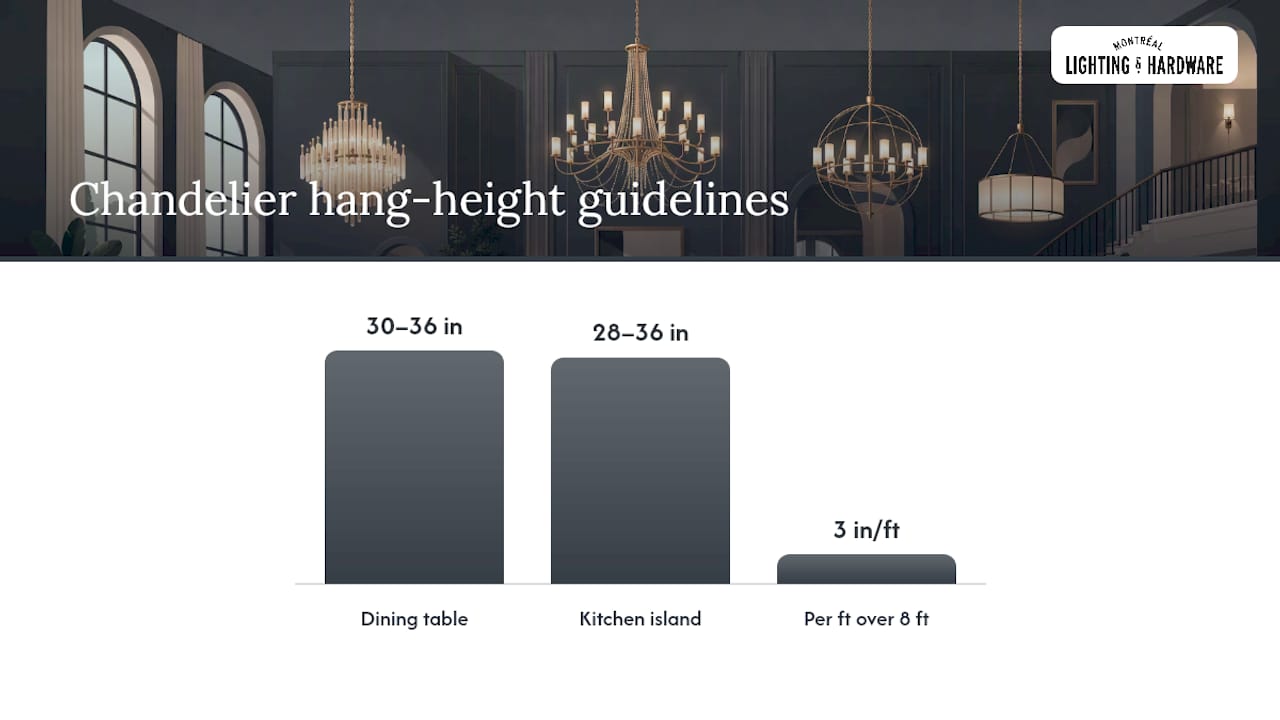
- Over a dining table: The bottom of the fixture should sit 30–36 inches above the tabletop.
- Over a kitchen island: 28–36 inches above the counter surface, depending on fixture size.
- Foyer or entryway: The bottom of the fixture should clear 7 feet from the floor. In a two-story foyer, center the fixture vertically in the open space rather than dropping it to the 7-foot minimum.
- Stairwell: The lowest point of the fixture should clear the highest step by at least 7 feet.
- For every foot of ceiling height above 8 feet: Add approximately 3 inches to the drop length to keep the fixture visually connected to the room rather than marooned near the ceiling.
Quick formula: Drop length (inches) = [Desired hang height from floor] subtracted from [Ceiling height in inches], minus [Fixture body height].
For ceilings above 12–14 feet, designers often increase fixture diameter and add multi-tier elements to maintain visual weight. Multi-light clusters with staggered drops are a common solution for stairwells and two-story foyers, where a single-tier fixture can look flat against all that vertical space.
Pro Tip: Before ordering, cut a piece of string to your target drop length and tape it to the ceiling. Hang a piece of cardboard cut to the fixture’s diameter. Live with it for a day. What looks right in your head often needs adjustment once you see it in the actual space.
How do you suspend and install fixtures in tall Canadian homes?
The answer is straightforward: use downrods, extension kits, long-chain suspensions, or stem extensions designed for the specific fixture. Never rely on a short stem that ships with a standard fixture and assume it will reach the right height.
Installation checklist for tall ceilings
- Rated ceiling box: Confirm the electrical box is rated for the fixture’s weight. Most standard boxes handle up to 35 lbs; heavier chandeliers require a fan-rated or structural box anchored to a joist or a brace bar.
- Canopy compatibility: Check that the canopy covers the ceiling opening and that the fixture’s canopy is compatible with your ceiling angle. For vaulted or sloped ceilings, fixtures with extended downrods or slope adapters are the right choice to maintain safe clearances and get light closer to the occupied plane.
- Fixture weight: Weigh the fixture before installation day. Anything above 50 lbs typically needs a structural anchor, not just a brace bar.
- Downrod and extension kit length: Confirm the maximum available rod length for your chosen fixture. Some Sonneman pendants, for example, offer extension options that let you dial in the exact drop.
- Service access: On very tall ceilings, think about how you’ll change bulbs or service the fixture. A fixture with integrated LED modules (no bulb changes needed for years) is a practical advantage at 16 feet.
- Electrician tasks: Wiring, box installation, and final fixture mounting should be handled by a licensed electrician. In Canada, electrical work in a home generally requires a licensed contractor, and many municipalities require a permit for new fixture installations.
Canada-specific considerations
| Item | What to check |
|---|---|
| CSA/UL listing | Confirm the fixture carries CSA or UL certification for use in Canada |
| Licensed electrician | Required for wiring; verify provincial licensing requirements |
| Permit | Check with your local municipality; often required for new circuits |
| Shipping and lead times | Larger fixtures may ship by freight; confirm delivery timelines before scheduling an installer |
| Returns | Review the retailer’s return window for oversized or special-order items before purchase |
Pro Tip: Order your fixture and confirm delivery before booking your electrician. Freight shipments for large chandeliers can take longer than standard parcel delivery, and rescheduling an electrician is an avoidable cost.
What bulbs and layering strategy work best in tall rooms?
Start with LED fixtures that offer higher lumen output, a warm color temperature, and dimming capability. That combination gives you the flexibility to shift the room’s mood from bright and functional to soft and inviting.
- Lumen output: A tall room needs more lumens than a standard-height room because the fixture is farther from the surfaces it’s meant to illuminate. A pendant at 14 feet casts a wider, softer cone of light than the same fixture at 8 feet. Plan for higher lumen output than you think you need, then use a dimmer to pull it back.
- Color temperature: For living rooms, dining rooms, and foyers, 2700K–3000K produces a warm, natural glow that feels welcoming. Kitchens and workspaces can go up to 3000K–3500K for a crisper, more functional light.
- CRI (Color Rendering Index): Look for a CRI of 90 or above. At that level, colors in fabrics, finishes, and artwork read true, which matters especially in rooms where you’ve invested in materials and textures.
- Dimmer compatibility: Confirm that your LED fixture is compatible with your dimmer type. ELV (Electronic Low Voltage) dimmers work well with most LED drivers; 0–10V dimming is common in commercial-grade LED fixtures. Check the fixture’s spec sheet before buying a dimmer.
- Layering the light: A single statement fixture, even a beautiful one, rarely does the whole job in a tall room. The most reliable approach pairs that statement piece with recessed ambient lighting for overall coverage, lower-level lamps or sconces for warmth at eye level, and accent uplighting to draw the eye upward and celebrate the ceiling height rather than hide it.
Pro Tip: Beam angle matters more than most shoppers realize. A fixture mounted at 16 feet with a narrow beam angle (15–25°) will create a tight pool of light directly below it. For general ambient use at height, look for fixtures with wider beam spreads or use multiple recessed cans with 40–60° beam angles to fill the room evenly.
How should you place and style fixtures by room type?
Each room type in a tall home has its own logic. The goal in every case is to bring the light down to where people are, while letting the fixture itself celebrate the ceiling height.
Foyer and entry
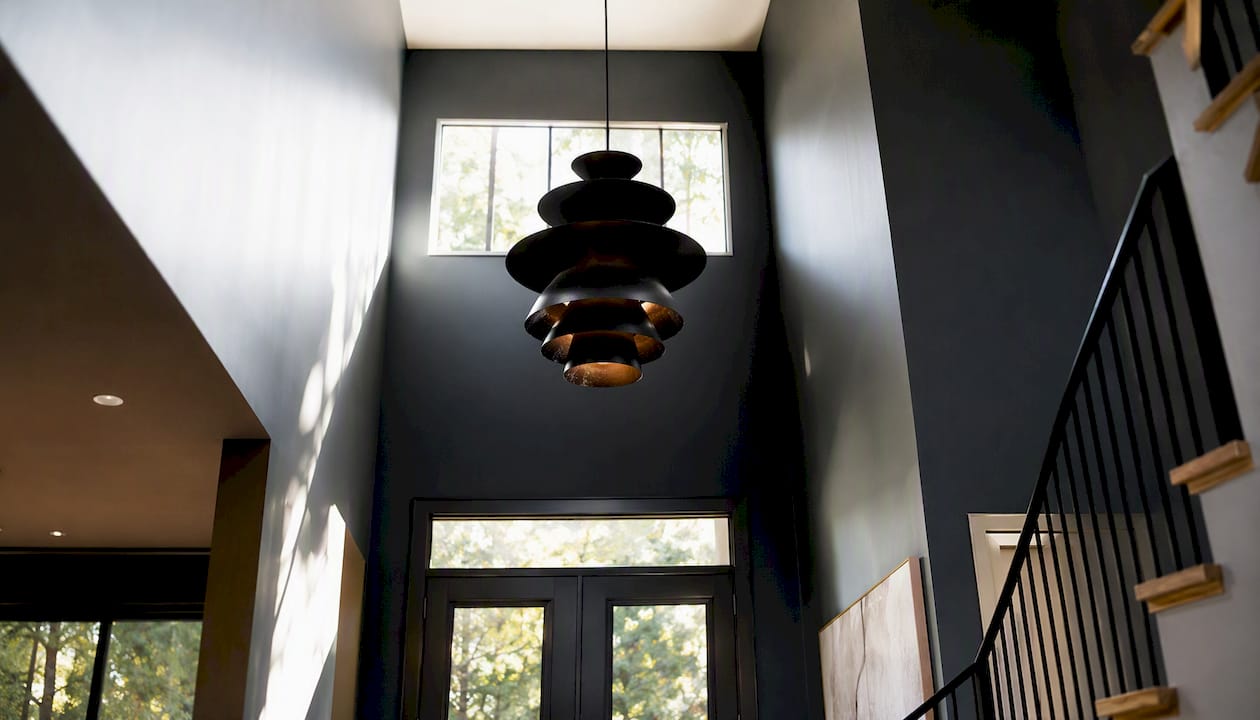
A two-story foyer calls for a chandelier or multi-tier pendant centered on the front door axis. Position it so the bottom of the fixture clears 7 feet from the floor, but let it fill the vertical space generously above that. Crystal chandeliers read as classic and formal; sculptural pendants in matte black or brushed brass feel more contemporary. Either way, scale up: a foyer chandelier should feel slightly larger than you think is right.
Stairwell
The stairwell is one of the trickiest placements in a tall home. A pendant or chandelier hung at the top of the stair void needs to clear the highest step by at least 7 feet. Multi-tier clusters with staggered drops work well here because they fill the vertical void without requiring one enormous fixture. Keep the sightline in mind: the fixture should be visible and beautiful from both the top and the bottom of the stair.
Living and dining rooms
- In a great room with vaulted ceilings, a large chandelier or a cluster of pendants at the center creates a natural gathering point.
- Over a dining table, symmetry matters. Center the fixture on the table, not the room, and size it so it’s roughly half to two-thirds the table’s width.
- For open-plan living areas, consider two or three pendants in a linear arrangement rather than one oversized chandelier.
Kitchen island
A pair of pendants spaced evenly over the island brings focused task light and a clean, modern look. Linear suspensions work equally well and feel more architectural. Keep the bottom of the fixture 28–36 inches above the counter.
Lofted and vaulted spaces
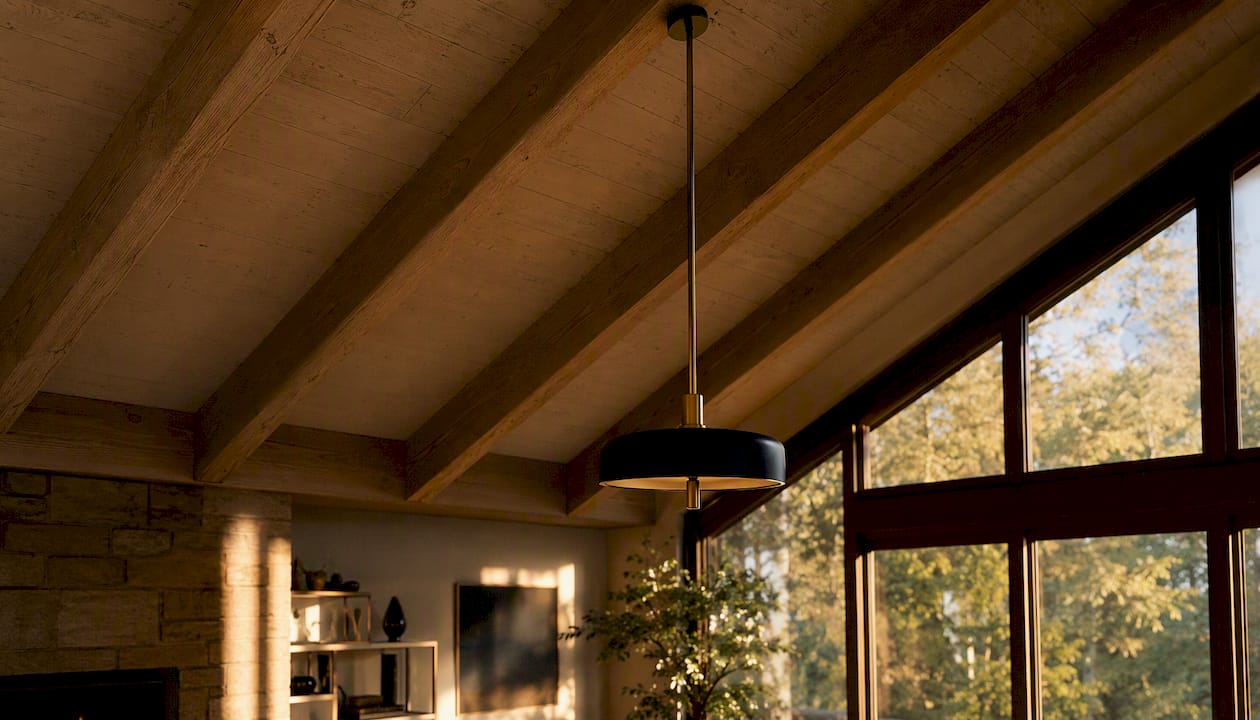
Vaulted ceilings with exposed beams or angled planes need fixtures that can adapt to the slope. Slope-ceiling adapters and extended downrods let you hang a pendant or chandelier plumb even on an angled surface. Coordinating your lighting choices with other design elements, like the style of your interior doors and architectural details, helps the whole room feel intentional rather than assembled piece by piece.
What should you check before buying a high-ceiling fixture?
Work through this list before placing an order. It takes 15 minutes and saves you from a costly return or a delayed installation.
- Measure the room: Length, width, and ceiling height. Calculate your target fixture diameter using the length + width formula above.
- Calculate the drop: Use the hang-height formula to determine exactly how long the rod, chain, or cord needs to be. Add a few inches of margin.
- Check fixture weight: Note the fixture’s listed weight and confirm your ceiling box can handle it.
- Confirm canopy and adapter compatibility: Does the canopy fit your ceiling type (flat, sloped, coffered)?
- Verify dimmer compatibility: LED fixtures often specify compatible dimmer types. Check before buying a separate dimmer.
- Review lumens and CRI: Confirm the output is sufficient for the room size and ceiling height, and that CRI is 90+.
- Read the warranty and return policy: Know the return window and whether oversized items are returnable before you order.
- Check lead times and shipping to Canada: Freight shipments for large fixtures can take several weeks. Confirm before scheduling your electrician.
Red flags to watch for:
- No listed drop length or maximum rod extension
- Missing CSA or UL certification
- Fixture diameter under 18 inches for a room larger than 12 × 12 feet
- No dimmer compatibility information on the product page
- Vague or missing weight specifications
Estimated cost ranges in Canada
Installation timelines typically run 2–6 weeks from purchase to fully installed fixture: 1–3 weeks for delivery (longer for freight), plus scheduling an electrician, which can add another 1–2 weeks depending on your area.
Curated Montreal Lighting & Hardware picks for tall ceilings
These fixtures were selected for their adjustable suspension, LED output, dimmability, and availability to Canadian shoppers through Montreal Lighting & Hardware.
- Sonneman Light Guide Ring LED Pendant: A clean, circular LED pendant with a luminous ring form. Integrated LED, dimmable, and available with extension options for tall ceilings. Its minimal profile reads beautifully in modern lofts and contemporary dining rooms.
- Sonneman Liquid LED Pendant: A sculptural, organic form with integrated LED output suited to spaces where you want a pendant that feels like art. Works well in tall living rooms and open-plan areas where the fixture is visible from multiple angles.
- Sonneman Grapes LED Pendant: A multi-point decorative pendant with individual LED spheres arranged in a cluster. The staggered form fills vertical space naturally, making it a strong choice for two-story foyers and stairwells.
- Crystorama Fulton Six Light Ceiling Mount: A larger multi-light fixture with detailed specs available on the Fulton product page. Its six-light configuration provides generous output and visual weight for grand dining rooms or great rooms.
- Crystorama Hulton Two Light Ceiling Mount: A more restrained option for spaces that need a decorative fixture without overwhelming scale. Spec details, including dimensions and mount type, are listed on the Hulton product page.
- Savoy House and Maxim collections: Both brands in the Montreal Lighting & Hardware catalog include chandeliers and pendants with multi-light configurations and finish options suited to tall residential spaces.
Pro Tip: When comparing drop kits across fixtures, check both the standard included rod length and the maximum extension available as an add-on. Some pendants ship with a 6-inch rod but can be extended to 120 inches with the right kit. Confirm that extension kit availability before you buy, especially for ceilings above 12 feet.
Why Montreal Lighting & Hardware is a trusted source for tall-ceiling fixtures
Montreal Lighting & Hardware specializes in high-quality lighting for both residential and commercial spaces, with a curated catalog that includes Sonneman, Crystorama, Savoy House, and Maxim. For shoppers planning a tall-ceiling installation, the combination of detailed product pages, Canadian shipping, and a trade program makes the process considerably smoother.
- Detailed product pages: Each fixture listing includes dimensions, drop length, weight, and certification details, so you can run through the pre-purchase checklist without hunting for specs elsewhere.
- CSA/UL-listed products: The catalog includes fixtures with certifications appropriate for Canadian installations.
- Trade program: Design professionals and contractors can access exclusive pricing and dedicated support. If you’re working with an interior designer or a contractor on a larger project, the trade desk is worth a conversation.
- Canadian showroom access: Seeing a fixture in person before committing to a large purchase is genuinely useful, particularly for statement pieces where scale and finish matter.
- Shipping and returns: Montreal Lighting & Hardware offers Canadian shipping with clear policies on returns and lead times, including for larger items that require freight handling.
- Warehouse sale pricing: Periodic sale events offer up to 50% off select fixtures, making it possible to find designer-quality pieces at accessible price points.
What the right fixture actually does for a tall room
There’s a tendency to treat high-ceiling lighting as a purely technical problem: calculate the drop, check the box rating, hire an electrician. Those steps matter. But the more interesting question is what a well-chosen fixture does for how a room feels.
A tall room without a strong light anchor tends to feel unfinished, even when the furniture and finishes are beautiful. The eye travels upward and finds nothing to hold onto. A correctly scaled chandelier or pendant cluster solves that problem not by filling the ceiling but by creating a visual center of gravity that pulls the room together. The ceiling height becomes an asset rather than a challenge.
The rooms that work best at scale are the ones where the lighting was planned as part of the architecture, not added afterward. Measure carefully, shortlist two or three fixtures, check the extension kit options, and then reach out to the Montreal Lighting & Hardware team for guidance. The showroom and trade desk are there for exactly this kind of project.
Light up your tall space with the right fixture
Montreal Lighting & Hardware’s collection of chandeliers and pendants is built for rooms that deserve something special. Whether you’re drawn to the sculptural form of the Sonneman Light Guide Ring LED Pendant or the decorative cluster of the Grapes LED Pendant, you’ll find fixtures with the specs, certifications, and extension options that tall ceilings actually require.

Browse the full catalog at Montreal Lighting & Hardware, or contact the trade desk directly if you’re working on a larger residential or commercial project. Canadian shipping, showroom access, and trade pricing are all available.
Sources
- High Ceiling Lighting Ideas: Best Fixtures, Heights & Tips
- Lighting a house with super high ceilings | Houzz Forum
Recommended
- Hulton Two Light Ceiling Mount | Crystorama – Montreal Lighting & Hardware
- Fulton Six Light Ceiling Mount | Crystorama – Montreal Lighting & Hardware
- Dakota Eight Light Ceiling Mount | Crystorama – Montreal Lighting & Hardware
- Calypso Six Light Ceiling Mount | Crystorama – Montreal Lighting & Hardware
