


A layered set of a low-glare recessed ambient light, vertical vanity task lights, and a soft accent or night-mode source makes most small bathrooms feel larger, work better, and look more polished. That three-part recipe is the foundation of every good small bathroom lighting plan, and the rest comes down to specs and fixture choices.
Before you shop, run through this quick checklist:
- Layer your light. Plan for ambient (ceiling), task (vanity/mirror), and at least one accent or night source.
- Check the ratings. Any fixture near a shower or tub needs a wet or damp rating (IP44 minimum for ceiling fittings).
- Prioritize CRI and color temperature. Look for CRI 90+ and a warm 2700K–3000K range for flattering, accurate light.
- Go dimmable. A dimmer transforms a single bathroom into a bright morning space and a relaxed evening retreat.
- Measure your ceiling height and wall clearance before ordering any fixture.
The sections below walk through each layer, fixture type, and spec in detail, with Canada-focused buying guidance and product examples from Montreal Lighting & Hardware.
Key Takeaways
Layered lighting with ambient, task, and accent sources is the single most effective approach to making a small bathroom feel larger and work better.
| Point | Details |
|---|---|
| Layer your lighting | Combine ambient, task, and accent sources — a single overhead fixture leaves both function and perceived space on the table. |
| Prioritize CRI and color temperature | Choose CRI 90+ and 2700K–3000K for accurate, flattering light that makes finishes and skin tones look their best. |
| Match IP ratings to zones | Use IP44-rated fittings throughout the ceiling as a practical minimum to cover wet and damp zones safely. |
| Go dimmable | Confirm fixture and dimmer compatibility before buying — dimmable LEDs give you full flexibility from bright mornings to relaxed evenings. |
| Montreal Lighting & Hardware | Carries Sonneman, Savoy House, and Maxim fixtures for small bathrooms in Canada, with trade pricing and showroom access. |
Table of Contents
- Why does layered lighting make a small bathroom feel bigger?
- Which fixture types work best in a small bathroom?
- How should you position vanity and mirror lighting?
- What specs should you check before buying bathroom light fixtures?
- What layout combos make a small bathroom feel more spacious?
- What safety rules apply to bathroom lighting in Canada?
- Your shopper’s checklist for choosing small-bathroom lighting
- Where can you buy small-bathroom lighting fixtures in Canada?
- Installation tips for Canadian homes
- Light up your small bathroom with the right fixtures
- Sources
Why does layered lighting make a small bathroom feel bigger?
A single overhead light is the most common mistake in compact bathrooms. It casts flat, shadowless light that flattens surfaces and makes the room feel like a utility closet rather than a retreat. Layering changes that dynamic completely.
Each layer has a distinct job. Ambient light fills the room with a soft, even glow so you can move safely. Task light at the vanity gives you the shadow-free clarity you need for grooming. Accent light adds depth and warmth, drawing the eye to textures and finishes. Night-mode light (a low-level toe-kick or nightlight strip) lets you navigate at 2 AM without blinding yourself.
Together, these layers create the impression of depth and dimension. Surfaces catch light from multiple angles, the mirror reflects it back, and the room reads as larger than its square footage. Toronto renovation guidance specifically recommends this layered approach for small bathrooms, noting that CRI 90+ with a warm color temperature around 2700K–3000K renders finishes and skin tones accurately, which makes the whole space feel more considered.
Contractor and designer guidance is consistent on this point: homeowners who rely on one ceiling light are leaving both function and perceived size on the table. A layered plan costs little more to install and pays off every single morning.
Pro Tip: When planning your layers, think about what you need the room to do at different times of day. A bright, crisp task light for the morning routine and a warm, dimmed ambient glow for a bath at night are not competing goals — a good dimmer and two circuits make both possible.
Which fixture types work best in a small bathroom?
The right fixture for a small bathroom is one that delivers its layer of light without eating into the visual space of the room. Here is a practical catalog of the types that consistently perform well, along with what to watch for in each.
- Flush-mount ceiling fixtures. The go-to ambient source for low ceilings. They sit tight to the ceiling, leave no dead air above them, and spread light evenly. Watch for the diameter: a fixture wider than roughly one-third of the shortest ceiling dimension can feel heavy. The Sonneman Pi LED Surface Mount is a slim, low-profile option that works well here.
- Recessed downlights. Ideal when you have ceiling depth to work with (typically 4–6 inches of clearance above the drywall). They disappear into the ceiling and keep the room feeling open. In wet zones, specify shower-rated trims with the correct IP rating.
- Vertical wall sconces flanking the mirror. The single most effective upgrade for vanity task lighting in a small bathroom. Mounted at roughly cheekbone height (more on this below), they eliminate the under-eye shadows that a top-bar fixture creates. Narrow sconces with a small footprint are ideal for tight walls.
- LED bath bars. When flanking sconces are not possible, a wide, diffused bath bar above the mirror spreads light more evenly than a narrow strip. The Sonneman SQ-bar LED Bath Bar is a shallow-profile option suited to narrow vanities.
- Backlit LED mirrors and lighted medicine cabinets. These combine task lighting and storage in one footprint, which is a genuine space-saving win. Practical small-bathroom guidance consistently recommends them as alternatives to bulkier separate fixtures.
- LED tape and undercabinet strips. Best used as accent or night-mode light under a floating vanity, inside a niche, or along a toe-kick. They add warmth and depth without adding bulk.
Pro Tip: For shower zones, never assume a standard downlight is safe. Check the fixture’s IP rating against the zone it will occupy — a wet-rated fitting is not optional, it is a code requirement. More on zones in the safety section below.
How should you position vanity and mirror lighting?
Placement matters as much as fixture choice. The goal is to light your face from the sides and front, not from above, so shadows fall away from your features rather than into them.
- Mount flanking sconces at approximately face level. This puts the light source roughly level with your face, which is where it does the most work.
- Space flanking sconces at a comfortable width apart, about shoulder-width. Closer than that and the light converges too sharply; wider and the coverage gets uneven toward the center of the mirror.
- If you can only use an over-mirror bar, choose one that is at least as wide as the mirror itself and position it so the bottom of the fixture sits no more than a few inches above the top of the mirror. A wide, diffused bar like the Sonneman Vanity LED Bath Bar spreads light more gently than a narrow strip.
- When wall space is too limited for any separate fixture, a backlit LED mirror or a lighted medicine cabinet is your best option. The Sonneman Vanity LED Mirror Kit integrates task lighting directly into the mirror surface, freeing up wall space entirely.
- Avoid recessed downlights as the sole vanity source. A single downlight directly above the mirror creates harsh top-down shadows on the face. If recessed is your only ambient option, supplement it with a mirror-integrated source.
Pro Tip: If your bathroom has a medicine cabinet with a mirrored door, consider swapping it for a lighted version. You gain task light, storage, and a cleaner wall in one move — a practical triple win for tight spaces. A recessed mirror cabinet that sits flush with the wall also frees up several inches of depth.
What specs should you check before buying bathroom light fixtures?
Getting the fixture shape right is half the job. The other half is making sure the numbers on the spec sheet match what your bathroom actually needs. Here are the specs that matter most.
- CRI (Color Rendering Index). A CRI of 90 or above renders skin tones, tile colors, and finishes accurately. Below 80, colors shift and the room can look washed out or sickly.
- Color temperature. The 2700K–3000K range produces a warm, flattering light that suits most bathrooms. Cooler temperatures (4000K+) can feel clinical and unflattering on skin.
- Lumens. For a small bathroom, choose a total lumen output that suits your ceiling height, surface reflectance, and overall lighting layers, though the right number depends on ceiling height, surface reflectance, and how many layers you are running.
- Dimmability. Not all LED fixtures are compatible with standard dimmers. Check that both the fixture and the dimmer switch are rated for each other — mismatched combinations cause flickering or buzzing.
- Wet/damp/IP rating. Fixtures inside a shower enclosure need a wet rating. Fixtures within a certain distance of the tub or shower (the exact zone depends on your layout) need at minimum a damp rating. IP44 is a practical minimum for ceiling fittings throughout a small bathroom.
- Beam angle. A narrow beam (under 25°) concentrates light and creates hotspots. For ambient and vanity use, a wider beam (40–60°) spreads light more evenly across a small space.
| Spec | What it affects | Recommended value |
|---|---|---|
| CRI | Accuracy of color and skin-tone rendering | 90+ |
| Color temperature | Warmth and flattery of the light | 2700K–3000K |
| IP rating (ceiling) | Safety near water | IP44 minimum |
| Beam angle | Even spread vs. hotspots | 40–60° for ambient |
| Dimmability | Flexibility across tasks and moods | Confirm fixture + dimmer compatibility |
Bathroom zone and IP guidance explains that using IP44-rated fittings throughout the ceiling of a small bathroom is a practical way to avoid zone confusion, since the ceiling area often falls within Zone 1 or Zone 2 depending on the shower layout.
What layout combos make a small bathroom feel more spacious?
A few well-chosen combinations do more for a small bathroom than a single expensive fixture. These four pairings are practical, copy-ready, and grounded in how light actually behaves in compact spaces.
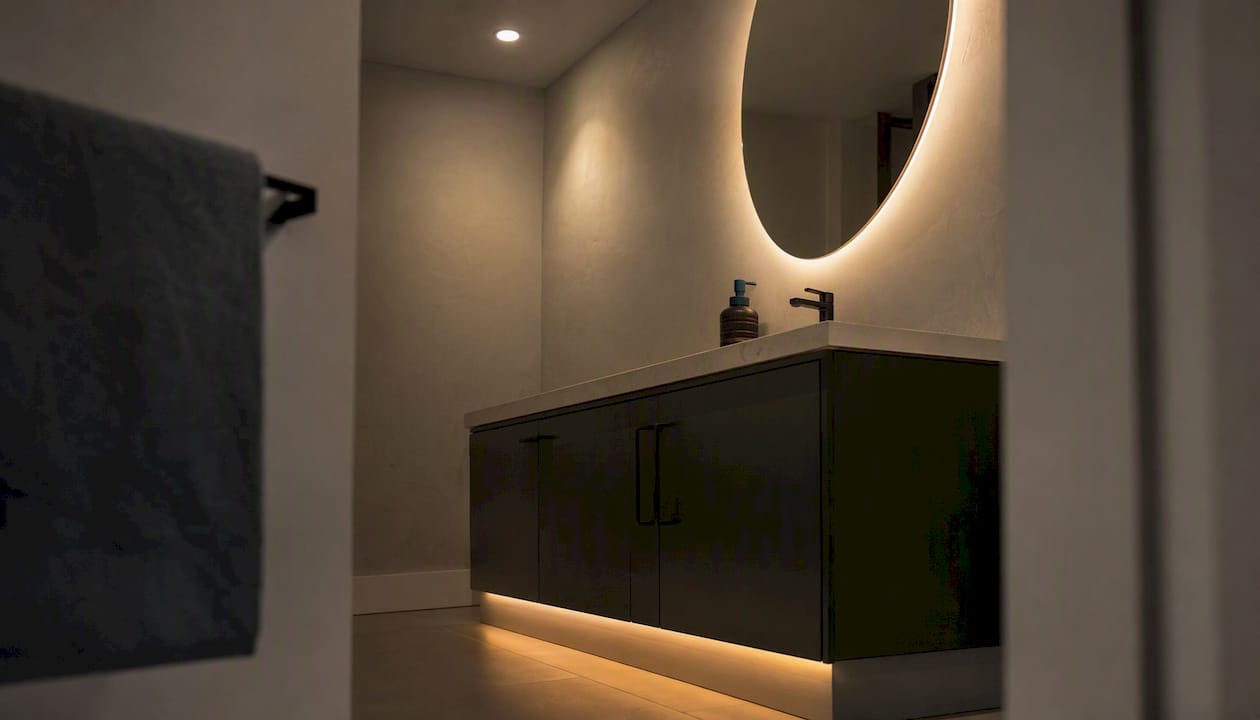
Recessed ambient + backlit mirror + toe-kick LED strip. This is the designer’s go-to for very small bathrooms. The recessed downlight handles ambient, the backlit mirror covers task, and the toe-kick strip adds a warm glow at floor level for night use. The result is three distinct light levels from fixtures that take up almost no visual space.
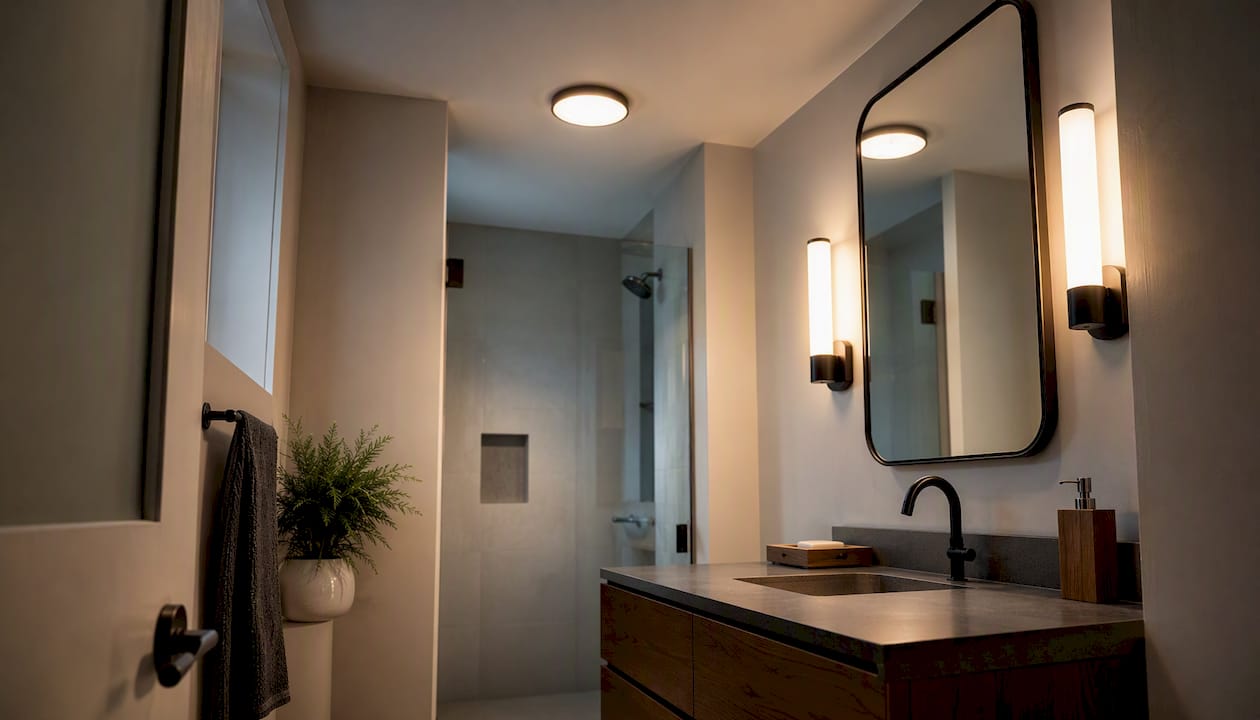
Flush-mount ceiling + flanking vanity sconces. When ceiling depth is limited and recessed is not possible, a slim flush-mount paired with two narrow sconces flanking the mirror covers both ambient and task cleanly. The flush-mount keeps the ceiling uncluttered, and the sconces do the heavy lifting for face-level light.
Lighted medicine cabinet + single recessed downlight. For bathrooms where wall space is genuinely scarce, a lighted medicine cabinet consolidates storage and task light into one unit. One recessed downlight handles ambient, and the cabinet handles everything else. Space-saving bathroom fittings guidance notes that recessed and integrated fixtures are among the most effective tools for keeping small rooms feeling open.
Bath bar + undercabinet tape light. A wide bath bar above the mirror provides diffused task light, while a short run of LED tape under a floating vanity adds warmth and the visual impression of the vanity hovering above the floor. That floating effect makes the floor plane read as larger.
A designer trade tip worth keeping: place any light source so it reflects off a light-colored or glossy surface — a white tile wall, a large mirror, a polished chrome fixture. Reflected light multiplies the perceived brightness of the room without adding more fixtures, and it softens the overall quality of the light at the same time.
Pro Tip: For low ceilings (under 8 feet), always choose a flush-mount or recessed fitting over a semi-flush or pendant. Even a few inches of hanging depth can make a low ceiling feel oppressive. The Sonneman Pi LED Surface Mount is designed specifically for this scenario.
What safety rules apply to bathroom lighting in Canada?
Wet-rated fixtures and a licensed electrician are non-negotiable for any bathroom lighting installation in Canada. This is not a suggestion — it is a safety and code requirement.
Bathroom zone and IP rating guidance explains the zone system: Zone 0 is inside the bath or shower itself, Zone 1 is directly above it, and Zone 2 extends outward from there. Each zone has a minimum IP rating requirement, and fixtures must meet or exceed that rating for the zone they occupy. In practice, specifying IP44 for all ceiling fittings in a small bathroom is a straightforward way to cover most layouts without needing to measure zones precisely.
Here are the key action items before and during installation:
- Hire a licensed electrician. In Canada, bathroom electrical work must comply with the Canadian Electrical Code (CEC). A licensed electrician knows the local requirements and will pull the necessary permits.
- Check the fixture’s IP rating on the spec sheet before purchasing. Confirm it matches the zone where you plan to install it.
- Ask your electrician about circuit separation. Running vanity lighting and ambient lighting on separate circuits (or at minimum separate dimmer switches) gives you independent control over each layer.
- Confirm dimmer compatibility before the electrician installs the switch. Bring the fixture’s spec sheet to the appointment.
- Budget for the install. A basic bathroom lighting installation by a licensed electrician in Canada typically runs in the range of a few hundred dollars for straightforward fixture swaps, with more complex rewiring or new circuit work adding to that cost. Get two or three quotes for accurate local pricing.
A practical checklist from a Canadian renovation resource reinforces the importance of using recessed, shower-rated downlights in wet zones and selecting dimmable LEDs for flexible light levels throughout the room.
Your shopper’s checklist for choosing small-bathroom lighting
Before you add anything to your cart, run through this list. Each item takes less than a minute to check and will save you a return or a call to an electrician.
- Measure your ceiling height and note any obstructions (exhaust fan, existing junction boxes). This tells you whether recessed or flush-mount is realistic.
- Identify your zones. Note which fixtures will be near the shower or tub. Those need a wet or damp rating.
- Confirm CRI 90+ on the spec sheet. This is the single spec most shoppers overlook, and it has the biggest impact on how the room looks and feels.
- Check color temperature. Stay in the 2700K–3000K range for a warm, flattering result.
- Verify dimmer compatibility. If you want a dimmer (and you should), confirm the fixture supports it before buying.
- Note the finish and make sure it coordinates with your faucets and hardware. Mixing brushed nickel and polished chrome in a small space reads as unfinished.
- Set a budget tier before you browse:
- Entry tier (under $100 per fixture). You will find functional flush-mounts and basic bath bars here. LED efficiency is good, but CRI and dimming options may be limited. Fine for secondary fixtures.
- Mid tier ($100–$300 per fixture). This is where CRI 90+, dimmable LEDs, and better finishes become consistent. Most homeowners land here for vanity and ambient fixtures.
- Designer tier ($300+ per fixture). Brands like Sonneman and Savoy House live here. The difference is in the quality of the diffusion, the precision of the color temperature, and the longevity of the finish. Worth the investment for the vanity, where you spend the most time.
Where can you buy small-bathroom lighting fixtures in Canada?
Montreal Lighting & Hardware carries a curated selection of fixtures suited to small bathrooms, with options across all three budget tiers and a trade program for design professionals and contractors.
Here are some specific lines worth considering:
- Sonneman SQ-bar LED Bath Bar. A shallow, linear bath bar designed for narrow vanities. Its diffused LED strip spreads light evenly without hotspots, and the slim profile keeps the wall feeling open. Available at Montreal Lighting & Hardware.
- Sonneman Vanity LED Mirror Kit. Integrates task lighting directly into the mirror, freeing up wall space and eliminating the need for a separate vanity fixture. A strong choice when flanking sconces are not feasible. See it at Montreal Lighting & Hardware.
- Sonneman Pi LED Surface Mount. A low-profile flush-mount that works for ambient light in rooms with ceilings under 8 feet. Its clean geometry suits both contemporary and transitional bathrooms.
- Savoy House and Maxim fixtures. Both brands offer vanity bars and wall sconces with strong CRI ratings and a range of finishes. Worth browsing if you want something with a warmer, more traditional character.
Canadian shoppers can browse the full collection online, check real-time stock, and access technical spec sheets directly on the product pages. The trade program offers exclusive pricing for designers and contractors, and the showroom provides hands-on access to fixtures before you commit.
Pro Tip: If you are working with a designer or contractor, ask them about Montreal Lighting & Hardware’s trade program. Exclusive pricing on designer brands like Sonneman can make a meaningful difference on a full bathroom renovation budget.
Installation tips for Canadian homes
Canadian housing stock covers a wide range of construction eras, and the installation approach that works in a newer build may not translate directly to a 1960s bungalow or a condo with a concrete ceiling.
Older homes often have aluminum wiring in circuits installed before the mid-1970s. Aluminum wiring requires specific connectors and compatible fixtures. A licensed electrician will identify this immediately and specify the correct approach. Never assume a standard fixture swap is safe without checking.
Condos and multi-unit buildings frequently have concrete or steel-framed ceilings that make recessed installation complex or impossible without a permit and structural review. In these cases, flush-mount and surface-mount fixtures are the practical path. The Sonneman Pi LED Surface Mount is designed for exactly this scenario.
Exhaust fan placement matters more than most homeowners realize. In a small bathroom, the fan and the ambient light fixture often compete for the same ceiling real estate. Combination fan-light units are a space-saving option, but check that the light component meets your CRI and lumen requirements before choosing one. Many combination units use lower-quality light sources that underperform on both counts.
GFCI protection is required for all bathroom receptacles and, in many jurisdictions, for bathroom lighting circuits as well. Your electrician will confirm what applies to your specific installation under the Canadian Electrical Code. Mirror cabinet guides for small bathrooms also note that integrated mirror cabinets with built-in lighting often require a dedicated circuit connection, which is worth confirming with your electrician before purchase.
A note from Montreal Lighting & Hardware
One thing we see consistently: homeowners spend time choosing the right fixture and then underinvest in the dimmer and the finish coordination. A warm-white LED at 2700K looks completely different on a brushed brass trim ring versus a matte black one, and neither looks its best at full brightness. Dimming down to about 70% is where most quality LEDs find their most flattering output. If you are planning a bathroom refresh and want to get the layering right the first time, our trade program and showroom team are there to help you work through the fixture selection, finish pairing, and installer referrals in one conversation.
Light up your small bathroom with the right fixtures
Soft, layered light transforms a compact bathroom from purely functional to genuinely pleasant. Montreal Lighting & Hardware carries the fixtures to make that happen, from the Sonneman SQ-bar LED Bath Bar for narrow vanities to the full Sonneman collection of surface mounts, bath bars, and integrated mirror kits. Whether you are outfitting a single powder room or planning a full renovation, the online store has real-time stock, detailed spec sheets, and trade pricing for professionals.

Browse the full bathroom lighting collection at Montreal Lighting & Hardware and find the fixtures that fit your space, your style, and your budget. Trade clients can apply for exclusive pricing directly on the site.
Sources
- Toronto Bathroom Lighting Guide 2025 | JG Contracting & Design Co.
- Bathroom Lighting Zones & IP Ratings | squote
- 11 Small Bathroom Lighting Ideas – Tips for Better Lighting
