


Most Canadian living rooms need moderate to bright total lumens appropriate for general lighting, bedrooms need less, and kitchens require more for general light (with even higher levels for task zones). The formula behind every one of those numbers is simple: room square footage multiplied by recommended foot-candles equals your total lumen target. This guide follows Natural Resources Canada’s Energy Star lighting guidance and IES standards, and yes, tall ceilings or dark walls will push your number higher.
TL;DR:
- Rooms with higher ceilings or dark walls may require 10 to 20 percent more total lumens than standard calculations to achieve the desired brightness.
- Key lighting zones, such as kitchen counters or reading nooks, should be lit with separate fixtures to ensure adequate brightness and avoid pooling light.
- LED bulbs typically output between 800 and 1,600 lumens, with color temperature and CRI ratings influencing mood and color accuracy.
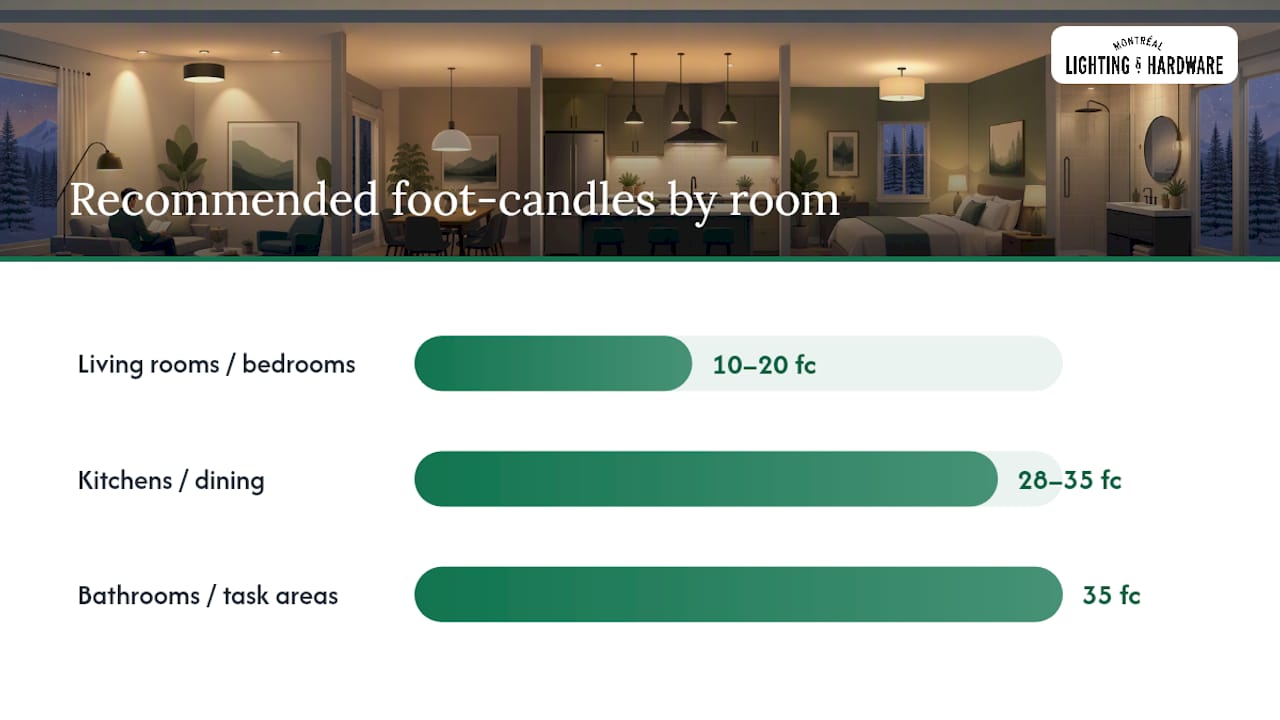
- Using a foot-candle target of 10 to 20 fc for living spaces and bedrooms, or 28 to 35 fc for kitchens and bathrooms, helps determine precise lumen needs.
- Adjusting calculated lumens based on wall and ceiling colors, as well as ceiling height, ensures lighting feels natural and appropriate for the space.
Table of Contents
- Lumens Per Room: A Quick Reference Chart
- How Do You Calculate the Exact Lumens You Need?
- Does Ceiling Height or Wall Color Change Your Target?
- What Should You Look For on a Bulb or Fixture Label?
- Turning Your Lumen Target Into an Actual Fixture Order
- Why the “Right” Number Still Comes Down to Feel
- Get Help Matching Your Lumen Target to the Right Fixtures
- Where These Recommendations Come From
- Sources
Lumens Per Room: A Quick Reference Chart
Before you reach for a calculator, it helps to know roughly where you’re headed. Think of these ranges as a starting point, not a rulebook carved in stone. Every room has its own personality, and the right total often sits somewhere between “cozy” and “bright enough to find your keys.”
Here’s what we recommend as a baseline for total lumens per room, drawn from Canadian lighting guidance and cross-checked against practical room-by-room presets used across the industry:
- Living room: 1,500 to 3,000 lumens
- Bedroom: 1,000 to 2,000 lumens
- Kitchen (general light): 3,000 to 4,500 lumens
- Kitchen (task areas, counters and stove): 4,500 to 8,000 lumens
- Bathroom: 2,000 to 4,000 lumens
- Dining room: 3,000 to 4,000 lumens
- Home office: 3,000 to 6,000 lumens
- Garage or workshop: 8,000 to 10,000 lumens
- Hallway: 500 to 1,500 lumens
Pro Tip: If you’re staring at the low end versus the high end of a range and feeling unsure, let the room’s job decide. A reading nook or open-concept great room pulls toward the top; a quiet bedroom meant purely for winding down can sit comfortably at the bottom.
Smaller rooms and spaces meant for relaxing, like a primary bedroom or a den, lean toward the lower end of their range. Larger rooms, task-heavy spaces, and anything finished in darker tones should lean higher. If you’re working with an open-concept condo, don’t try to light the whole floor plan as one unit. Break it into zones instead: your kitchen island gets its own task allowance, your living area gets its own ambient target, and a small reading corner gets a dedicated lamp. Add those zone totals together, and you’ll land on a far more accurate number than trying to apply one blanket figure to 900 square feet of open space.
How Do You Calculate the Exact Lumens You Need?
The lumen method is the same formula lighting designers have used for decades, and it works whether you’re lighting a nursery or a two-car garage: square footage × recommended foot-candles = total lumens. A foot-candle is simply one lumen landing on one square foot of surface, which is why the two figures multiply so cleanly.
IES illuminance standards set foot-candle targets by activity, and Canadian guidance from Natural Resources Canada uses those same benchmarks. Here’s the general breakdown:
| Room type or activity | Recommended foot-candles |
|---|---|
| Living rooms and bedrooms | 10 to 20 fc |
| Kitchens and dining rooms | 28 to 35 fc |
| Bathrooms and task areas | 35 fc |
Follow this workflow for any room in your home:
- Measure the room’s length and width, then multiply for square footage.
- Pick a foot-candle target from the table above based on how the room is used.
- Multiply square footage by foot-candles to get total lumens.
- Divide that total by the lumen output of a single bulb or fixture to find how many you need.
- Adjust the placement so light spreads evenly rather than pooling in one corner.
Worked example 1: a 12-by-12 living room. That’s 144 square feet. At a relaxed 15 foot-candles, you get 144 × 15 = 2,160 lumens. Split across three 800 to 1,600 lumen LED fixtures, you’d land comfortably in range with two 1,000 lumen bulbs and one smaller accent lamp.
Worked example 2: a 150 square foot kitchen. Kitchens run brighter because they’re workspaces. At 35 foot-candles, 150 × 35 = 5,250 lumens for the whole room. That number usually splits between general ceiling light and dedicated task lighting over counters, which is why kitchens often need a layered approach rather than one big fixture.
If you’re working from a lux measurement instead of foot-candles, the conversion is straightforward: 1 foot-candle equals roughly 10.76 lux. So a 300 lux kitchen target is close to 28 foot-candles, right in line with the range above. A Canadian lumens-per-square-foot calculator can double-check your arithmetic if you’d rather not do the math by hand.
Does Ceiling Height or Wall Color Change Your Target?
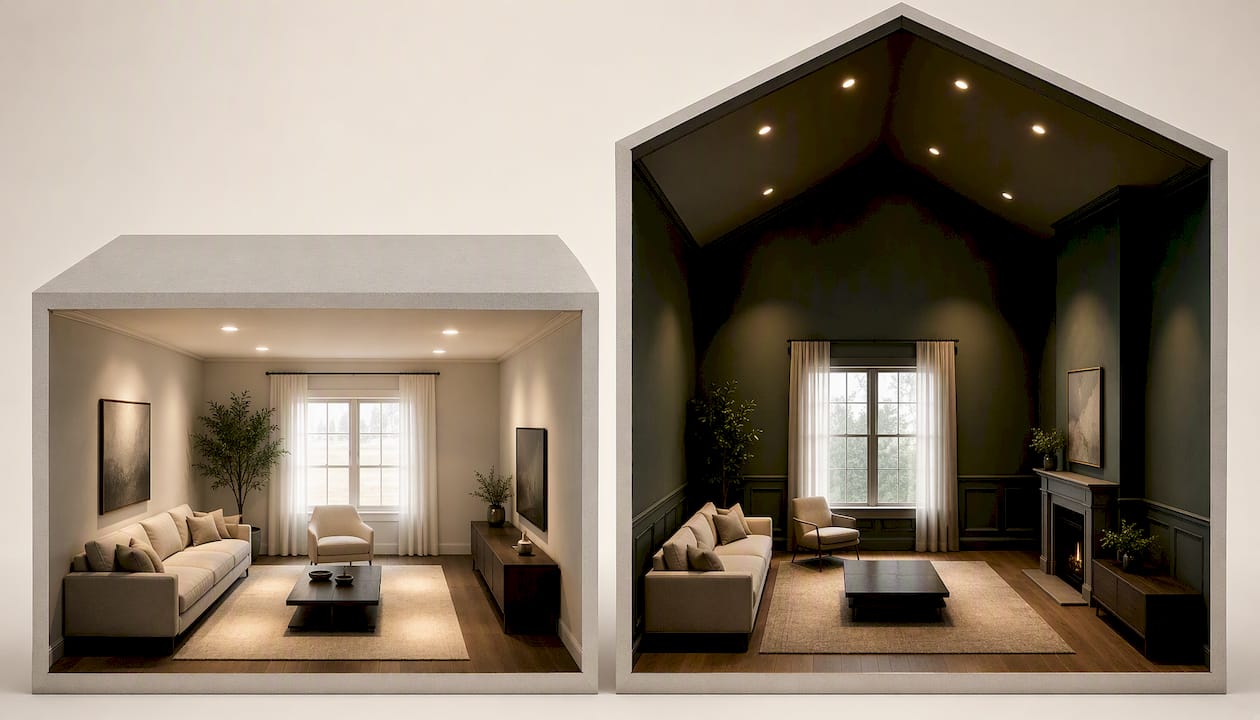
Yes, and this is where a lot of homeowners get caught out after installing fixtures that seemed like plenty on paper. Standard residential ceilings sit around 8 to 9 feet, and the ranges above assume that baseline.
Once you’re building or renovating a space with ceilings 12 feet or taller, light has farther to travel before it hits a surface, and it spreads thinner along the way. Natural Resources Canada’s guidance suggests bumping your total lumen target up by roughly 10 to 20 percent to compensate. A vaulted great room calculated at 3,000 lumens on paper might actually perform better closer to 3,600.
Wall and ceiling color matters just as much, sometimes more. Light-colored, glossy surfaces bounce lumens around a room, while dark or matte finishes absorb them.
- Light, satin-finish walls: no adjustment needed, use your base calculation.
- Medium-toned or matte walls: increase your target by roughly 1.5 to 2 times.
- Deep charcoal, navy, or matte black walls: some rooms need 3 to 4 times the base lumens to feel equally bright.
Beam spread plays a role too. A narrow-beam recessed downlight concentrates its lumens into a tight circle, which means you need more fixtures, or higher-output ones, to cover the same floor area evenly than you would with a wide-beam flush mount. Manufacturer candela charts show this clearly: tighter beams need higher nominal lumens to achieve the same surface brightness, a detail worth checking before you finalize a recessed lighting plan.
That’s nearly double the “textbook” number. If you’re choosing a paint color alongside your lighting plan, it’s worth looking at how trim and door color affects perceived brightness in the same room.
What Should You Look For on a Bulb or Fixture Label?
Every bulb package carries four numbers worth reading before you buy: lumens, Kelvin, CRI, and watt-equivalent. Lumens tell you brightness. Kelvin tells you color, warm or cool. CRI tells you how accurately colors render under that light. Watt-equivalent is mostly a legacy comparison for anyone still thinking in incandescent terms.
Most LED bulbs sold today output somewhere between 800 and 1,600 lumens each, and Energy Star guidance recommends checking the label for dimmability if you plan to use a dimmer switch, since not every LED dims smoothly. A four-light fixture using 800 lumen bulbs delivers 3,200 lumens total, which happens to land right in the sweet spot for a mid-size living room.
Color temperature changes the mood as much as the math:
- 2,700K to 3,000K for living rooms and bedrooms, a warm, relaxed glow.
- 3,000K to 4,000K for kitchens and bathrooms, crisp enough for tasks without feeling clinical.
- CRI 80 or higher anywhere you care about accurate color, especially kitchens, bathrooms, and closets.
Pro Tip: Don’t rely on one fixture to do every job. Layer ambient light (ceiling fixtures), task light (under-cabinet or reading lamps), and accent light (wall sconces or picture lights), then put the ambient layer on a dimmer. A dimmable ambient layer lets one calculated lumen target serve breakfast, homework, and movie night without rewiring anything. For bedroom-specific layering ideas, our guide to bedroom lighting walks through how to balance all three layers in a room that has to do double duty as a retreat and a workspace.
Turning Your Lumen Target Into an Actual Fixture Order
Doing the math is the easy part. Matching that number to real products, ones that fit your ceiling height, your décor, and your electrical setup, is where most homeowners stall out.
A lighting retailer stocks a range of pendants, flush mounts, and sconces built to hit these targets, often supported by trade programs for designers and contractors who need volume pricing and fast turnaround. Say your living room calculation lands at 3,200 lumens: that might translate to one statement pendant rated around 1,800 lumens paired with two wall sconces at 700 lumens each, giving you both the total output and a layered look instead of one flat ceiling glow.
Before you check out on any product page, confirm four things: the listed lumen output, the Kelvin color temperature, the CRI rating, and whether the fixture is dimmable. Mounting height and recommended spacing matter too, especially for pendants over islands or dining tables, since hanging height changes how evenly that light actually spreads across the surface below.
Why the “Right” Number Still Comes Down to Feel
Formulas get you close, but they don’t know that you read in bed every night or that your television sits in the darkest corner of the room. Designers routinely adjust calculated targets for exactly this reason. A TV nook often wants less ambient light than the math suggests, so glare doesn’t wash out the screen. A reading chair usually wants more direct task light than the room average, focused tightly rather than spread evenly.
Our advice: treat your calculated total as a floor, not a finished plan. Install with temporary bulbs first if you can, live with the room for a week, and adjust using dimmers or an added lamp before you commit to permanent fixtures. Measured light and comfortable light aren’t always the same thing, and the gap between them is where good lighting design actually happens.
— Montreal Lighting & Hardware
Get Help Matching Your Lumen Target to the Right Fixtures
A specialized lighting retailer can offer real inventory, trade pricing for design professionals, and showroom access so you can see lumen output and color temperature in person before you commit. Instead of hunting through overseas marketplaces with vague listings and slow shipping, you get fast delivery and product pages that list the exact specs this guide just walked you through.

If your living room math lands around 3,000 to 3,500 lumens, a fixture like the Light Guide Ring LED Pendant delivers strong, even ambient output as a centerpiece, while a Zoom LED Surface Mount works well in rooms where a pendant isn’t practical. Browse the current warehouse sale for up to 50 percent off, or reach out for specification help if you’d rather have someone confirm the fixture count before you buy.
Where These Recommendations Come From
The room-by-room ranges and formulas in this guide draw from established Canadian and industry standards, not guesswork:
- Natural Resources Canada’s Energy Star lighting guidance for foot-candle recommendations and ceiling-height adjustments.
- Illuminating Engineering Society (IES) illuminance standards, the reference point lighting designers use worldwide.
- Energy Star’s light bulb guidance for reading lumens, Kelvin, and CRI on packaging.
Run your numbers through one of these calculators before you order fixtures, especially if your room has an unusual ceiling height or an open floor plan that spans multiple lighting zones.
