


Set the junction box roughly between 60 and 72 inches from the finished floor to fixture center for hallways, living rooms, and entries. Bedside sconces sit lower, generally in a range that corresponds to about 30 to 36 inches above the mattress top. Vanity sconces run 60 to 66 inches. Always measure to the center of the fixture, not the top or bottom, and use the mattress or countertop as your reference point when the room’s furniture is already chosen.
TL;DR:
- Bedside sconces should be mounted 55 to 65 inches from the floor or 30 to 36 inches above the mattress to ensure functional and aesthetic lighting.
- Vanity sconces are best placed 60 to 66 inches from the floor, spaced 36 to 40 inches apart, with full-wall mirrors mounted higher.
- Hallway and living room sconces should be installed 60 to 72 inches from the floor, spaced 6 to 10 feet apart, and aligned with architectural features for visual rhythm.
- Kitchen and art sconces typically sit around 60 inches from the floor or 6 inches above the top of art frames for consistent illumination.
- For high-ceiling rooms, mounting heights should be adjusted upward to maintain proportion and visual balance, especially in rooms with vaulted ceilings.
Table of Contents
- Wall Sconce Height Quick Reference by Room
- How High Should a Bedside Sconce Be Mounted?
- Where Should Vanity Sconces Sit Above a Bathroom Mirror?
- What’s the Right Spacing for Hallway and Living Room Sconces?
- How High Should Kitchen, Dining, and Art Sconces Go?
- How Do You Measure and Install Sconces Correctly?
- What Sconce Mounting Mistakes Should You Avoid?
- Does Ceiling Height Change Where Sconces Should Go?
- How Do You Adjust Sconce Height for Different Users and Accessibility Needs?
- How Does Sconce Height Change the Mood of a Room?
- Why Montreal Lighting & Hardware Backs These Numbers
- How Montreal Lighting & Hardware Can Help With Your Sconce Project
- Sources
Wall Sconce Height Quick Reference by Room
Every room asks something different of its light. A bedside fixture needs to land near a reader’s shoulder; a hallway sconce needs rhythm and repetition. Here’s how the ranges break down before you get into the details of any single room.
| Room or use | Height from floor to center | Spacing or notes |
|---|---|---|
| Bedside | 55–65 in. (or 30–36 in. above mattress) | Center over nightstand; keep switch within arm’s reach |
| Vanity (flanking mirror) | 60–66 in. | 36–40 in. between centers |
| Vanity (above mirror) | 75–80 in. | Use when mirror spans wall-to-wall |
| Hallway / living / entry | 60–72 in. | Space every 8–10 feet on center |
| Kitchen / counter | ~60 in. (or 24 in. above counter) | Raise near sinks or windows |
| Artwork | ~6 in. above frame | Center horizontally on the piece |
| Dining / buffet accent | ~60 in. | Center over furniture below; pair with a dimmer |
Treat this table as a starting point, not a rulebook. Ceiling height, mattress thickness, and the fixture’s own design all nudge these numbers up or down, which is exactly what the next few sections walk through.
How High Should a Bedside Sconce Be Mounted?
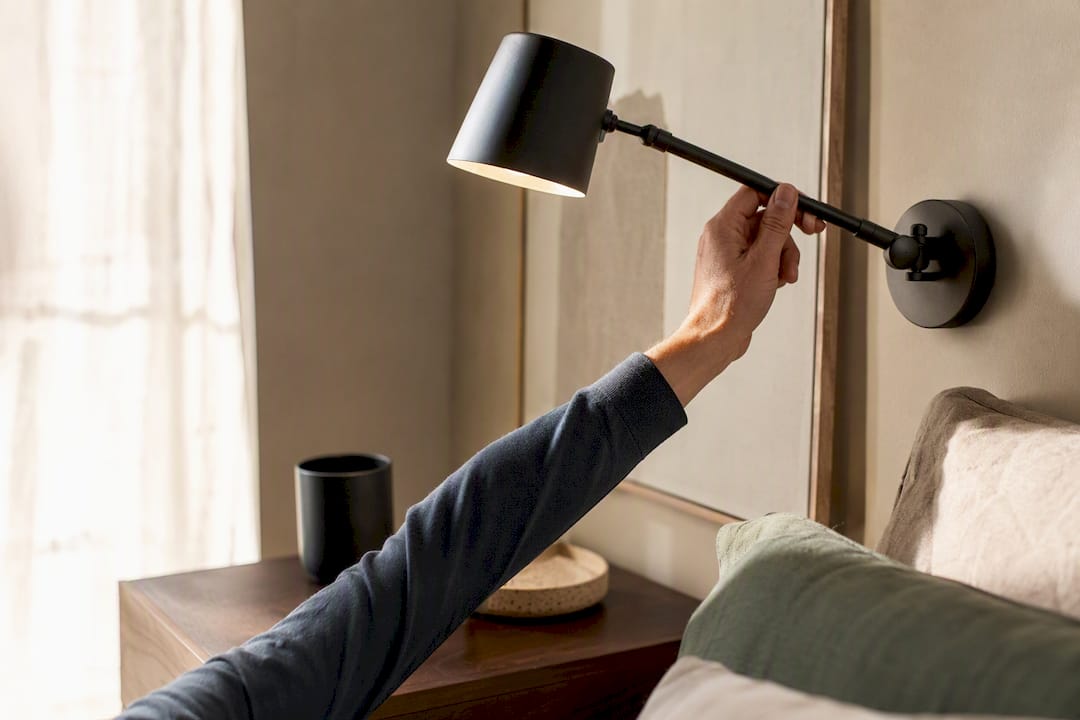
Bedside sconces do double duty: they’re reading lights and they’re decor, and getting the height wrong ruins both jobs. The standard range is 55 to 65 inches from the floor, or 30 to 36 inches above the top of the mattress. For actual reading comfort, aim the light source 6 to 12 inches above where a seated person’s shoulder would be. That’s a more reliable method than a flat floor measurement, because mattress height varies wildly between a low platform bed and a pillow-top on a tall frame.
A few placement details make the difference between a sconce that works and one that just looks nice:
- Center the fixture over the nightstand, or set it about 12 inches in from the mattress edge if there’s no nightstand to anchor it to.
- For a headboard with a tall profile, shift your reference point to the top of the headboard rather than the mattress, since that’s what visually frames the fixture.
- Swing-arm sconces give you flexibility after installation. Fixed sconces need the height locked in before drywall goes up, so measure twice.
- On unusually low or high beds, lean on the shoulder-height rule over the mattress rule. It adapts to the person, not the furniture.
Exposed-bulb designs should sit a little higher to avoid glare directly in a reader’s eyeline. Shaded or diffused fixtures, like the kind with an opal or frosted lens, give you more room to work within that range.
Where Should Vanity Sconces Sit Above a Bathroom Mirror?
Bathroom lighting has one job most other rooms don’t: even, shadow-free light on a face. That means placement matters as much as brightness. The standard range for flanking vanity sconces is 60 to 66 inches from the floor to fixture center, spaced 36 to 40 inches apart so the light crosses in front of the face instead of casting shadows from the side.
Keep these variables in mind before you finalize the layout:
- Standard vanity height sits around 32 to 36 inches, so 60 to 66 inches at the fixture puts the light roughly at or slightly above eye level for most adults.
- When a mirror runs the full width of the wall, there’s often no space for flanking sconces. A single fixture mounted 75 to 80 inches up above the mirror is the standard fallback.
- Diffused or opal-glass sconces reduce the harsh shadows that exposed bulbs can throw across a face at this height.
- If you’re unsure how a specific fixture will scale against your mirror, Montreal Lighting & Hardware’s guide on choosing the right vanity light size walks through proportions in more detail.
What’s the Right Spacing for Hallway and Living Room Sconces?
Hallway and entry sconces aren’t about task lighting. They’re about rhythm, the kind that makes a corridor feel intentional instead of like an afterthought with a light bulb screwed into it. Most designers recommend 60 to 72 inches from the floor to fixture center, leaning toward the lower end in a narrow hallway and higher where ceilings vault upward.
A few rules keep multiple sconces looking deliberate rather than scattered:
- Space fixtures 6 to 10 feet apart on center for overlapping pools of light, tightening the spacing in shorter hallways.
- Center sconces between door casings rather than mechanically measuring from a wall corner. Symmetry around an opening reads better than symmetry around a random point.
- In older homes, don’t trust a single level line across the whole run. Floors settle and trim shifts, so measure each position from the nearest architectural reference, like a door header or chair rail, rather than a laser level.
Living rooms follow the same general range, though you’ll often set fixtures a bit higher, around 66 to 72 inches, when flanking a fireplace or a piece of art meant to draw the eye upward.
How High Should Kitchen, Dining, and Art Sconces Go?
Kitchen sconces used for ambient light generally sit around 60 inches from the floor, or about 24 inches above the counter line if you’re measuring from the work surface instead. Near a sink or a window, raise the fixture slightly, roughly 6 inches above the window’s top frame, so it doesn’t compete with the trim or crowd the glass.
Dining rooms and buffets call for a different logic entirely: center the fixture around 60 inches and anchor it visually to the furniture underneath, whether that’s a buffet, sideboard, or the table itself. Pair these with a dimmer. A sconce that only does one brightness level is a sconce that fights against a room meant to shift from a bright weeknight dinner to a quiet dinner party.
For artwork lighting, position the fixture about 6 inches above the top of the frame and center it horizontally on the piece. If you’re sourcing new frames or gallery-style pieces to light, a partner resource like curated wall art is worth a look before you finalize sconce placement, since frame size and proportion should drive the lighting plan, not the other way around.
How Do You Measure and Install Sconces Correctly?
Getting the number right on paper means nothing if the installation doesn’t match it. Here’s the sequence that keeps a project on track:
- Pick your reference point first. Finished floor for hallways and living spaces, mattress top for bedside sconces, countertop for kitchen and vanity fixtures.
- Mark the junction box center, not the edge, at your chosen height. Every range above refers to the fixture’s center point.
- Account for canopy and bulb offset. If the light source sits above or below the fixture’s visual center (common in cage or drum-shade designs), shift the junction box to compensate so the actual light lands where you intended.
- Mock it up before you commit. Tape a paper template to the wall at the proposed height and test it from a seated and standing position before any wire gets pulled.
Pro Tip: Finalize your mattress, headboard, mirror, and vanity choices before the electrician roughs in the boxes. Moving a junction box after drywall goes up costs far more than adjusting a lighting plan on paper.
For older walls with uneven plaster or shifting trim, retrofit boxes give you some forgiveness. Measure twice from the nearest fixed reference point rather than trusting a level line across the whole wall.
What Sconce Mounting Mistakes Should You Avoid?
The single most common error is measuring one perfect height with a level and applying it uniformly across a wall that isn’t perfectly straight. Older Canadian homes especially tend to have settled floors and slightly uneven casings, so a fixture that reads level relative to the floor might look crooked relative to the door frame beside it.
Watch for these as well:
- Mounting switches out of easy reach from bed. Test the reach from a seated position before finalizing wiring, not after.
- Mixing sconce heights within the same sightline. Consistency across a hallway or a pair of bedside fixtures matters more than hitting an exact inch count.
- Skipping the mock-up step. A paper template on the wall reveals problems a tape measure alone won’t catch.
Pro Tip: Keep every sconce in a single room at the same height, even if the furniture beneath them varies slightly. A matched line reads as intentional; a staggered one reads as a mistake.
Does Ceiling Height Change Where Sconces Should Go?
Standard mounting ranges assume a fairly typical 8 to 9 foot ceiling. Once a room climbs higher, those numbers start to feel low relative to the space, and a sconce mounted at 66 inches under a 12-foot ceiling can look like it’s floating near the floor rather than anchoring the wall.
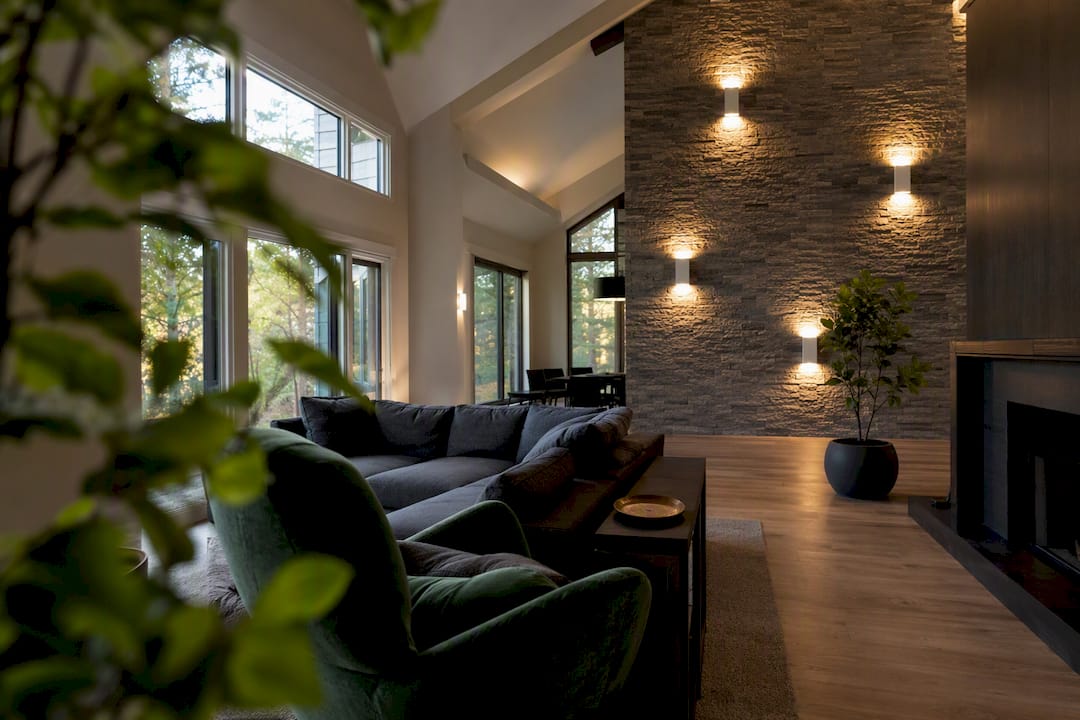
For rooms with vaulted or higher ceilings, shift toward the top of the standard range, or slightly above it, so the fixture holds its own visually against the extra wall height. A hallway with 10 foot ceilings often looks better with sconces closer to 72 to 76 inches than the standard 60 to 72 inch band. The goal is proportion: the sconce should feel like it belongs to the wall it’s on, not like an afterthought stuck at a generic height.
Low ceilings pull in the opposite direction. In a basement conversion or an older Canadian home with 7.5 foot ceilings, pushing a fixture to the top of any standard range risks it feeling cramped against the ceiling line. Dropping to the lower end of the range, or slightly below it for hallways, usually reads more comfortably in a compact space.
This is one area where a strict number matters less than stepping back and looking at the wall as a whole. Stand across the room, hold a template at your intended height, and judge it against the ceiling line and any nearby trim before committing to a junction box location. A room’s proportions should guide the final call more than a chart ever will.
How Do You Adjust Sconce Height for Different Users and Accessibility Needs?
Standard ranges assume an average adult reach and sightline, but households don’t come in one size. A family with a mix of heights, aging parents, or a member using a wheelchair needs a placement strategy built around actual use, not a generic chart.
For general accessibility, keep switches and pull chains within reach from a seated position, generally no higher than about 48 inches from the floor for someone in a wheelchair, according to widely used accessibility guidance. That’s considerably lower than most sconce fixture heights, which is exactly why a wall-mounted or remote switch placed separately from the fixture itself often works better than a pull chain built into the sconce.
Bedside sconces in a household with a shorter or seated user benefit from the shoulder-height rule more than the mattress-height rule, since it adapts directly to the person rather than the furniture. If multiple people share a room with different heights, a swing-arm or adjustable sconce solves more problems than a fixed fixture ever will, letting each user angle the light toward their own reading position.
Montreal Lighting & Hardware’s guide on ADA-compliant sconces covers switch height, projection limits, and fixture selection in more depth for households or commercial spaces that need to meet formal accessibility standards. Even outside a strict compliance requirement, the same principles, lower switches, adjustable arms, and shoulder-based reading heights, make a home more comfortable for everyone in it, not just the person the adjustment was made for.
How Does Sconce Height Change the Mood of a Room?
Where a sconce sits on the wall changes more than function. It changes how the light actually falls, and that shapes the mood of a room as much as the fixture’s finish or shade color does.
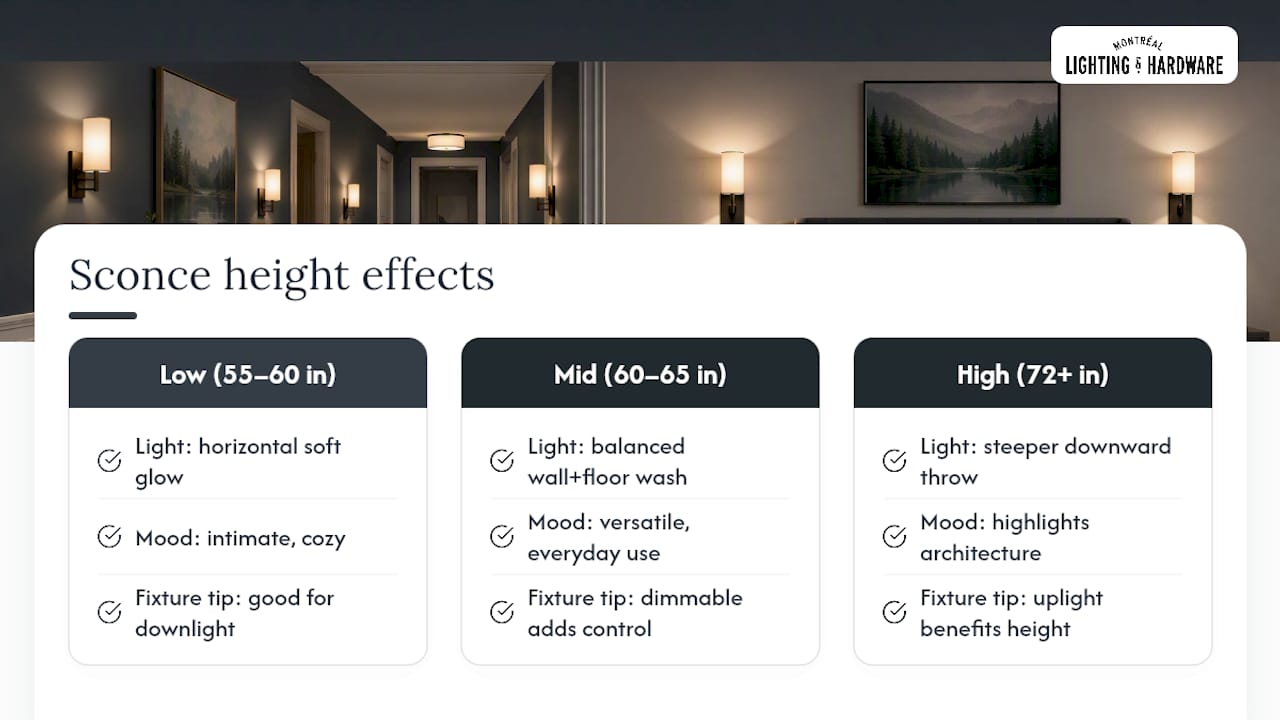
Mount a sconce low, near the 55 to 60 inch range, and the light spreads more horizontally, creating a warm, intimate wash that works well in a bedroom or a reading nook. Push that same fixture to 72 inches or higher and the light throws downward at a steeper angle, which flatters architectural detail and casts a broader, more even glow across a hallway or living space. Neither is better. They serve different purposes.
Fixtures with an uplight component, ones that direct light toward the ceiling, benefit from slightly higher placement so the upward wash has room to spread before it hits the ceiling plane. A downlight-only sconce mounted too high, by contrast, can leave the wall itself looking dim while throwing a hot spot on the floor. This is where checking a fixture’s actual light distribution, not just its height on a chart, matters. A product page that shows the light source position relative to the canopy, the kind Montreal Lighting & Hardware includes on listings like the Midtown LED wall sconce, lets you confirm how the light will actually behave before you commit to a height.
Dimmable sconces add one more layer of control. A dining or living room fixture mounted at the recommended height still needs the flexibility to shift from bright task lighting to a low, ambient glow depending on the hour, and that flexibility often matters more to the room’s overall feel than the exact inch measurement on the wall.
Why Montreal Lighting & Hardware Backs These Numbers
Standard ranges only mean something once you can see them applied to a real fixture. That’s where product specifics matter more than a generic chart. The Sabon LED wall sconce and the Midtown LED wall sconce both show their canopy dimensions and light-source position directly on the product page, which lets a Canadian homeowner or designer confirm the actual offset before ordering rather than guessing after installation.
Montreal Lighting & Hardware supports that decision with trade pricing for design professionals, a showroom for hands-on comparison, and fast shipping across Canada, all useful when a rough-in date is already locked and there’s no room for a slow reorder.
— Montreal Lighting & Hardware
How Montreal Lighting & Hardware Can Help With Your Sconce Project
Once you know your target height, the next step is finding a fixture whose proportions actually match it, and that’s where a general home decor retailer usually falls short on detail. Montreal Lighting & Hardware lists canopy size and light-source offset directly on product pages, so you can confirm a fixture will land exactly where you measured before it ships.

Start with the Sabon LED wall sconce or the Midtown LED wall sconce if you’re planning bedside or hallway installations. Both show full specs for confirming offset against your junction box height. Designers and contractors working across multiple rooms can request trade pricing through the main site, and anyone weighing a larger fixture, like a statement piece for a dining room or entry, can browse the Light Guide Ring LED pendant as a complementary option alongside wall sconces. Book a showroom visit to see proportions in person before your rough-in date arrives.
Sources
- Vatero — Wall sconce height: bedside, vanity and hallway rules
- This Old House — Wall sconce installation guidance
