

Adjustable recessed gimbals, suspended pendants with swivel canopies, and track systems are the most reliable choices for sloped ceiling lighting in Canadian homes. For most vaulted rooms, start with an IC-rated gimbal downlight or a canless LED direct-mount, then layer in pendants or track heads for task and accent light.
Quick answers before you read further:
- Ceilings past a 3/12 pitch (about 14°) need adjustable or slope-rated fixtures to avoid glare aimed at eye level.
- Vaulted rooms taller than average heights typically need higher lumen output per recessed fixture compared to standard ceiling heights.
- Always confirm IC or IC-AT rating before buying recessed fixtures. Insulation follows the roofline on most vaulted ceilings, and a non-IC housing in contact with insulation is a fire risk.
- Measure your slope in degrees or rise/run before ordering. Montreal Lighting & Hardware carries slope-compatible fixtures and offers trade program support for designers and contractors across Canada.
Table of Contents
- Which fixture types work on sloped or vaulted ceilings?
- What mounting hardware and adapters do you need?
- How do you pick the right light for your sloped ceiling?
- What does installation cost and how long does it take?
- How do you place and layer light in a vaulted room?
- What problems come up with sloped ceiling lights and how do you fix them?
- Recommended fixtures for sloped ceilings available in Canada
- Key Takeaways
- Our perspective on lighting vaulted spaces
- Ready to find the right fixture? Montreal Lighting & Hardware can help.
- Useful sources and further reading
Which fixture types work on sloped or vaulted ceilings?
Choosing the right fixture family saves you from glare, wobble, and wasted light. Here is how each option performs on angled surfaces.
Adjustable recessed gimbals are the go-to for most vaulted rooms. The LED head tilts and swivels inside the housing so the beam points straight down regardless of ceiling pitch. Most gimbals offer 30–40° of tilt, though some trims top out at 25–30°, which can fall short on steep cathedral pitches. Look for a 9°–45° tilt rating if your ceiling exceeds a 9/12 slope; the HALO RLS4 canless adjustable downlight, for example, is designed specifically for this range.
Slope-rated recessed housings with angle-cut trims are purpose-built for specific pitches. The trim face is cut at a matching angle so the lens faces the floor. They look exceptionally clean, but you must order the right pitch, and repositioning later is difficult.
Canless LED direct-mount downlights skip the separate housing entirely and mount straight to the junction box. Many canless systems accept slopes up to 38° and require less drywall repair during a retrofit. A strong modern choice for both new builds and renovations.
Suspended pendants with swivel canopies work beautifully because gravity keeps the cord or cable perfectly vertical. A sloped-ceiling adapter lets the canopy sit flush against the angled surface while the pendant hangs straight. For multi-pendant runs over a kitchen island, vary cord lengths by roughly 3 inches per foot of height change to keep the bottoms level.
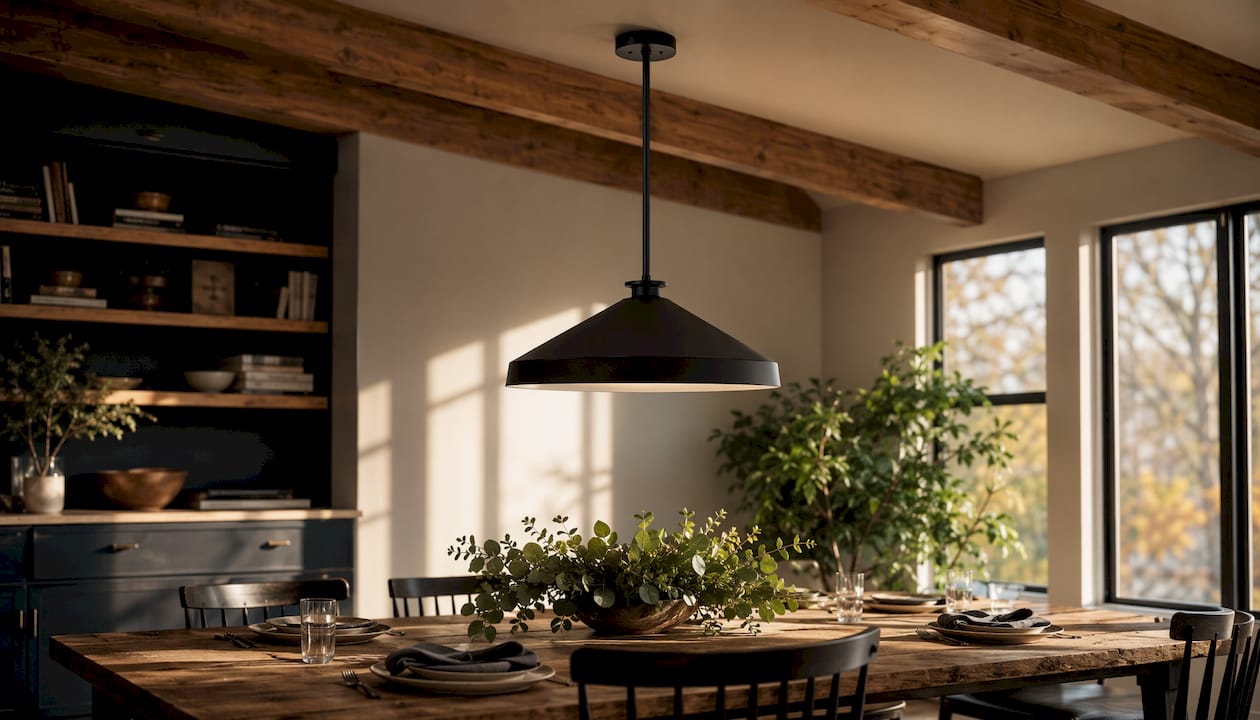
Chandeliers on long chains or stems suit tall vaulted foyers and dining rooms where ceiling height gives you room to drop the fixture to a comfortable visual level. The chain absorbs the angle at the canopy; the chandelier body hangs plumb.
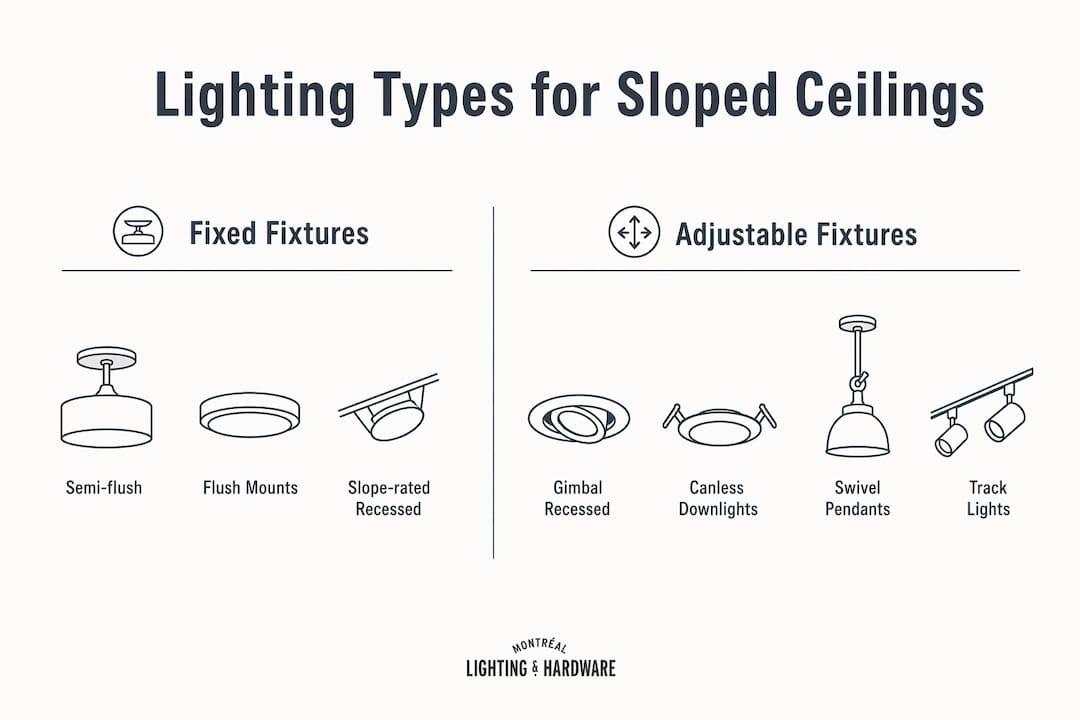
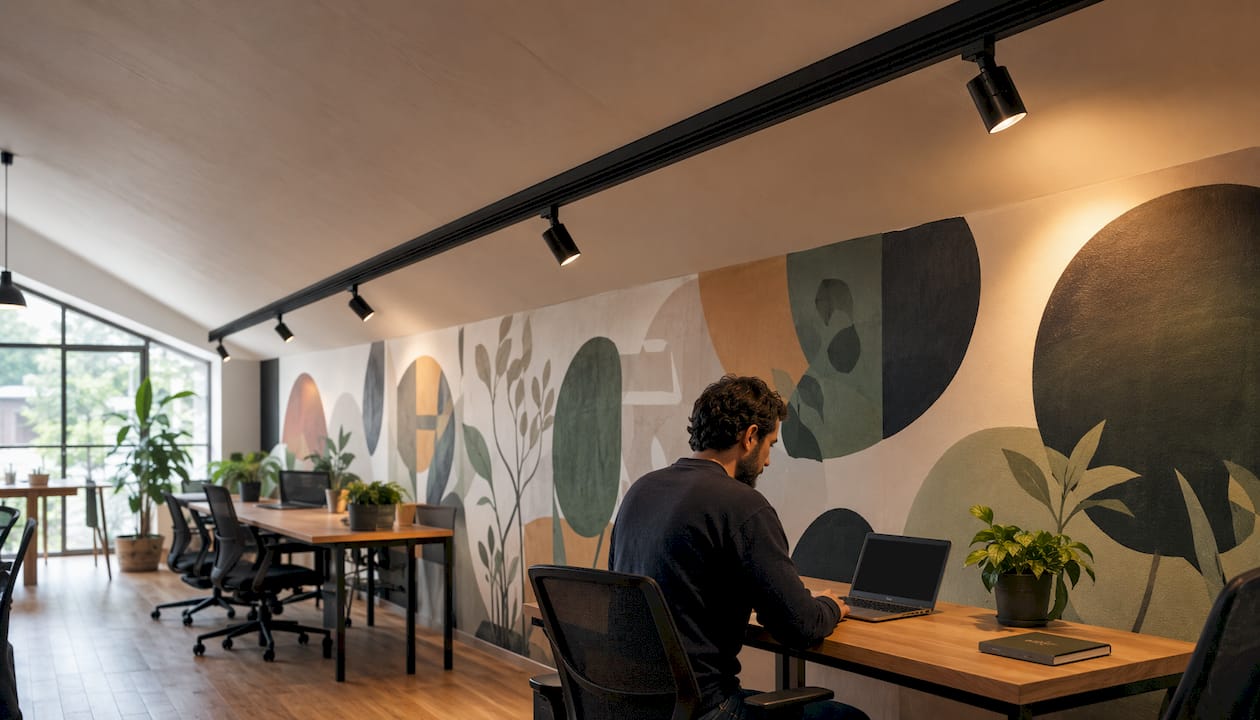
Track and magnetic track systems offer the most flexibility for accent and task lighting on angled ceilings. The track mounts to the slope or suspends from it, and each head aims independently. Magnetic track in particular allows you to reposition heads without rewiring.
Semi-flush and flush mounts work on gentle slopes (under 3/12) where glare is minimal. On steeper pitches, the fixed lens angle becomes a problem.
| Fixture type | Best for | Mounting method | Max compatible slope | Ideal ceiling height | Price range (CAD) | Dimmable / bulb type |
|---|---|---|---|---|---|---|
| Adjustable gimbal recessed | General ambient, any vaulted room | Recessed housing | 9°–45° (confirm tilt rating) | 9 ft+ | $100–$250 per fixture | Yes / integrated LED |
| Canless LED direct-mount | Retrofits, tight ceiling depth | Direct to junction box | Up to 38° (varies by model) | 8 ft+ | $150–$350 per fixture | Yes / integrated LED |
| Slope-rated housing + angle-cut trim | New construction, clean aesthetic | Recessed housing | Matched to pitch (2/12–12/12) | Any | $200–$450 per fixture | Yes / integrated LED |
| Pendant with swivel canopy | Dining, kitchen island, entry | Chain, cable, or rod | Any (canopy adapts) | 10 ft+ recommended | $300–$600 | Yes / E26 or integrated |
| Chandelier on long chain/stem | Foyers, dining rooms, great rooms | Chain or stem | Any (canopy adapts) | 12 ft+ | — | Yes / E12 or E26 |
| Track / magnetic track | Accent, task, flexible layouts | Surface-mount or suspended | Any | 8 ft+ | $150–$800 per run | Yes / GU10 or integrated |
| Semi-flush / flush mount | Gentle slopes, bedrooms | Direct ceiling mount | Up to 3/12 (14°) | 8–10 ft | — | Yes / E26 or integrated |
Buyer signal: For slopes under 3/12, almost any fixture works. Between 3/12 and 6/12, choose a gimbal or canless direct-mount. Above 6/12, prioritize a high-tilt gimbal (9°–45°) or a slope-rated housing, and consider suspending pendants or track for supplemental light.
What mounting hardware and adapters do you need?
Getting the mounting right is where most sloped-ceiling projects succeed or stall. The fixture itself is only half the equation.
Sloped-ceiling canopy adapters are small angled collars that sit between the electrical box and the canopy of a pendant or chandelier. They let the canopy lie flat against the ceiling while the cord or chain hangs vertically. For very steep pitches or apex installations, a pendant flex hook or a plug-in pendant can sidestep the box orientation problem entirely.
Chain vs. cable vs. rigid rod: Chain is the most forgiving because it drapes naturally and absorbs small angle variations. Cable gives a cleaner, more contemporary look but requires a swivel fitting at the ceiling end. Rigid rods work well for semi-flush and flush mounts on gentle slopes, but need a swivel canopy on anything steeper than about 3/12.
Canless direct-mount units attach straight to a standard junction box and eliminate the need for a separate housing. The HALO RLS canless adjustable downlight, for example, tilts from 9° to 45° and offers field-selectable color temperature with dimming down to 5%. That kind of built-in flexibility makes it a practical retrofit option for most Canadian homes.
| Slope range | Rise/run | Fixture options | IC / IC-AT note |
|---|---|---|---|
| 14° (3/12) or less | Flat to gentle | Any recessed, semi-flush, pendant | Standard IC housing acceptable |
| 14°–26.6° (3/12–6/12) | Moderate | Gimbal, canless direct-mount, pendant with adapter | IC-rated housing required |
| 26.6°–38° (6/12–9/12) | Steep | High-tilt gimbal (9°–45°), canless up to 38°, pendant/track | IC-AT (airtight) strongly recommended |
| 38°–45° (9/12–12/12) | Very steep | Slope-rated housing, high-tilt gimbal (9°–45°), pendant/track | IC-AT required; verify housing pitch range |
Pre-purchase compatibility checklist:
- Measure slope in degrees or rise/run (a digital angle finder costs under $20 at most hardware stores)
- Confirm the fixture’s tilt or slope rating covers your pitch
- Verify IC or IC-AT rating if insulation contacts the housing
- Check dimmer compatibility (LED dimmers differ from incandescent ones)
- Confirm ceiling depth for recessed housings (shallow ceilings may need canless units)
- Identify junction box type and orientation before ordering a pendant adapter
Pro Tip: If your ceiling has less than 4 inches of depth above the drywall, skip the traditional housing entirely and go canless. Modern canless LED direct-mounts handle most slopes up to 38° and leave almost no repair work behind.
How do you pick the right light for your sloped ceiling?
A clear selection sequence keeps you from buying twice. Work through these steps before placing an order.
- Measure your slope. Use a digital angle finder or a smartphone level app. Note both the degree and the rise/run ratio (e.g., 6/12 = 26.6°). This single number determines which fixture families are compatible.
- Decide the room’s function. A living room needs warm ambient light. A kitchen island needs focused task light. A foyer benefits from a statement fixture with accent layers. Function drives fixture family.
- Set your lumen target. For vaulted ceilings above 12 ft at the peak, plan on 900–1,200 lumens per recessed fixture. Standard 8-ft rooms work with 600–800 lm. Dimmer switches let you dial back when the full output isn’t needed.
- Choose color temperature. Warm white (2700K–3000K) suits living rooms, bedrooms, and dining areas. Cool white (4000K) works better in kitchens and home offices. If you want flexibility, look for 5-CCT selectable products that let you adjust after installation.
- Select fixture family and trim style. Match the family to your slope range using the table above. For trim style, a baffle trim reduces glare on steep pitches; a reflector trim adds brightness in darker rooms.
- Verify IC/IC-AT and dimmer compatibility. Check the housing or canless unit’s rating against your insulation situation. Pair with an LED-compatible dimmer, not a legacy incandescent one.
- Confirm serviceability. LED fixtures in tall vaulted ceilings are hard to reach. Choose integrated LED units rated for 50,000 hours or more so you are not on a ladder every few years.
Size and scale guidelines:
- Pendant bottom height: 7 ft above finished floor for dining tables; 6.5 ft for kitchen islands
- Chandelier diameter (inches): roughly equal to the room’s length plus width in feet (e.g., a 12 × 14 ft room suits a 26-inch chandelier)
- Pendant drop in vaulted spaces: allow at least 12 inches of clearance between the fixture bottom and the tallest person’s reach
- Recessed fixture spacing: divide the ceiling height by two to get approximate spacing in feet (a 10-ft peak → ~5-ft spacing between fixtures)
Questions worth asking your retailer or electrician:
- What is the electrical box type and can it support the fixture weight?
- Does the housing carry an IC or IC-AT rating for my insulation situation?
- What is the warranty period and what does it cover?
- Is trade program pricing available for this project?
- What is the return policy if the slope rating doesn’t match on-site?
What does installation cost and how long does it take?
Planning the budget and timeline upfront prevents surprises. There are two main installation routes, plus a surface-mount alternative for ceilings with limited depth.
Retrofit (cut-in or canless direct-mount): The most common approach for existing homes. An electrician cuts an opening, fishes wire to the new location, and installs the fixture. Canless units speed this up considerably since there is no housing to frame in. A simple pendant swap on an existing box typically takes 1–2 hours. A canless recessed retrofit per fixture runs roughly 1–2 hours of labor depending on wire access.
New-construction method: The housing is installed before drywall goes up, which gives full access for wiring and positioning. This is the cleanest result and the easiest install, but it only applies during a renovation or new build.
Surface-mount alternatives: For ceilings with tongue-and-groove wood or very shallow depth, surface-mounted track or semi-flush fixtures avoid cutting into the ceiling entirely. They are faster to install and easier to reposition.
Typical Canadian cost ranges (CAD): Simple pendant swap on existing box: $100–$250 (labor only). Canless recessed retrofit per fixture: $150–$350 (labor + fixture). Full recessed gimbal retrofit with new wiring per fixture: $300–$600. New-construction recessed layout (per fixture, wiring included): $200–$450. Full rewire or panel upgrade: varies widely; get three quotes from licensed electricians.
Recessed work in vaulted ceilings almost always requires a licensed electrician. The combination of height, insulation contact, and junction box orientation creates real safety risks for DIY installs. Montreal Lighting & Hardware’s trade program connects design professionals and contractors with product support, spec sheets, and exclusive pricing, making it easier to coordinate the buying and installation side of a project.
How do you place and layer light in a vaulted room?
Scale and placement are where vaulted rooms either feel dramatic and warm or end up with dark corners and glare. A few placement principles make a significant difference.
Spacing adjusted for height:
- Divide the ceiling’s peak height by two to get the starting spacing between recessed fixtures (10-ft peak = ~5-ft spacing). Increase lumen output per fixture rather than crowding more fixtures together.
- Mirror the fixture layout symmetrically across the ridge for a balanced look. Asymmetrical layouts on vaulted ceilings tend to emphasize the slope rather than the room.
- For pendant clusters over a kitchen island, space pendants 24–30 inches apart and hang them 6–7 ft above the floor. On a vaulted ceiling, use a canopy adapter and vary cord lengths to keep the bottoms level.
Layering ambient, task, and accent light:
- Ambient: Recessed gimbals or track heads provide the base layer. Aim them toward the floor, not the walls, to avoid hot spots.
- Task: Pendants over counters and islands deliver focused light where you actually work. For vaulted kitchen areas, pendants on adjustable cords give you the flexibility to fine-tune height after installation.
- Accent: Gimbals aimed at artwork or architectural features, wall washers, and cove uplights add depth. Track systems with individually aimed heads are particularly good for accent work because you can redirect them as the room evolves.
Placement examples:
- Kitchen island: Three pendants spaced 24 inches apart, bottoms at 6.5 ft, with a swivel canopy adapter at each ceiling mount point.
- Living room with vaulted ceiling: Recessed gimbals on a 5-ft grid (for a 10-ft peak), aimed straight down, plus a floor lamp or table lamp for warm fill near seating.
- Entry hall or foyer: A chandelier or statement pendant centered on the space, hung so the bottom clears 7 ft above the floor, with wall sconces for soft fill at eye level.
Pro Tip: Practitioners recommend “cross-aiming” gimbals on one slope to illuminate the opposite side of the room. This reduces the spotlight effect and creates more even coverage across large vaulted spaces.
What problems come up with sloped ceiling lights and how do you fix them?
Even well-planned installs run into a few predictable issues. Knowing what to watch for saves a callback.
- Beams pointing upward or at walls: Caused by a fixed recessed fixture installed without tilt correction. Fix: replace with an adjustable gimbal or canless direct-mount that can aim toward the floor.
- Glare at eye level: The most common complaint on vaulted ceilings. A deep-baffle trim absorbs stray light and narrows the beam angle. If the trim is already baffled, the fixture may need a higher tilt rating for your slope.
- Wobbling pendants: Usually a loose canopy or an undersized junction box. The box must be rated for the fixture’s weight. A swivel canopy adapter that sits flush against the ceiling also reduces movement.
- Dimmer flicker: Almost always a mismatch between the LED driver and the dimmer switch. Swap the dimmer for an LED-compatible model from the same manufacturer as the fixture when possible. Check the fixture’s dimmer compatibility list before buying.
- Overheating from non-IC housings: If insulation is in contact with a non-IC housing, the fixture will overheat and may fail or create a fire risk. The fix is to replace the housing with an IC-rated or IC-AT unit. This is not a DIY repair on a vaulted ceiling.
- Uneven illumination across the room: Often caused by fixtures spaced for a flat ceiling without adjusting for the slope’s added length. Add fixtures or increase lumen output per fixture, and consider cross-aiming gimbals to fill the opposite slope.
Call a licensed electrician when: the junction box orientation is unsafe, a non-IC housing is in contact with insulation, new wiring is needed, or the ceiling height requires scaffolding to reach safely.
Recommended fixtures for sloped ceilings available in Canada
These options cover the most common vaulted-ceiling scenarios and are available through Montreal Lighting & Hardware in Canada.
-
Crystorama Capsule One Light Ceiling Mount: A compact, low-profile ceiling mount that works well on gentle to moderate slopes where you want a clean, understated look. Its simple geometry adapts easily with a swivel canopy. Available at Montreal Lighting & Hardware; view the Capsule.
-
Crystorama Fulton Three Light Ceiling Mount: Three light sources in one fixture make this a practical choice for mid-size vaulted rooms where a single recessed downlight would leave the space feeling dim. The multi-arm design distributes light across a wider area without requiring multiple electrical boxes. See the Fulton Three Light for specs and pricing.
-
Crystorama Brielle Four Light Chandelier: A statement piece for tall vaulted foyers and dining rooms. The four-light configuration delivers enough output for a large open space, and the chandelier’s proportions read well under high ceilings where a smaller fixture would look lost. Available through Montreal Lighting & Hardware; view the Brielle chandelier.
-
Crystorama Fulton Six Light Ceiling Mount: When a vaulted great room or open-plan living area needs a real anchor fixture, the six-light version of the Fulton delivers both output and visual presence. Its ceiling-mount format keeps the profile lower than a chandelier, which suits rooms where drop length is limited. See the Fulton Six Light.
-
Crystorama Dakota Eight Light Ceiling Mount: For large vaulted spaces, an eight-light ceiling mount provides the kind of ambient output that recessed fixtures alone struggle to match. The Dakota Eight Light suits open-plan rooms and dramatic foyers where scale matters.
Montreal Lighting & Hardware offers warranty coverage and trade pricing on these fixtures, with showroom access across Canada for designers and homeowners who want to see finishes in person before ordering. Trade clients receive exclusive pricing, and the team can advise on slope compatibility and dimmer pairing for any fixture in the catalog.
Key Takeaways
Sloped ceiling lighting works best when you match the fixture family to your ceiling’s pitch, verify IC/IC-AT and dimmer compatibility before buying, and layer ambient, task, and accent sources for even, comfortable light.
| Point | Details |
|---|---|
| Match fixture to slope | Ceilings past 3/12 (14°) need adjustable gimbals, canless direct-mounts, or pendants with swivel canopies. |
| Lumen output matters more at height | Vaulted ceilings above 12 ft need 900–1,200 lm per recessed fixture, not the standard 600–800 lm. |
| IC/IC-AT rating is non-negotiable | Insulation follows the roofline; a non-IC housing in contact with insulation creates overheating and fire risk. |
| Spacing rule for vaulted rooms | Divide ceiling peak height by two for fixture spacing in feet (10-ft peak = ~5-ft spacing). |
| Montreal Lighting & Hardware | Carries slope-compatible fixtures including the Crystorama Capsule, Fulton, and Brielle lines, with trade pricing and Canadian showroom access. |
Our perspective on lighting vaulted spaces
There is a tendency in lighting guides to treat sloped ceilings as a problem to solve rather than an opportunity to use. A vaulted room is one of the most architecturally generous spaces a home can have, and the right lighting approach lets that geometry do its work rather than fighting it.
The most common mistake we see is homeowners choosing fixtures based on style alone, then discovering the slope rating doesn’t match or the IC situation wasn’t checked. A beautiful pendant hung from an improperly rated box, or a recessed fixture aimed straight into the room because no one confirmed the tilt range, undermines both the look and the safety of the space. The technical details are not obstacles. They are the foundation that lets the design land the way you imagined it.
The other thing worth saying: layering matters more in vaulted rooms than in any other space. A single row of recessed gimbals will light the floor but leave the walls and the ceiling’s own texture in shadow. Add a statement pendant or chandelier for visual warmth, a few accent gimbals aimed at architectural features, and the room feels complete rather than just illuminated.
Ready to find the right fixture? Montreal Lighting & Hardware can help.
Sloped and vaulted ceilings deserve fixtures chosen with care, not guesswork. Montreal Lighting & Hardware carries a curated selection of slope-compatible ceiling mounts, chandeliers, and pendants from trusted designer brands, available across Canada with fast shipping and trade program pricing for design professionals and contractors.

Bring your slope measurements and room dimensions to the showroom, or reach out online to ask about IC/IC-AT housing compatibility and dimmer pairing for any fixture. The Crystorama Fulton Three Light Ceiling Mount is a strong starting point for mid-size vaulted rooms, and the Brielle Four Light Chandelier makes a natural focal point in a tall foyer or dining room. Both are available now at montreallighting.com. Trade clients can ask about exclusive pricing and the current warehouse sale offering up to 50% off select fixtures.
Useful sources and further reading
- Pot Lights for Vaulted Ceilings: How to Choose, Space & Spec Them Right — RC Lighting’s guide covering slope thresholds (3/12 dividing line), lumen targets for tall vaults, IC/IC-AT requirements, and spacing formulas.
- How to Install Recessed Lighting on Sloped and Vaulted Ceilings — Amicolight’s complete installation guide, including canless direct-mount systems and slope compatibility up to 38°.
- HALO RLS4 Sloped Ceiling Canless Downlight Spec Sheet — Technical spec sheet for the HALO RLS4 canless downlight: 9°–45° slope range, 900 lm, 90+ CRI, field-selectable CCT, and 5% dimming.
- Tangra 4 Gimbal Sloped Wide Trim — Lotus LED Lights product page with tilt-degree ratings and cross-aiming guidance for steep cathedral pitches.
- How to Hang a Pendant Light from a Vaulted or Sloped Ceiling — Bicycle Glass guide on sloped-ceiling adapters, swivel canopies, and pendant flex hooks for tricky apex installations.
- How to Light Sloped Ceilings — Jim Lawrence’s practical guide on cable and chain pendants, cord-length adjustment for multi-pendant leveling, and fixture selection for angled surfaces.
- What Is the Best Lighting for a Sloped Ceiling? — DecorWhim’s 2026 overview of fixture families, color temperature recommendations (2700K–4000K), and layering strategies for vaulted rooms.
- A Simple Guide to Sloped Ceiling Recessed Lighting — RecessedLighting.com’s overview of gimbal vs. angle-cut trim options, glare prevention, and installation challenges specific to vaulted ceilings.
Recommended
- Dakota Eight Light Ceiling Mount | Crystorama – Montreal Lighting & Hardware
- Ceiling Mount Two Light Ceiling Mount | Crystorama – Montreal Lighting & Hardware
- Ceiling Mount Two Light Ceiling Mount | Crystorama – Montreal Lighting & Hardware
- Ceiling Mount Two Light Ceiling Mount | Crystorama – Montreal Lighting & Hardware
