


The easiest way to transform a bedroom is to layer three kinds of light, warm ambient glow, a bedside task lamp, and one statement overhead fixture, then put dimmers on all of it. Choose 2700K warm white bulbs and aim for roughly 2,000 to 4,000 total lumens across the room, not one overhead can doing all the work — and consider adding cozy seating with pieces like the Lowtide Dream Modular Configuration in Warm White to create a boutique-hotel or lounge-style bedroom ambience. Here’s the quick plan:
- Measure first — note ceiling height and room dimensions before you shop.
- Pick a ceiling fixture — chandelier, pendant, or flush mount, sized to the room.
- Add bedside lamps or sconces — flanking the bed at the right height.
- Install dimmers — so every layer adjusts with your mood.
Montreal Lighting & Hardware carries the fixtures and finishes to build this scheme from the ceiling down.
Key Takeaways
Layered lighting, warm 2700K bulbs, and properly matched dimmers turn a flat bedroom into a room that actually feels calm to be in.
| Point | Details |
|---|---|
| Layer three light types | Combine ambient, task, and accent lighting at different heights instead of one overhead fixture. |
| Hit the lumen target | Aim for 2,000 to 4,000 total lumens across the room, spread over multiple fixtures. |
| Stay warm white | Use 2700K to 3000K bulbs for ambient and bedside light; save cooler tones for task areas only. |
| Match dimmers to bulbs | Confirm trailing-edge dimmer compatibility with LED bulbs before replacing every fixture. |
| Shop with fit in mind | Montreal Lighting & Hardware offers trade pricing and showroom help to confirm dimmer and finish fit before purchase. |
Table of Contents
- How do you layer ambient, task, and accent lighting?
- What ceiling fixture fits your bedroom size?
- Where should bedside lamps and sconces go?
- Which dimmers and bulbs work best together?
- How do finishes and materials change the way light looks?
- Where should you buy bedroom lighting in Canada?
- How much time and money should you budget for a lighting update?
- Does bedroom lighting affect your energy bill?
- What safety mistakes should you avoid during installation?
- Why layering and dimmers are the standard we recommend
- How can Montreal Lighting & Hardware help you get started?
- Frequently asked questions about bedroom lighting
- Sources
How do you layer ambient, task, and accent lighting?
Layered lighting is the backbone of a bedroom that actually feels restful, and it comes down to three jobs done by three different fixtures. Ambient light fills the room (your ceiling fixture or a plug-in floor lamp). Task light does the close work (a bedside lamp for reading). Accent light adds mood and drama (LED tape under a floating nightstand, or a small picture light over art).
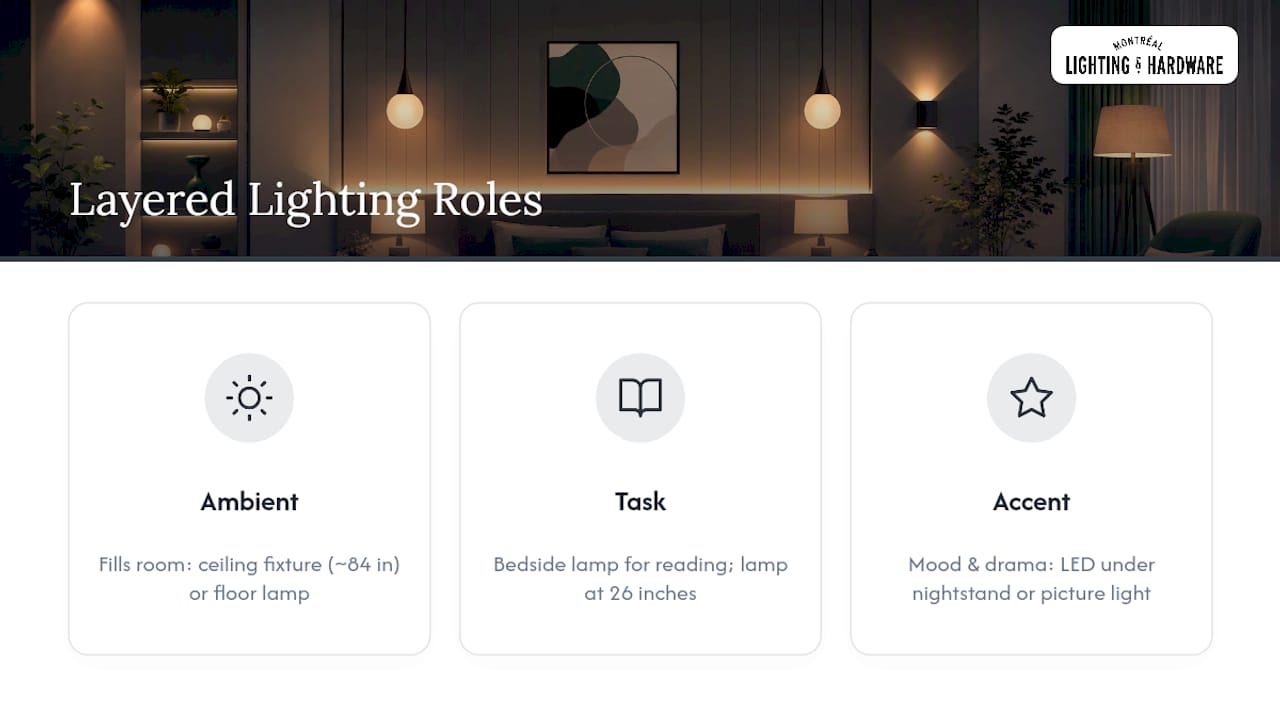
Build the scheme in that order: ambient first, so the room has a base glow, then task lighting where you actually need to see, then accent last, for polish. Designers place fixtures at multiple heights on purpose. A ceiling light at 84 inches, a lamp at 26 inches, and a floor lamp somewhere in between create visual rhythm that a single flat ceiling light can’t fake. This is also why interior sources warn against relying on recessed cans alone: they flatten a room instead of shaping it.
Pro Tip: Stagger your fixtures at three different heights, floor, bedside, and ceiling, and the room will feel intentional even before you turn on a single dimmer.
What ceiling fixture fits your bedroom size?
Overhead fixtures set the tone for the whole room, and getting the scale wrong is the most common mistake we see. A useful shortcut: add your room’s length and width in feet, then treat that number as inches for your fixture’s diameter. A 12 by 14 foot room points you toward a fixture with a diameter appropriate to room size, which rules out anything too dainty for the space.
Ceiling height decides the fixture type as much as floor area does:
- Flush mounts — best for ceilings under 8 feet or rooms where headroom is tight.
- Semi-flush mounts — a step up in presence without eating into clearance, good for 8 to 9 foot ceilings.
- Pendants — pull light lower and work well over a reading nook or beside (not directly above) the bed.
- Chandeliers — the statement piece for 9-foot-plus ceilings and rooms that can handle a sculptural centerpiece.
A textured chandelier suits a room already leaning into pattern and warmth, while a minimal flush mount like the Crystorama two-light ceiling mount fits a quieter, low-ceiling space. Lumens’ guidance suggests total room output around 2,000 to 4,000 lumens, so factor your ceiling fixture’s output against your bedside lamps rather than choosing it in isolation. Always confirm clearance over the bed and check your local electrical code before a hardwired install.
Where should bedside lamps and sconces go?
Bedside lighting is where function meets comfort, and a few inches of placement can make or break both. As a general rule, the bottom of a table lamp shade should sit close to eye level when you’re sitting up in bed. For sconces, mount them at a height that ensures light falls where you read, not into your eyes.
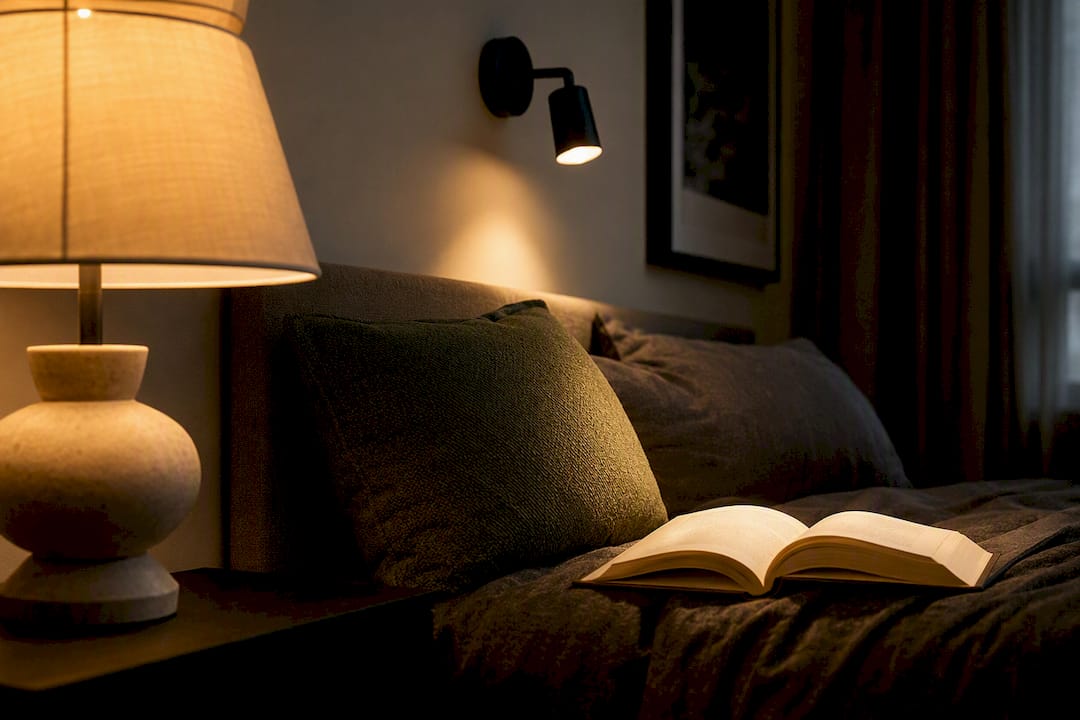
Pendants or wall sconces beat table lamps when nightstand space is tight or you rent and can’t run new wiring, plug-in sconces solve both problems at once. Small-bedroom fixes like wall-mounted sconces or LED tape free up surface area while still giving you a proper task-light layer.
For bulbs, stay in the 2700K to 3000K warm white range, dimmable, and select a comfortable lumen output per bedside fixture, enough to read comfortably without washing out the room’s mood.
- Table lamp: 25 to 29 inches tall, positioned an inch or two from the bed edge.
- Sconce: mounted 60 to 65 inches high, angled toward the reading side.
- Plug-in sconce: same height guidance, ideal for renters avoiding hardwiring.
Which dimmers and bulbs work best together?
Mismatched dimmers and bulbs cause almost every flicker complaint we hear about, and it’s an easy fix if you check compatibility before buying five of the same bulb. Most modern LED bulbs need a trailing-edge dimmer rather than the older leading-edge style built for incandescent loads. Smart dimmers add scheduling and app control, useful if you want your bedroom to shift from bright morning light to warm evening glow automatically.
For bulb temperature, stick with 2700K to 3000K warm white for ambient and bedside fixtures, and 3500K to 4000K only for a dedicated task area like a closet or vanity nook. Tunable white bulbs give you both in one bulb if you want flexibility without rewiring.
Before committing to a full room refit, run this checklist:
- Confirm the dimmer’s VA rating covers the total wattage of every bulb on that circuit.
- Match dimmer type to bulb type, trailing-edge for LEDs, in almost every case.
- Check that your fixture’s LED driver is dimmer-compatible, not just the bulb.
Pro Tip: Buy one dimmable LED bulb and test it with your chosen dimmer before replacing every bulb in the room. A five-minute test saves you from returning a dozen bulbs later.
How do finishes and materials change the way light looks?
The fixture you choose matters less than what it’s made of once the light actually turns on. A linen or parchment shade diffuses light into something soft and golden, while opal glass spreads a cleaner, slightly cooler glow, both worlds away from an exposed bulb’s harsh point of light. Architectural Digest points to tactile materials like parchment, linen, and aged metals as the details that separate a boutique-hotel bedroom from a builder-grade one.
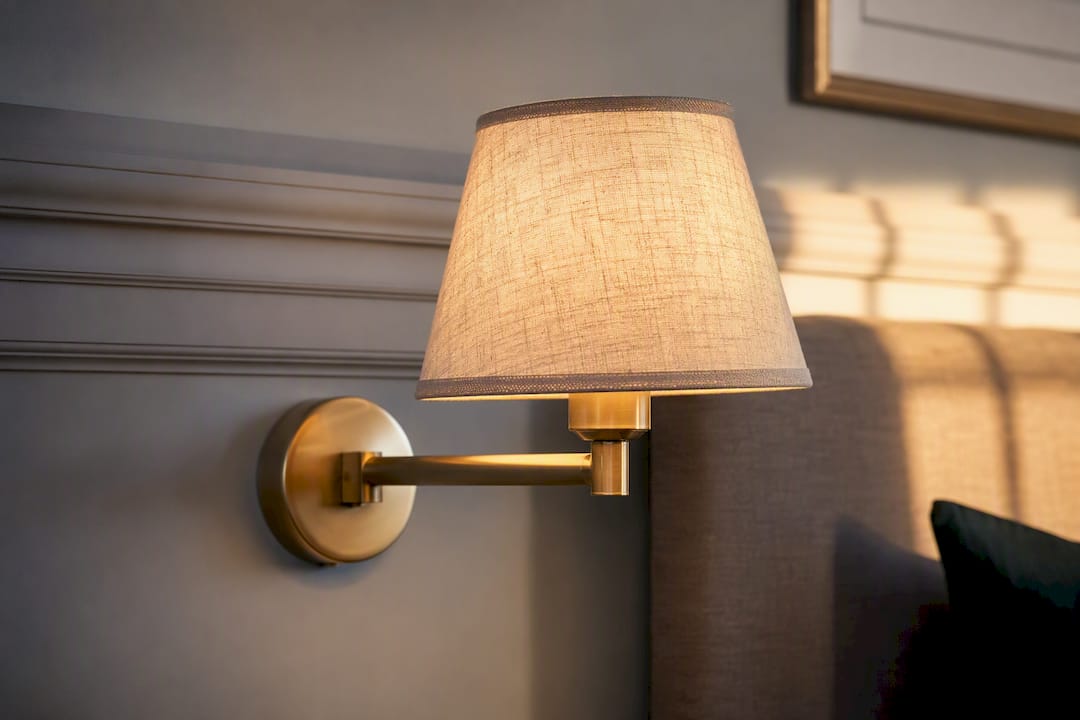
Metal finish plays its own role: warm brass and aged bronze read cozy under 2700K bulbs, while matte black and brushed nickel lean cooler and more modern even with the same warm bulb inside. Heading into 2026, textured shades and sculptural statement fixtures continue to trend alongside a broader warm-minimalist look, fewer stark white shades, more organic shapes and aged patinas.
Keep the visual interest around eye level, a sconce, a pendant, a lamp shade, and match the finish and scale to your existing hardware so the room doesn’t feel like it’s fighting itself.
Where should you buy bedroom lighting in Canada?
Before you buy anything, confirm four things: socket type and bulb compatibility, whether the fixture works with your existing dimmer, the retailer’s return policy, and realistic shipping or lead times, especially for imported statement pieces that can take weeks to arrive. Montreal Lighting & Hardware stocks Canadian-market-ready fixtures from brands like Savoy House and Maxim, and their team can confirm dimmer compatibility and finish samples before you commit, along with trade pricing for designers and contractors working on multiple rooms.
Run through this checklist before checkout:
- Measure your room and ceiling height, and note any low-clearance obstacles.
- Confirm dimmer compatibility with the fixture’s driver, not just the bulb.
- Request a finish sample if the fixture will anchor the whole room’s palette.
- Check that mounting hardware suits your ceiling type (plaster, drywall, junction box).
Budget fixtures in Canada often run $60 to $150 for a simple flush mount, mid-range pendants and semi-flush fixtures land in the $150 to $400 range, and a genuine statement chandelier, like a multi-light Crystorama piece, typically starts around $400 and climbs from there. Splurge on the one fixture your eye lands on first when you walk into the room; save on the bedside lamps flanking it.
How much time and money should you budget for a lighting update?
A full bedroom lighting refresh is a weekend project once the fixtures arrive, but shipping and electrician scheduling are usually the real bottleneck, not the install itself. Here’s a realistic sequence:
- Measure the room and map out where ambient, task, and accent light will live.
- Choose your ceiling fixture and bedside pieces based on that plan.
- Order bulbs and dimmers rated for your specific fixtures.
- Book an electrician if you’re installing a hardwired ceiling fixture or new dimmer switch.
- Install everything, then fine-tune bulb placement and dimmer settings over a few nights.
Budget-band projects (flush mount plus two plug-in lamps) often total $200 to $400 and take a weekend. Mid-range projects with a semi-flush fixture, sconces, and a smart dimmer usually land between $500 and $900. Premium projects with a statement chandelier and full rewiring can run $1,000 or more once electrician labor is included. Total output should still land near that 2,000 to 4,000 lumen target regardless of budget. If you’re in a condo, check your building’s electrical bylaws before any hardwired change, some buildings require a licensed electrician’s sign-off even for a simple fixture swap.
Does bedroom lighting affect your energy bill?
Bedroom lighting is one of the easier places in a Canadian home to cut electricity use without sacrificing mood, since bedrooms don’t need the sustained brightness a kitchen does. LED bulbs use a fraction of the wattage incandescent bulbs need to produce the same warm glow, and they last years longer, which matters if your statement chandelier holds six bulbs instead of one.
Dimmers add a second layer of savings beyond the bulb itself.
Smart bulbs and smart dimmers push this further with scheduling, a bedroom that automatically dims from bright task light to a low amber glow an hour before bed uses less energy over the course of a year than one left at a single fixed setting. Tunable white bulbs let you shift color temperature without swapping hardware, useful if you want cooler light for a morning routine and warmer light at night from the same fixture.
None of this requires an expensive smart-home overhaul. A basic dimmable LED bulb rated for your fixture, paired with a compatible trailing-edge dimmer, gets most of the efficiency gain on its own. The bigger sustainability win is simply not over-lighting the room. Building toward that 2,000 to 4,000 lumen range instead of installing more fixtures than the space needs keeps both your bill and your bulb count in check.
What safety mistakes should you avoid during installation?
The most common bedroom lighting mistake isn’t aesthetic, it’s electrical. Any hardwired fixture, new ceiling box, or dimmer switch replacement involving your home’s wiring should go through a licensed electrician, especially in older Canadian homes where box wiring and circuit capacity may not match current code. Swapping a light fixture yourself is usually fine; adding a new circuit or moving a junction box is not a DIY job.
Dimmer mismatches cause more service calls than almost anything else in residential lighting. Installing a standard incandescent dimmer on an LED circuit often causes flickering, buzzing, or premature bulb failure, because most older dimmers weren’t built for the low-wattage draw of LED bulbs. Always confirm the dimmer’s minimum load rating against your bulbs’ combined wattage before installation, not after.
Ceiling fixture weight is another overlooked risk. A statement chandelier needs a junction box rated for its weight, not just any ceiling box, and an electrician can confirm this in minutes before you hang anything. For pendant lights positioned near a bed, keep the fixture high enough that it’s out of reach when someone sits up suddenly, a surprisingly common cause of cracked glass shades.
Finally, never overload a single circuit with multiple high-wattage fixtures and a space heater or humidifier, a common bedroom combination in Canadian winters. If in doubt about circuit capacity, ask an electrician during your fixture consultation rather than after the breaker trips.
Why layering and dimmers are the standard we recommend
Bedroom lighting fails most often when it’s treated as an afterthought, one ceiling fixture, one bulb temperature, done. We recommend layered light and dimmers as a baseline, not an upgrade, because they’re what separates a room that just has light from one that actually feels calm to be in. Our showroom team and trade program exist specifically to help you get this right the first time, matching fixtures, finishes, and dimmer compatibility before you buy rather than after.
How can Montreal Lighting & Hardware help you get started?
Choosing between a flush mount, a pendant, and a full chandelier is easier with someone who can talk through your ceiling height, your dimmer setup, and your budget before you order anything. That’s the gap Montreal Lighting & Hardware fills for Canadian homeowners and renters, in-person showroom guidance and a team that checks dimmer and driver compatibility for you, instead of leaving you to guess from a product listing.

Design professionals and contractors get access to trade pricing across the full catalog, including brands like Savoy House and Maxim, and shipping is set up for Canadian addresses from the start. If you’re ready to move past browsing, start with the Montreal Lighting & Hardware homepage to see current fixtures, or look directly at a piece like the Hulton two-light ceiling mount to get a feel for scale and finish before you measure your own room.
Frequently asked questions about bedroom lighting
What’s the best overall lighting for a bedroom? Layered lighting works best: an ambient ceiling fixture, a task lamp at bedside, and one accent source, all on 2700K warm white bulbs with dimmers wherever possible.
How many lumens does a bedroom need? Most bedrooms look and feel right around 2,000 to 4,000 total lumens, spread across several fixtures rather than concentrated in one ceiling light.
Should bedroom lighting be warm or cool? Warm white in the 2700K to 3000K range suits ambient and bedside fixtures best; reserve cooler 3500K to 4000K bulbs for a dedicated task spot like a closet.
Can renters install nicer bedroom lighting without an electrician? Yes. Plug-in wall sconces, swing-arm lamps, and freestanding floor lamps deliver the same layered effect as hardwired fixtures without touching any wiring.
Do I need a dimmer for every bedroom fixture? Not strictly, but dimmers on your ceiling fixture and bedside lamps give you the most control over mood, and they’re one of the cheapest upgrades in the whole project.
Sources
- How to Light a Modern Bedroom - Bedroom Design | Lumens
- 27 Bedroom Lighting Ideas to Set a Serene Mood | Architectural Digest
- 27 Bedroom Lighting Ideas That Add Style and Ambience | Martha Stewart
Recommended
- Best Bathroom Vanity Lights for Canadian Homeowners – Montreal Lighting & Hardware
- Top Lighting Stores in Canada: Editor Picks – Montreal Lighting & Hardware
- Palla Four Light Bathroom Vanity | Crystorama – Montreal Lighting & Hardware
- Clifton One Light Wall Mount | Crystorama – Montreal Lighting & Hardware
