

Door hardware backset is the distance from the door’s edge to the center of the hole drilled for your lock or knob. Nearly every residential door uses one of two sizes: 2-3/8 inches (60 mm) for most interior doors, or 2-3/4 inches (70 mm) for exterior doors and deadbolts. Before you buy anything, measure your existing setup to the center of that bore hole. If you’re unsure or replacing hardware on a door you can’t measure yet, look for a lockset with an adjustable latch, which fits both sizes.
TL;DR:
- Most interior doors use a 2-3/8 inch backset, while exterior doors and deadbolts typically require a 2-3/4 inch measurement.
- Accurate measurement involves measuring from the door edge to the center of the cross-bore, not the edge of the hole or faceplate.
- Narrow stiles often only support the shorter backset, so checking stile width and manufacturer’s specs is essential before ordering hardware.
- Adjustable latch hardware provides flexibility for multiple door types and can prevent costly mistakes when backset measurements are uncertain.
- Changing a backset requires precise drilling, patching, and frame adjustments, making professional installation advisable for solid or historic doors.
Table of Contents
- What Is Door Hardware Backset?
- Common Backset Sizes and Where You’ll See Them
- How to Measure Backset Accurately
- How Door Construction Limits Your Backset Options
- Adjustable Latches and Extra-Long Backset Options
- Can You Change a Door’s Backset? What’s Actually Involved
- Common Fit Problems and Quick Troubleshooting Checks
- Installer Tips and a Buying Checklist From Montreal Lighting & Hardware
- What Most Backset Advice Gets Wrong
- Get the Right Hardware Fit, No Guesswork Required
- Sources
What Is Door Hardware Backset?
Backset measures the horizontal distance from the door’s edge (the latch edge, not the hinge side) to the center of the cross-bore, that big hole where the knob or lever sits. It’s a small number that carries a lot of weight. Get it wrong, and the latch or bolt won’t line up with the strike plate on the frame, which means the door won’t close cleanly or lock securely.
Backset directly affects how smoothly the latch or deadbolt engages. Too short or too long, and you’ll feel resistance, hear the classic seasonal binding sound, or find the door creeping open on its own. Over time, mismatched backset accelerates wear on both the strike plate and the latch mechanism.
There’s a second, easily confused measurement worth knowing: hinge backset, the distance from the door’s face to the hinge pocket. It’s a completely different number that matters for hanging the door itself, not the lockset, and confusing the two is one of the most common mistakes people make when ordering hardware.
Quick summary of what backset governs:
- Whether the latch or bolt aligns with the strike plate
- How much clearance your hand has around the lever or knob
- Long-term wear on the latch mechanism and frame
- Compatibility with the pre-drilled holes already in your door
Common Backset Sizes and Where You’ll See Them
Two sizes cover the overwhelming majority of North American residential doors, and knowing which one you’re dealing with narrows your hardware search instantly. Interior doors typically use the shorter 2-3/8 inch backset, while exterior doors and most deadbolts use the deeper 2-3/4 inch measurement, largely because entry doors need more clearance for larger deadbolt mechanisms and a comfortable hand grip.
Older homes and custom millwork sometimes use nonstandard backsets that don’t match either figure. If your door falls outside the two common sizes, don’t force a standard lockset onto it. Adjustable-latch hardware, covered further down, solves this without custom-order pricing or a long wait for specialty parts.
How to Measure Backset Accurately
Grab three tools before you start: a tape measure or steel ruler, a caliper for precision if you have one, and a pencil or marking tool. If your existing lockset is still installed, measure it in place first. That gives you a reliable reference point before anything gets removed and potentially lost.
- Close the door and locate the edge where the latch or bolt sits.
- Find the center of the cross-bore, the large hole where the knob or lever mounts.
- Measure horizontally from the door’s edge to that center point, not to the edge of the hole.
- Record the number in inches, then convert to millimeters if you’re cross-checking against metric specs.
- Remeasure once to confirm. A quarter-inch error here throws off the entire installation.
The most common mistake is measuring to the edge of the bore hole instead of its center, which throws your number off by roughly half an inch. A close second is including the thickness of the latch faceplate in the measurement, which quietly adds extra length that doesn’t belong in the backset figure at all.
Pro Tip: Measure the existing latch while it’s still installed, before you remove anything. Once the old hardware comes out, you lose your easiest reference point, and guessing costs more time than a second measurement ever would.
How Door Construction Limits Your Backset Options
Not every door can accept every backset, and this is where a lot of frustration starts. Stile width, the vertical strip of solid wood or material running along the door’s edge, physically limits how far from the edge a bore hole can sit.
- Narrow stiles, often around 4-1/2 inches wide, frequently force a 2-3/8 inch backset because there simply isn’t room for anything deeper.
- Wider stiles can usually accommodate either standard size, giving you more flexibility when choosing hardware.
- The cross-bore itself is typically 2-1/8 inches in diameter, and that hole has to fit within the stile without breaking through the door’s face or edge.
- Door collections often list allowable backsets by model, so checking the manufacturer’s tech sheet before ordering saves a return trip to the hardware aisle.
If your door’s construction rules out your preferred backset, don’t force it. A 2-3/4 inch deadbolt jammed into a stile built for 2-3/8 inches risks cracking the door or leaving the mechanism exposed at the edge. For a deeper look at how stile dimensions interact with hardware choices, this breakdown of interior door replacement considerations is worth a read before you commit to a purchase.
Adjustable Latches and Extra-Long Backset Options
Adjustable-latch hardware exists precisely for situations where you’re not 100% sure which backset you need, or where a single product line has to serve multiple door types. These latches slide or reconfigure to fit either 2-3/8 or 2-3/4 inches, and many modern locksets ship with this feature standard rather than as a premium add-on.
- Adjustable latches remove the guesswork if you’re buying hardware before you’ve measured every door in a project.
- Extra-long or specialty backsets exist for older homes and unusual door thicknesses, though they typically require a special order rather than an off-the-shelf pickup.
- Smart locks and heavier handleset combinations can strain against a mismatched backset. If the bolt has to travel farther than the motor or spring mechanism was designed for, you’ll notice sluggish retraction or a lock that occasionally fails to fully engage.
- Always double check clearance around the interior mechanism when pairing a smart lock with a deeper backset door. Some units need more internal room than a standard mechanical lock.
Can You Change a Door’s Backset? What’s Actually Involved
Changing a backset isn’t a simple swap. It means drilling a brand new cross-bore at the correct depth, patching and finishing the old hole, and repositioning the strike plate on the frame to match. That’s real carpentry work, not a five-minute fix.
- New holes must be drilled precisely, since a slightly off center throws the whole installation out of alignment.
- The old bore hole needs patching and refinishing, especially on stained or painted doors where a mismatch will show.
- The strike plate on the frame has to move too, and that often means additional wood filling and repainting.
- Seasonal wood movement can complicate the fit further, which is why professional installation is generally the safer route for exterior and entry doors.
If your door is solid wood, historic, or load bearing in any structural sense, changing the backset yourself carries real risk of a cosmetic and functional mess. When in doubt, this is a job worth handing to a pro.
Common Fit Problems and Quick Troubleshooting Checks
A lockset that won’t latch, a deadbolt that binds, or a lever that feels unnaturally tight almost always traces back to a measurement or alignment issue rather than a defective product.
- Re-measure the backset on the actual door, not just the box the hardware came in.
- Check that the strike plate on the frame lines up with the bolt’s resting position.
- Confirm the door thickness and bore diameter match what the lockset was designed for.
- If the latch binds only in humid weather, seasonal wood movement is often the cause, not the hardware itself.
Pro Tip: If a brand new lockset feels stiff right out of the box, don’t assume it’s broken. Re-check backset and strike alignment first. That combination resolves the majority of “defective” hardware complaints.
Installer Tips and a Buying Checklist From Montreal Lighting & Hardware
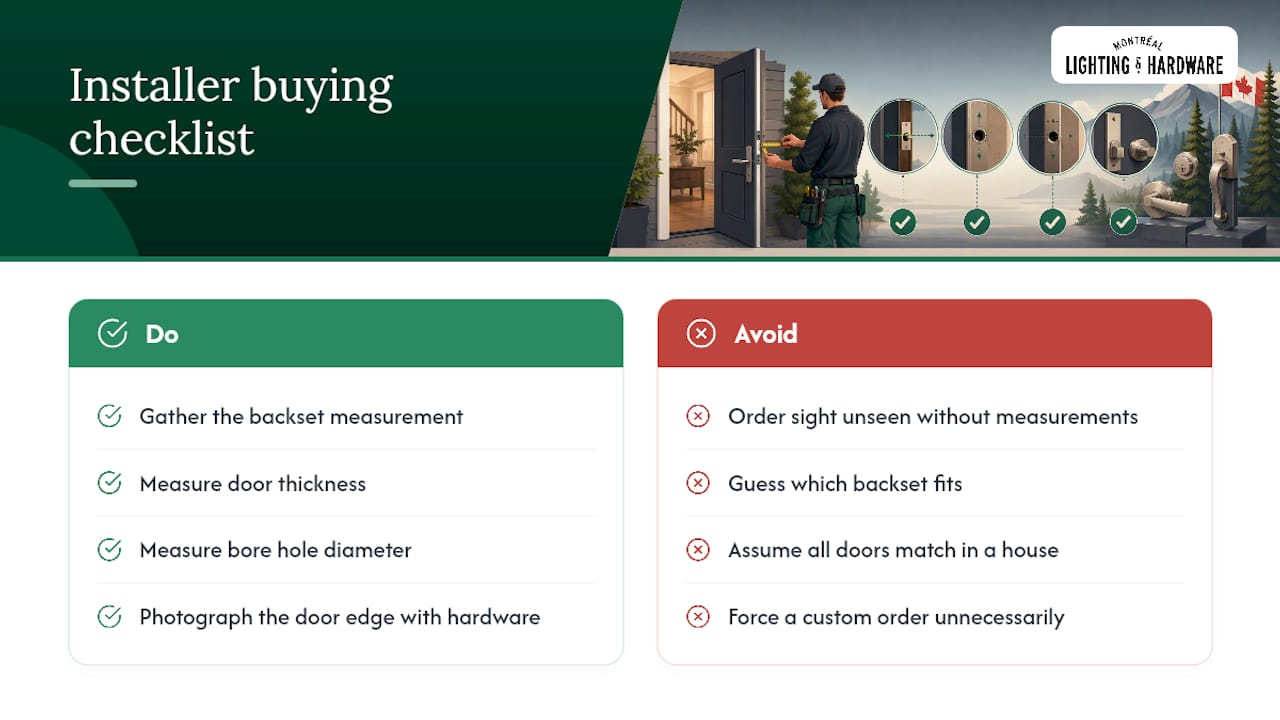
Before you order hardware or call an installer, gather four things: the backset measurement, door thickness, bore hole diameter, and a photo of the door edge with the old hardware still in place if possible. That level of detail speeds up matching and cuts down on returns, especially when you’re ordering sight unseen.
If you’re not fully certain which backset your door takes, or you’re outfitting several doors that might not match, adjustable-latch hardware is the pragmatic choice. It removes the guesswork without forcing you into a custom order.
Some lighting and hardware suppliers work with trade professionals and homeowners who need this kind of precision, offering detailed product pages, staff support, and fast shipping to help ensure the right hardware reaches the right door the first time.
What Most Backset Advice Gets Wrong
Most guides treat backset like a simple lookup: measure once, buy accordingly, done. In practice, the bigger risk isn’t picking between 2-3/8 and 2-3/4 inches. It’s assuming your door’s construction will accept whichever one you prefer. Stile width and bore placement often make that decision for you, especially on narrower interior doors, and no amount of careful measuring changes what the wood physically allows.
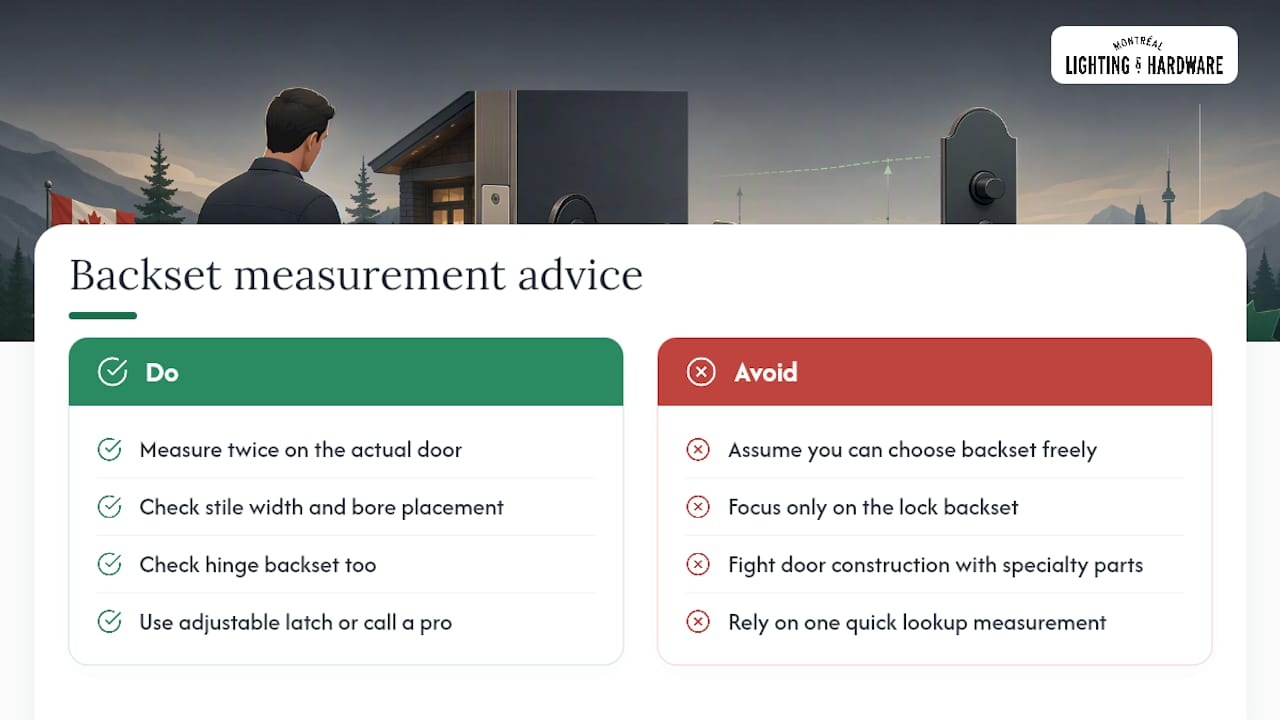
The conventional advice also underweights hinge backset. Homeowners fixate on the lock measurement and forget that a door hung with the wrong hinge backset creates its own alignment headaches, independent of anything happening at the latch. Both numbers deserve attention, not just the one that’s easier to search for.
If there’s one thing to prioritize, it’s this: measure twice, on the actual door, before you order anything. And when a door’s construction limits your options, don’t fight it with a specialty part. An adjustable latch, or a quick call to someone who handles this daily, saves more time than any amount of forum research.
— Montreal Lighting & Hardware
Get the Right Hardware Fit, No Guesswork Required
Some lighting and hardware suppliers carry detailed product pages that spell out backset, bore size, and door thickness requirements upfront, reducing guesswork about which lockset actually fits the door. They may offer team support to walk you through compatibility questions and provide trade professionals with exclusive pricing and fast shipping on top of that support.
Whether you’re outfitting a single interior door or working through a full renovation, starting with accurate measurements and the right product page saves you a return trip. Browse Montreal Lighting & Hardware’s full catalog to see detailed specs before you buy, or reach out to our team with your door’s dimensions and let us help you match the correct hardware the first time.
