

For buyers, value engineering lighting means assembling spec-preserving, trade-priced fixture packages that cut total project cost without dulling the look or performance your design promised. It’s a purchasing discipline, not an engineering process. A practical path to real savings is standardizing repeat fixtures, checking specs before checking price, and buying at the right moment through a knowledgeable trade partner.
TL;DR:
- Confirm that substituted fixtures meet actual performance metrics such as lumens, CRI, UGR, and compatibility with dimming controls, not just visual similarity.
- Assess the fixture’s rated life, warranty support, and local representation to avoid replacements or service issues during the project’s lifetime.
- Build SKU families and standardize fixtures for secondary spaces to leverage volume pricing and simplify procurement.
- Negotiate delivery terms, lead times, and damage protection alongside price to prevent installation delays and added costs.
- Beware of low-cost quotes lacking detailed specifications for lumen, CRI, warranty, or lead time, which can lead to costly replacements or substandard performance.
Table of Contents
- Why Cutting Corners on Lighting Costs More Later
- What to Check Before You Approve Any Substitution
- How to Build a Value-Engineered Lighting Package
- Trade Buying Tactics That Actually Move the Needle
- Red Flags That Turn Savings Into Regret
- A Trade Partner’s View on Preserving Design While Cutting Cost
- Get Trade Pricing on Designer Fixtures That Fit Your Budget
- Where This Guidance Comes From
- Sources
Why Cutting Corners on Lighting Costs More Later
There’s a real difference between swapping a fixture because it’s cheaper and swapping it because it does the same job for less. The first approach is guesswork. The second is what Montreal Lighting & Hardware would actually call value engineering, and it only works when someone technically compares the original spec against the substitute before the order goes in. Skip that comparison and you inherit someone else’s problem.
Lighting professionals see this play out constantly: a swap that looked like a bargain on paper turns into glare complaints, a warranty claim nobody can process, or an electrician stuck rewiring a fixture that needed different hardware. The collaborative approach to value engineering preserves design intent precisely because it treats substitution as a technical exercise, not a discount hunt.
The risks of a careless swap show up in predictable places:
- Higher Unified Glare Rating (UGR) than the room can tolerate, especially in offices and kitchens
- A CRI drop that makes finishes and skin tones look flat or off
- No local warranty support when a driver fails eighteen months in
- Commissioning failures that force a return trip and a second labor bill
The fix is thinking in lifecycle cost, not sticker price. A fixture that costs more but runs on a longer-rated LED engine and pairs cleanly with your dimming system often wins over time, even though it loses on day one.
What to Check Before You Approve Any Substitution
Every fixture proposal deserves a short interrogation before approval. Buyers who skip this step often find out mid-installation that “equivalent” was doing heavy lifting in someone’s sales pitch.
Run candidates through this order:
- Light performance first. Confirm lumens, LPW (lumens per watt), CCT, CRI, and UGR against the original spec, not against a generic “similar” fixture. A living room pendant can tolerate a CRI in the 80s; a kitchen task light or a vanity really can’t.
- Durability and service. Check the rated life in hours, the warranty term, and whether the brand has local representation for parts. A fixture with no accessible replacement driver is a liability the moment it fails.
- Control compatibility. Verify the driver works with your dimming protocol, whether that’s 0-10V, DALI, or DMX. Mixing driver types across a project is one of the most common causes of flickering and callback visits. This driver selection guide is worth a read before you finalize a package.
- Procurement signals. Ask for lead time by SKU, not by order. Landed cost, meaning the unit price plus freight and damage risk, often changes the math entirely.
- Installation impact. Look at assembly level and mounting hardware. A fixture that needs a custom junction box or extra labor hours can erase whatever you saved on the sticker price.
Pro Tip: Ask every supplier for the fixture’s rated life in hours, not just “years of service.” Marketing language rounds up; the hour rating doesn’t.
How to Build a Value-Engineered Lighting Package
Getting a package that holds its design integrity while trimming cost is a sequence, not a single negotiation. Skipping steps is how “affordable” turns into “regrettable.”
- Set priorities with your design team first. Decide which fixtures are non-negotiable, the entryway chandelier, the statement pendant over an island, and which ones can be standardized without anyone noticing.
- Build SKU families. Choose one or two repeatable fixtures for hallways, closets, and secondary rooms, then order them in bulk. Reserve the boutique, feature-worthy pieces, like a Sonneman pendant, for the rooms where they’ll actually get noticed.
- Run a lifecycle-cost check on every substitute. Compare initial price against projected energy draw, maintenance needs, and replacement risk over the fixture’s rated life. Lifecycle-cost analysis frequently tips the decision toward the higher-upfront-cost option once energy savings are factored in.
- Pilot before you commit to volume. Order one or two units of any substitute and test them for optical match and control compatibility before the full purchase order ships. This step alone catches most of the failures that show up during commissioning.
- Negotiate the whole package, not just the price. Freight terms, staged delivery dates, and lead-time guarantees matter as much as the unit discount. A well-timed lighting schedule makes this negotiation far easier because you already know exactly what ships when.
Trade Buying Tactics That Actually Move the Needle
Unit price is the number everyone fixates on, but it’s rarely the number that determines whether a purchase was smart. Trade pricing works as a three-level equation: quoted unit price, landed cost once shipping and handling are added, and installed cost once labor and commissioning are factored in. A fixture that wins on price one can lose badly on price three.
Timing matters just as much as the math. Clearance sections and floor models are smart buys when the fixture is going into a low-visibility space and you can verify it in person. They’re a poor bet when your project has a hard deadline and the supplier can’t guarantee a second unit if the first one arrives damaged.
Beyond the headline discount, worth negotiating:
- Freight thresholds that waive shipping above a certain order size
- Reserved inventory so your SKUs aren’t sold out from under you mid-project
- Staged deliveries that match your installation schedule instead of arriving all at once
- Replacement terms in case of transit damage, which happens more often with glass and finished metal fixtures than most buyers expect
Standardizing your fixture selection across a project does more than simplify installation. It gives you real leverage when you’re negotiating volume pricing, because a supplier can plan inventory around a repeat order instead of a one-off request.
Red Flags That Turn Savings Into Regret
The cheapest quote on the table is sometimes the most expensive fixture you’ll ever buy. Watch for a few patterns before you sign off on any substitution.
- A lumen match with no mention of UGR or CRI. Lumens tell you brightness, not comfort, and a pro buying guide for sale fixtures flags material integrity and environment rating as the details buyers skip at their own risk.
- Warranty language that’s vague about who handles a claim, or a supplier that can’t name a local point of contact.
- Lead times that shift after the deposit clears, or a pattern of damaged packaging on delivery, both are signs of a supply chain under strain.
- Nonstandard bulb or driver requirements buried in the spec sheet, which quietly commit you to a single vendor for replacement parts.
Pro Tip: Add acceptance criteria directly to your purchase order, spelling out lumens, CRI, and warranty terms in writing. It turns a vague promise into something you can actually enforce.
A Trade Partner’s View on Preserving Design While Cutting Cost
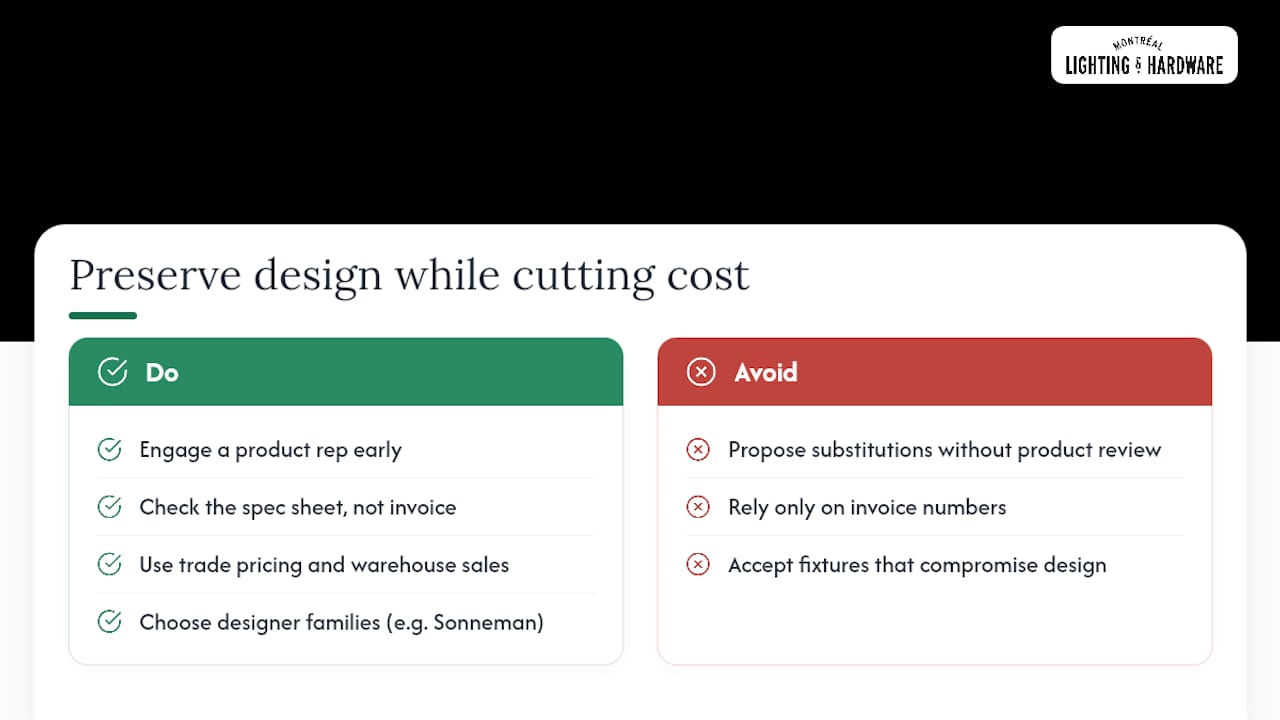
The projects that go smoothly almost always have one thing in common: someone with product knowledge got involved before the substitutions were proposed, not after. A rep who knows the catalog can flag an optical mismatch or a driver incompatibility in a five-minute conversation, saving weeks of rework later.
That’s the role a trade program is built to play. Access to exclusive pricing, a warehouse sale with meaningful markdowns, and designer families like Sonneman gives buyers room to hit a budget without settling for a fixture that looks like a compromise. The savings are real, but they only stay real when someone is checking the spec sheet, not just the invoice.
Get Trade Pricing on Designer Fixtures That Fit Your Budget
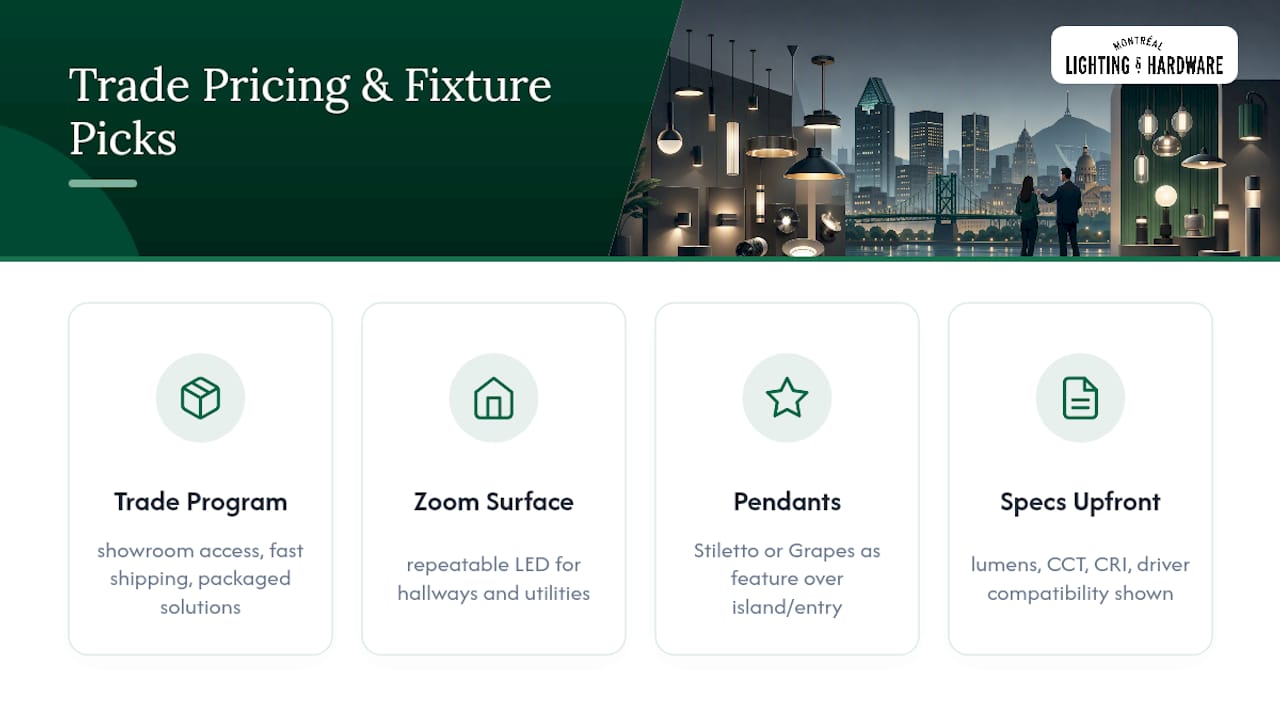
Access to designer brands at trade pricing, without showroom retainers or long waits, can be facilitated through certain trade programs that include showroom access, fast shipping, and packaged solutions built around the fixtures needed for your project.

Sonneman’s catalog is a good place to see what spec-driven value looks like in practice. The Zoom LED Surface Mount works well as a repeatable fixture across hallways and utility spaces. The Stiletto LED Pendant or the Grapes LED Pendant make sense as the reserved feature piece over an island or entry table. Every listing shows lumens, CCT, CRI, and driver compatibility up front, so you’re comparing specs, not guessing.
If you’re building a package for a full project, contact the trade team to review current warehouse sale pricing and confirm lead times before you finalize your SKU list.
Where This Guidance Comes From
The checklist and tactics in this guide draw on collaborative value engineering practices, trade pricing structures across landed and installed cost, lifecycle-cost analysis for lighting projects, and buying guidance for discounted fixtures. Lifecycle-cost thinking extends beyond lighting, too. The same logic that governs long-term HVAC operating costs applies just as directly to a fixture’s energy draw and maintenance schedule over its rated life.
Sources
- Value Engineering: The Collaborative Process to Find Cost-Efficiencies without Compromising the Performance, Longevity, or Intent of the Original Design
- Bulk Lighting Trade Pricing That Pencils Out – Hudson Valley Review
- Value engineered products: an electrical engineer’s guide in lighting projects – PacLights
- Light Fixtures on Sale: A Pro’s Buying Guide for 2026 – Golden Lighting
