

Soft white gives off a warm, golden glow that feels like a candlelit evening, while warm white is a touch cleaner and brighter, making it better suited to spaces where you need a little more clarity. The rule of thumb is simple: softer, warmer tones for rooms where you unwind, slightly cooler tones for rooms where you work.
- Soft white: bedrooms, living rooms, dining areas, hallways
- Warm white: kitchens, bathrooms, laundry rooms, home offices
- Quick check: always look for the Kelvin (K) number on the box, not just the marketing name
Table of Contents
- What warm white vs soft white actually means in Kelvin
- Side-by-side: how soft white and warm white compare
- Room-by-room recommendations for Canadian homeowners
- What to check before you buy: a practical checklist
- Other technical factors that shape your final result
- Frequently asked questions
- Key Takeaways
- The Montreal Lighting & Hardware perspective
- Find the right fixture at Montreal Lighting & Hardware
- Useful sources
What warm white vs soft white actually means in Kelvin
Color temperature is measured in Kelvin (K) and describes the visual tone of light, not its heat. Lower values appear more golden and amber, higher values look crisper and whiter. Marketing labels vary by brand, so the Kelvin number on the package is always the reliable guide.
| Visual Tone | Common Label | Typical Use |
|---|---|---|
| Deep amber, candlelight | Extra warm / vintage | Decorative, accent lamps |
| Soft golden yellow | Soft white | Bedrooms, living rooms, dining |
| Clean warm white | Warm white | Kitchens, bathrooms, task areas |
| Neutral white | Cool white / neutral | Offices, garages, commercial |
| Bright blue-white | Daylight | Studios, workshops |
Both soft white and warm white sit in the yellow-to-white range and are far less harsh than daylight or cool white, which starts around 4000K and can carry a noticeable blue tone.
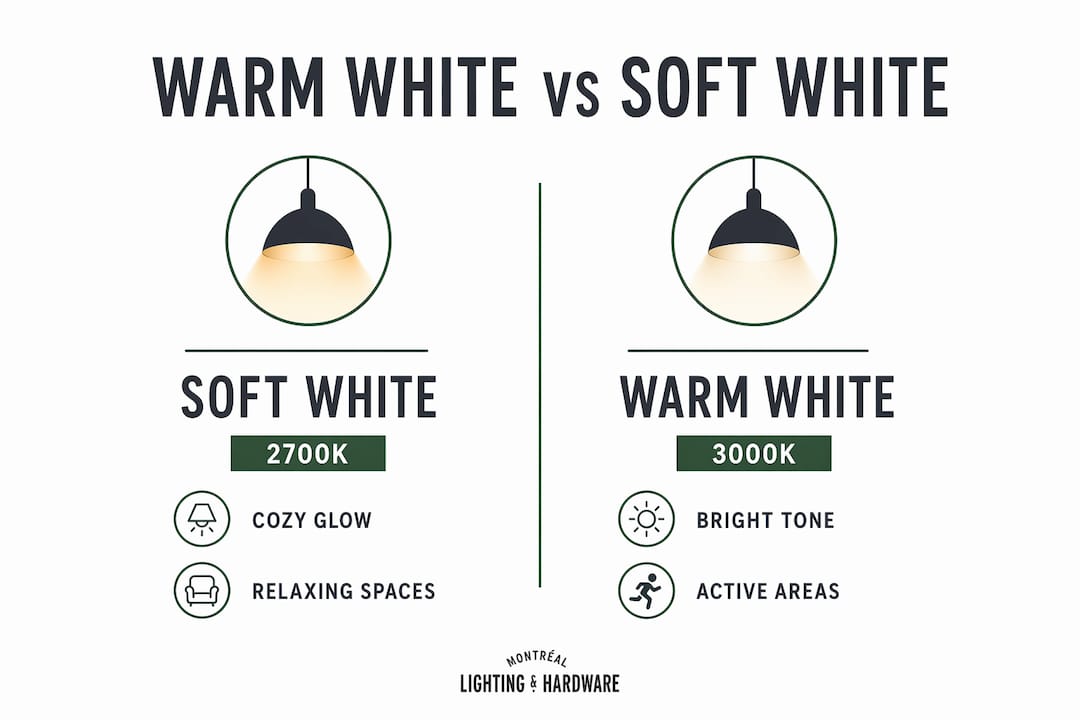
Side-by-side: how soft white and warm white compare
| Feature | Soft White | Warm White |
|---|---|---|
| Typical Kelvin | 2700K | 3000K |
| Visual tone | Golden, slightly amber | Clean warm, minimal yellow |
| Best rooms | Bedrooms, living rooms, dining | Kitchens, bathrooms, laundry |
| CRI expectation | 80–90+ | 80–90+ |
| Mood | Cozy, relaxed | Clear, welcoming |
A few practical tradeoffs worth knowing:
- Cozy vs. clarity: softer light softens shadows and reduces contrast, which feels restful. Slightly cleaner warm light keeps warmth but adds enough clarity for food prep or grooming.
- Color rendering: both benefit from a good CRI level, but the difference shows most in kitchens and bathrooms where you need accurate color.
- Wall and finish colors: 2700K can cast a slight yellow tint on white or cool-toned walls. If your home has bright white trim or gray cabinetry, 3000K is often the safer choice because it reads warm without going amber.
Room-by-room recommendations for Canadian homeowners
Living room and dining room
Stick with 2700K across every light source in your living room. The golden tone flatters wood finishes, natural textiles, and skin, and it creates that easy, end-of-day feeling you want when you settle in. Dining rooms follow the same logic: food looks richer and more appealing under a warm 2700K glow, and the atmosphere feels more intimate.
Bedroom
The bedroom is where 2700K truly earns its place. Some designers even go as low as 2200K on decorative bedside lamps for a cinematic, deeply restful quality. Use 2700K for your ceiling fixture and table lamps, and save any brighter light for a dedicated reading lamp positioned close to the page.

Kitchen
The kitchen is the one room where 3000K is worth the slight shift. You need to see the true color of produce, check whether meat is cooked through, and read labels clearly. A vanity or ceiling fixture at 3000K handles the task lighting, while a 2700K pendant or under-cabinet strip adds warmth once the cooking is done.

Bathroom
Bathrooms follow kitchen logic. Use 3000K at the vanity for reliable grooming light, especially for makeup and skincare. A three-light vanity bar positioned at eye level on either side of the mirror gives the most even, shadow-free result. If your bathroom is large enough for a shelf lamp, a 2700K bulb there adds a softer layer for evenings.
Laundry room and closets
Both spaces call for 3000K at a minimum. You are sorting colors, checking for stains, and deciding whether that shirt is navy or black. Warm, amber light makes all of those tasks harder than they need to be.
Hallways and home office
Hallways feel welcoming at 2700K, and the softer light is less jarring if you are navigating at night. A home office benefits from 3000K overhead for daytime focus, with a 2700K floor lamp nearby for video calls and evening sessions.
Pro Tip: Keep all ambient fixtures in one open-concept space at the same Kelvin value. Mixing 2700K and 4000K in the same room creates a visual tension your eye never fully adjusts to. If you want variation, use dimmers or a separate accent fixture rather than switching Kelvin values.
Dim-to-Warm LED technology is worth considering for living rooms and bedrooms. These bulbs shift toward amber as you dim them, mimicking the behavior of a classic incandescent, so you get a cozy, hospitality-style glow at low levels without buying a separate bulb.
How your bulb color interacts with your walls and trim matters too. If you are updating white interior doors or trim, keep in mind that 2700K can make bright white surfaces read slightly cream, while 3000K keeps them looking clean and fresh.
What to check before you buy: a practical checklist
- Kelvin (K) number: find it printed on the box or the bulb base. Ignore the marketing name; trust the number. Soft white is 2700K, warm white is 3000K.
- Lumens, not watts: lumens measure actual brightness. For most table lamps and ceiling fixtures, 800 lumens is roughly equivalent to a 60W incandescent. Larger rooms or task areas may need 1,100 lumens or more.
- CRI (Color Rendering Index): aim for 90 or higher in kitchens, bathrooms, and anywhere you care about how colors look. A CRI of 80 is acceptable for hallways and closets.
- Dimmer compatibility: check the box for a dimmer-compatible label. Not all LED bulbs work with every dimmer switch, and a mismatch can cause flickering or buzzing.
- Bulb type and base size: LED is the right choice for nearly every Canadian home today, given energy savings and bulb life. Confirm the base size (E26 is the standard medium base in Canada) before ordering online.
- Dim-to-Warm option: if you want that incandescent shift at low levels, look specifically for “Dim-to-Warm” on the packaging.
- Avoid mixing Kelvin in one room: buy all bulbs for a single room at the same time, from the same product line, to avoid subtle color differences between fixtures.
- Energy and efficiency labels: look for ENERGY STAR or NRCan certification on the packaging for verified efficiency ratings.
A quick note on lumens: brightness and color temperature are separate decisions. You can have a bright 2700K bulb or a dim 3000K one. Choose your Kelvin first, then select the lumen output that suits the fixture.
Other technical factors that shape your final result
Lumens and Kelvin work independently, but they interact in the room. A 2700K bulb at 400 lumens in a small bedside lamp feels soft and intimate. The same Kelvin at 1,600 lumens in an overhead fixture can feel harsh. Match your lumen output to the fixture’s purpose, not just the room.
CRI matters most where color accuracy counts. A CRI of 90+ means the light reveals colors close to how they look in natural daylight. In a kitchen, that means seeing the true color of food. In a bathroom, it means your foundation actually matches your skin. The NRCan home lighting design guide highlights CRI and dimming as two of the most important factors in residential lighting design.
Dimming behavior in LEDs is worth understanding before you buy. Some LED bulbs maintain their color temperature as they dim. Others shift slightly warmer, which can be a pleasant effect. Dim-to-Warm bulbs do this intentionally and dramatically, dropping toward a deep amber at low levels. If you are pairing bulbs with an existing dimmer, check the compatibility list on the bulb packaging.
Pro Tip: Buy one bulb and test it in the actual fixture before purchasing a full set. Light looks different on a store shelf than it does bouncing off your specific wall color, cabinetry, or ceiling height. One test bulb saves you from returning a dozen.
Frequently asked questions
Is soft white the same as warm white? Not exactly. The terms are often used interchangeably in marketing, but soft white refers to 2700K and warm white to 3000K. Always check the Kelvin number on the package.
Does soft white look yellow? A 2700K soft white bulb casts a gentle golden tone, especially on white or cool-toned walls. It reads as cozy rather than harsh. If you want warmth without the amber tint, 3000K is the cleaner option.
Which is brighter, soft white or warm white? Brightness is measured in lumens, not Kelvin. A 3000K warm white bulb can be dimmer or brighter than a 2700K soft white bulb depending on the product. Check the lumen output on the box.
Can you mix soft white and warm white in the same home? Yes, across different rooms. Using 2700K in bedrooms and living areas while using 3000K in kitchens and bathrooms is a common and effective approach. Avoid mixing the two within a single open-concept space, where the difference becomes visible and unsettling.
Which is better for a modern home with white walls? 3000K tends to work better with bright white or cool-toned finishes. It reads warm without casting the amber tint that 2700K can produce on crisp white surfaces.
Key Takeaways
Soft white (2700K) creates a cozy, golden atmosphere for relaxing spaces, while warm white (3000K) delivers cleaner light for task-oriented rooms like kitchens and bathrooms.
| Point | Details |
|---|---|
| Check the Kelvin number | Ignore marketing names; 2700K is soft white, 3000K is warm white — always verify on the box. |
| 2700K for unwinding | Use soft white (2700K) in bedrooms, living rooms, and dining areas for a relaxed, golden atmosphere. |
| 3000K for tasks | Use warm white (3000K) in kitchens, bathrooms, and laundry rooms for clearer color accuracy. |
| CRI and lumens matter | Aim for CRI 90+ in color-critical rooms; match lumens to fixture purpose, not just room size. |
| Montreal Lighting & Hardware | Browse fixtures and get personalized help choosing the right Kelvin and CRI for every room in your home. |
The Montreal Lighting & Hardware perspective
The most common lighting mistake we see in Canadian homes is treating color temperature as an afterthought. Homeowners spend weeks choosing paint colors and then install whatever bulb came with the fixture. A 2700K bulb in a kitchen with white cabinetry can make the whole space feel slightly dingy, while a 3000K bulb in a bedroom can make it feel like a hotel corridor at midnight. The fix costs almost nothing and takes five minutes. Pick your Kelvin based on the room’s purpose, confirm the CRI is 90 or above for any space where color matters, and put every ambient fixture on a dimmer. That combination gives you more control over atmosphere than any fixture upgrade alone. If you are working on an open-concept space or a renovation with multiple rooms, our team is happy to help you map out a consistent Kelvin plan before you buy.
Find the right fixture at Montreal Lighting & Hardware
Choosing the right bulb is only half the picture. The fixture shapes how that light spreads, softens, or focuses in a room.

At Montreal Lighting & Hardware, you will find a curated selection of residential and commercial fixtures from designer brands like Savoy House and Maxim, all available with fast shipping across Canada. Whether you are outfitting a bathroom vanity at 3000K or layering a living room with warm 2700K pendants, the team can help you match the right fixture to your Kelvin plan. Trade professionals also have access to exclusive pricing and a dedicated trade program.
- Shop online at montreallighting.com for the full fixture range, including the Hulton Six Light Chandelier and other statement pieces
- Get personalized help through the online chat or by visiting the showroom for hands-on guidance
Useful sources
- Home Lighting Design Guide — Natural Resources Canada / Energy Star Canada: Canadian government guidance on CRI, dimming, and energy-efficient lighting choices for residential spaces.
- Home Lighting Color Temperature Guide — Cree Lighting: Clear breakdown of Kelvin values and how soft white, warm white, and daylight differ visually.
- Choosing Between 2700K and 3000K — Waveform Lighting: Practical advice on why design professionals rely on Kelvin numbers rather than marketing labels.
- 5 Tips for Choosing the Right Lighting Temperature — ProBuilder: Designer-focused guidance on Kelvin consistency, finish interactions, and avoiding color mismatches.
- What Is Dim-to-Warm? — Aispire: Explains how Dim-to-Warm LED technology shifts color toward amber at lower brightness levels.
- Warm White vs. Soft White Light Bulbs — The Spruce: Consumer-friendly room-by-room comparison with practical examples for everyday homeowners.
Recommended
- Best Bathroom Vanity Lights for Canadian Homeowners – Montreal Lighting & Hardware
- Staircase Chandelier Ideas: Style, Size & Safety Guide – Montreal Lighting & Hardware
- Hulton Two Light Ceiling Mount | Crystorama – Montreal Lighting & Hardware
- Palla Four Light Bathroom Vanity | Crystorama – Montreal Lighting & Hardware
