


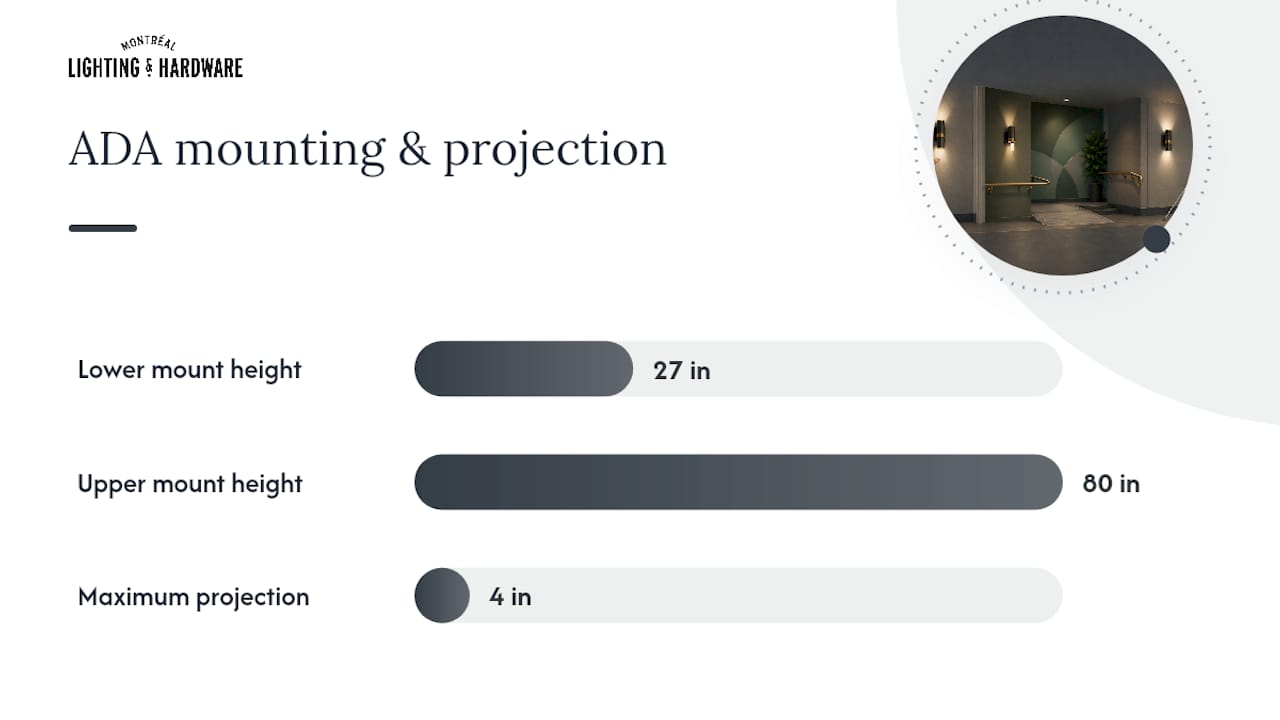
Yes, wall sconces can be ADA compliant when they meet the protrusion and mounting limits set out in federal accessibility guidance. The rule that matters most: fixtures mounted within a standard height range above the finished floor generally cannot project more than a limited small distance from the wall face. This falls under ADA Section 204: Protruding Objects, and it exists to keep walking surfaces clear for people using canes or wheelchairs.
- Check the projection spec (in inches) before anything else on a product page.
- A sconce mounted at 60 inches with a 3.5-inch projection typically clears the rule; one with a decorative arm that extends beyond the usual projection limit at the same height does not.
Quick rule: Fixtures mounted within the specified height range above finished floor must project a small distance or less from the wall to avoid creating a hazard for someone navigating with a cane or in a wheelchair, according to guidance referenced on wall sconce product pages built around this standard.
Table of Contents
- What Makes A Wall Sconce ADA Compliant?
- What Measurements Should You Check On A Sconce?
- Which Sconce Styles Are Easiest To Keep Compliant?
- How Do You Choose And Verify A Compliant Sconce?
- How Do You Maintain ADA Compliance For Sconces?
- Do ADA Rules Align With Other Building Codes?
- How Montreal Lighting & Hardware Helps You Verify Compliance
- Where To Verify These Numbers Yourself
- What Actually Matters When You’re Buying For Compliance
- Ready To Find Your Compliant Sconce?
- Sources
What Makes A Wall Sconce ADA Compliant?
The ADA doesn’t regulate “sconces” by name. It regulates protruding objects, any fixture, sign, or architectural element that sticks out into a circulation path and could go unnoticed by someone scanning the space with a cane. A wall sconce becomes a protruding object the moment it’s mounted at cane detection range and juts out past the allowed limit. That’s the whole concept in plain terms, and it’s why the same lighting fixture can be compliant in one hallway and noncompliant in another, depending purely on where and how it’s hung.
A handful of fixture attributes decide which side of that line a sconce lands on:
- Projection depth — how far the fixture extends from the wall face, measured at its outermost point, including any glass shade or decorative arm.
- Mounting offset — the height at which the fixture sits, since the 4 inch rule only kicks in within the 27 to 80 inch band.
- Shielding or covering — enclosed or flush designs reduce the outermost projection point compared to open, arm-style sconces.
- Shape and profile — rounded, tapered, or angled forms tend to comply more easily than boxy or cantilevered designs.
Marketing copy that says “ADA friendly” isn’t a substitute for the numbers. The product cut-sheet and installation instructions are the actual verification documents, and retailers who filter listings as “ADA” are describing measured capability, not a legal certificate, according to how category pages on sites like Destination Lighting on Houzz present these fixtures. Pull the spec sheet before you pull the trigger on a purchase.
What Measurements Should You Check On A Sconce?
Three numbers matter, and they’re easy to confuse if you’ve never measured a fixture with this in mind.
- Mounting height (AFF). Measured from the finished floor to the fixture’s centerline or bottom edge, depending on the manufacturer’s spec sheet. Many guides reference a range close to what ADA specifies as the relevant band for wall-mounted objects.
- Projection. Measured from the wall face to the outermost point of the fixture, including shades, arms, or diffusers. This is the number tied to the 4 inch rule.
- Offset or standoff. The gap between the wall and the fixture’s mounting plate, which affects total projection even before you add the shade or housing.
The number to memorize: 4 inches. That’s the maximum allowable projection for any object mounted between 27 and 80 inches AFF in a circulation path.
For a quick gut check: a hallway sconce at 66 inches AFF with a 3-inch cylindrical shade passes easily. A bathroom sconce flanking a mirror at 60 inches with a 5-inch swing arm does not, even if it looks proportionally modest in the showroom. Corridor placements deserve extra scrutiny since ADA path-of-travel rules stack on top of the protrusion limit there.
Which Sconce Styles Are Easiest To Keep Compliant?
Some fixture families make compliance almost automatic, and knowing which ones tends to save you a return shipment. Flush and recessed mounts sit nearly against the wall by design, so there’s little room for the projection number to creep past 4 inches. Integrated LED modules help too, since they replace bulky sockets and shades with a slim, sealed housing, delivering the energy-efficient benefits of LED lighting.
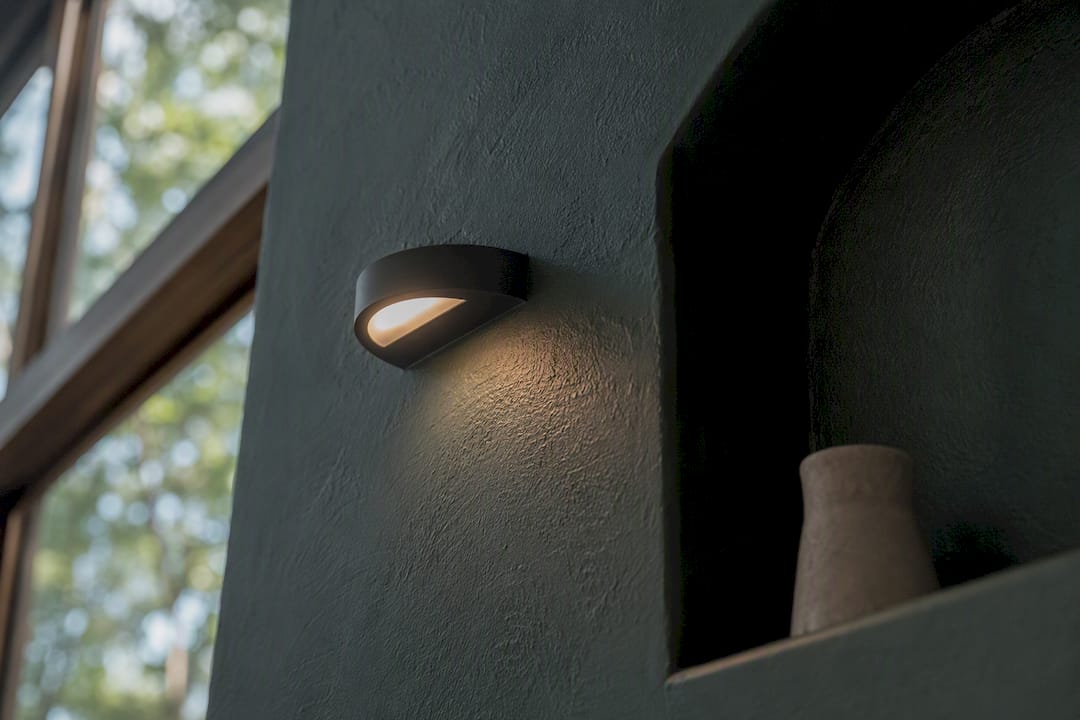
Shielded uplight and downlight sconces, where the light source is tucked behind a lens or baffle rather than exposed on an arm, tend to comply for the same reason: less hardware sticking out into the hallway. Suppliers who specialize in accessible lighting consistently point to shallow-profile, integrated-LED fixtures as the practical default, since fewer moving parts (arms, harps, separate shades) means fewer chances for the outermost point to exceed the limit, a pattern confirmed by product notes across ALA Lighting’s supplier listings.
Style checklist for compliant shopping:
- Flush or semi-flush mount, not arm-extended
- Integrated LED driver rather than a separate socket and shade
- Shielded lens or baffle instead of an open bulb
- Rounded or tapered profile with no sharp cantilevers
Beyond the legal minimum, lumens and color temperature matter for anyone shopping with aging eyes in mind. A sconce in the 2700K to 3000K range with adequate output reduces glare while still supporting the visual acuity many older adults need in hallways and bathrooms.
Pro Tip: Ask for the fixture’s total assembled projection, not just the “housing depth.” Shades and diffusers often add an inch or more that doesn’t show up in the headline spec.
How Do You Choose And Verify A Compliant Sconce?
Selecting the right fixture is only half the job. Confirming it stays compliant once it’s on the wall is the part people skip, and it’s the part that gets flagged in an inspection.
- Ask your supplier for the exact projection in inches, not a rounded figure or a marketing label. Request the installation cut-sheet and any referenced ADA or ANSI guidance the manufacturer cites.
- Confirm the mounting offset separately from the shade or housing depth, since some decorative arms add projection that isn’t obvious from a catalog photo.
- Measure on-site from the finished floor, not the subfloor or a temporary surface, before you drill a single hole.
- Check the wheelchair path clearance in the actual corridor or room, accounting for furniture, handrails, or other fixtures nearby.
- Run a mock placement test with a cardboard template or taped outline at the proposed height and projection. This low-cost step catches problems that spec sheets alone can miss, a practice reflected in installation guidance from suppliers like Wall Sconce.
Watch for a few red flags before you commit: decorative arms with generous offsets that look elegant but blow past 4 inches, listings that omit a projection number entirely, and proprietary mounting brackets that quietly add an inch or two beyond what the fixture’s own housing suggests.
Pro Tip: Keep a paper trail. Save the cut-sheet, the supplier’s written projection confirmation, and a photo of your mock-up test. If a building inspector ever asks, you’ll have the answer in your inbox instead of scrambling.
How Do You Maintain ADA Compliance For Sconces?
Compliance isn’t a one-time checkbox you clear at installation. It’s a condition that has to survive years of repainting, remodeling, and fixture swaps, and small changes can quietly undo it.
Repainting a hallway often adds a fraction of an inch of buildup around a mounting plate, which sounds trivial until you’re at the edge of the 4 inch limit already. Check projection again after any wall renovation or repaint cycle, especially in commercial corridors where multiple coats accumulate over years.
Bulb or module replacements matter more than most people expect. If a fixture’s original LED module fails and a contractor swaps in a different aftermarket part, the replacement may sit further from the wall or add a visible housing that wasn’t part of the original compliant design. Always match replacement components to the manufacturer’s original spec, or re-measure after the swap.
Loose mounting hardware is a quieter risk. A sconce that’s shifted slightly on its bracket, even by a half inch, can tip a borderline fixture over the projection limit. Building managers overseeing multiple corridors should include a projection spot-check in routine facility inspections, not just an electrical safety check.
Finally, keep documentation current. If you replace a fixture, update the cut-sheet on file so the next contractor or inspector isn’t working from outdated specs. A five-minute filing habit now saves a compliance dispute later.
Do ADA Rules Align With Other Building Codes?
ADA guidance doesn’t operate alone. Most jurisdictions layer it against the International Building Code (IBC) and, for many commercial and public projects, ICC A117.1 standards, which provide the technical dimensions many local codes adopt by reference. In practice, the numbers rarely conflict: the 4 inch projection limit and the 27 to 80 inch height band show up consistently across these frameworks because ANSI-based accessibility standards feed into all of them.
Where things get more complicated is scope. The ADA applies broadly to places of public accommodation and commercial facilities, while state and provincial building codes may add stricter clearance requirements for specific occupancy types, hospitals and senior care facilities in particular. A sconce that clears the baseline ADA rule might still need extra clearance in a memory care corridor if local code sets a higher bar.
Residential projects sit in a gray zone. The ADA generally doesn’t govern private single-family homes, but designers working on aging-in-place renovations often apply the same 4 inch, 27 to 80 inch framework anyway, since it’s a reasonable, tested benchmark for lighting for aging eyes and mobility-conscious design. When a project spans jurisdictions or occupancy types, the safest move is applying the strictest applicable standard rather than assuming the federal minimum covers every local requirement.
How Montreal Lighting & Hardware Helps You Verify Compliance
Getting the paperwork right is as important as picking a good-looking fixture, and that’s where Montreal Lighting & Hardware fits into your project. Every product listing comes with access to manufacturer cut-sheets, so you’re not guessing at projection or mounting offset from a photo. Trade professionals get pricing support and direct consultation for multi-unit or commercial specs, and our showroom team can help with hands-on measurement questions before you commit to an order.
Our catalog includes several low-profile families worth a look for accessible sconces for disabled access corridors and aging-in-place bathrooms, including the Sabon LED wall sconce and the Angled Plane LED wall sconce, both built around shallow, integrated-LED housings. These are examples of the shallow-profile category, not a ranked recommendation over other compliant options you might find elsewhere.
Before you order:
- Request the cut-sheet and confirm the exact projection in inches.
- Ask about mounting offset for your specific wall assembly.
- Schedule a trade consultation if you’re specifying fixtures across multiple units or corridors.
| Point | Details |
|---|---|
| Controlling rule | Fixtures mounted 27 to 80 inches AFF must project 4 inches or less to meet ADA Section 204. |
| Verify before buying | Request the exact projection figure and cut-sheet from the supplier, not a rounded estimate. |
| Best-fit profiles | Flush, recessed, and integrated LED sconces reduce projection risk more reliably than arm-style designs. |
| Recheck after changes | Repainting, hardware repairs, and bulb swaps can quietly push a compliant fixture past the limit. |
| Publisher support | Montreal Lighting & Hardware provides cut-sheets and trade consultation to confirm specs before installation. |
Wall sconces meet ADA standards when their measured projection and mounting height fall within the federally recognized protruding-object limits, and verifying those two numbers matters more than any marketing label.
Where To Verify These Numbers Yourself
- Destination Lighting on Houzz for examples of projection and mounting specs on retail listings.
- Montreal Lighting & Hardware for cut-sheets and trade consultation on specific fixtures.
What Actually Matters When You’re Buying For Compliance
Most advice on this topic treats ADA compliance like a checkbox you either tick or miss. That framing misses the real risk, which is drift. A sconce that’s compliant on installation day can stop being compliant two years later after a repaint, a bracket repair, or a well-meaning maintenance swap nobody measured. The industry talks endlessly about which fixtures qualify at purchase and barely mentions what happens after.
If you take one thing from this guide, prioritize documentation over decoration. A fixture with a slightly less striking profile but a clean, verifiable cut-sheet will serve a commercial corridor better over a decade than a beautiful arm-style sconce with a projection number nobody wrote down. Facility managers should treat projection spot-checks the way they treat fire extinguisher inspections: routine, boring, and non-negotiable.
The other overlooked piece is scope creep between codes. Don’t assume the federal minimum satisfies your local building department or your state’s accessibility code for healthcare and senior facilities. When in doubt, measure for the stricter standard and keep the paperwork to prove it.
— Montreal Lighting & Hardware
Ready To Find Your Compliant Sconce?
Montreal Lighting & Hardware gives you something most single product listings can’t: real access to the people who can confirm a fixture’s numbers before you buy, not after the return window closes. Instead of piecing together projection specs from thumbnail photos across scattered retailer sites, you get manufacturer cut-sheets, a showroom team that can talk through mounting offset with you directly, and trade pricing if you’re specifying for multiple units or corridors.
That matters most when a project spans several fixtures with tight code requirements, a senior living corridor, a multi-unit residential renovation, a commercial hallway retrofit. Browse our wall sconce collection to compare low-profile LED options, or reach out to request a cut-sheet and confirm projection on any fixture before you place an order. If you’re weighing accessible bathroom lighting alongside wall sconces, our Sabon LED pendant is worth a look for adjacent fixtures in the same space.
