


Use a layered scheme for staircase wall lighting: wall sconces as your primary light source, step or linear LED lights for direct tread illumination, and dimmable controls so you can shift from bright and functional to warm and welcoming at night. This combination solves the two things a staircase actually needs — enough visible light on every tread to prevent a stumble, and enough warmth to make the stairwell feel like part of your home instead of a utility corridor.
For new construction, you have the freedom to wire sconces at the ideal height and run linear LED channels into the tread nosings during framing. For a retrofit, plan around your existing electrical boxes first, then fill gaps with battery-powered or plug-in step lights. Either way, the safety benchmark is simple: you should be able to see the edge of every single tread from the top of the staircase to the bottom.
Before you shop for fixtures, grab a tape measure. Two numbers matter most:
-
Riser height (the vertical distance between treads), which tells you how many sconces you’ll need per flight
-
Total tread count, so you can plan even spacing rather than guessing as you go
Key Takeaways
Layered lighting, correct mounting height, and dimmable controls together solve both the safety and design goals of any staircase project.
| Point | Details |
|---|---|
| Layer three light sources | Combine wall sconces, step or linear task lights, and dimmable controls for full coverage. |
| Mount at the right height | Position sconces 60 to 66 inches above each adjacent tread, measured tread by tread. |
| Space for overlap | Place one sconce every 3 to 4 treads, adjusting for beam spread and lumen output. |
| Target visible treads | Aim for 5 to 15 foot-candles at tread level, well above the 1 foot-candle code minimum. |
| Shop proven fixtures | Montreal Lighting & Hardware’s Sonneman Stiletto, Sabon, and Crystorama Sloane and Sylvan sconces fit standard stair specs. |
Table of Contents
- Fixture Types That Work Best on Staircase Walls
- How High Should You Mount Staircase Wall Sconces?
- Choosing a Fixture Style That Fits Your Staircase
- Smart Controls for Safer, More Convenient Stairs
- What to Expect During Installation or a Retrofit
- Fixtures From Montreal Lighting & Hardware Built for Stair Use
- Why Measurements Matter More Than Inspiration Photos
- Get the Right Fixtures for Your Staircase Project
- Sources
Fixture Types That Work Best on Staircase Walls
Wall sconces do the heaviest lifting in most staircase lighting plans, and for good reason. Mounted at a consistent height alongside each tread, sconces are the most effective way to illuminate the tread surface because they throw light downward exactly where your foot lands next. Sconces come in three basic beam patterns: up-light (softer, more ambient, less direct tread coverage), down-light (the most functional for navigation), and up-down combinations that give you both a glow on the ceiling and a pool of light on the stair below. If you only choose one fixture type for a staircase, this is it.
Step and riser lights go a level further. These small, recessed fixtures sit directly in or above the tread, casting light straight onto the walking surface with almost no visible fixture. They’re the closest thing to airport runway lighting for your home, and they pair naturally with the sconce layer rather than replacing it.
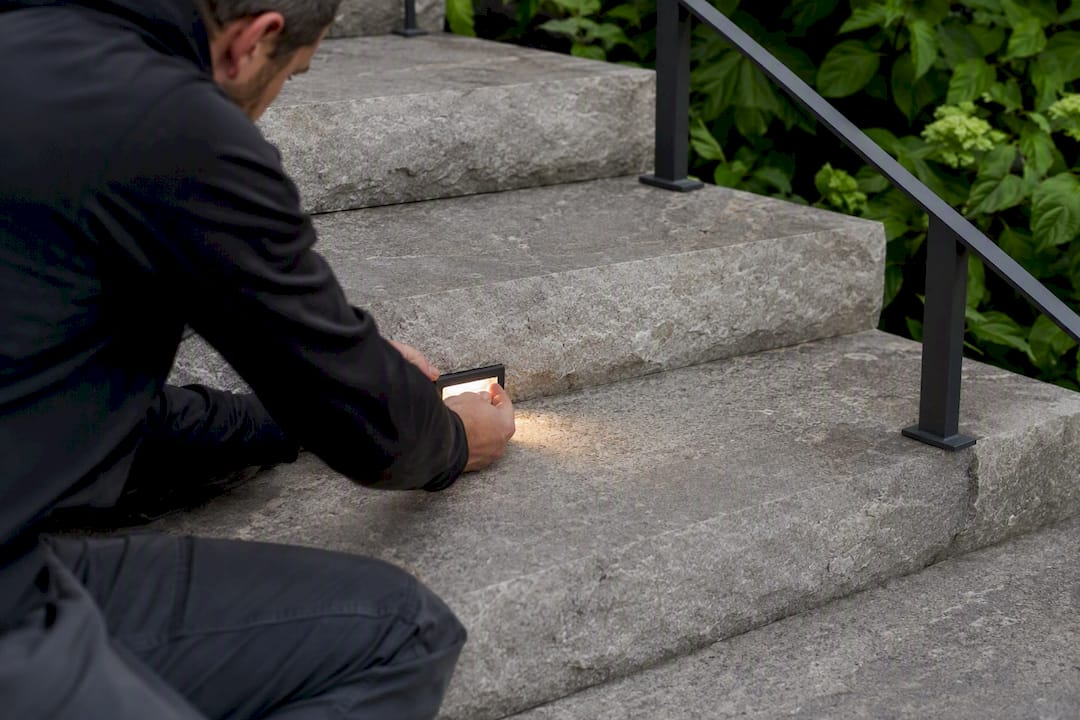
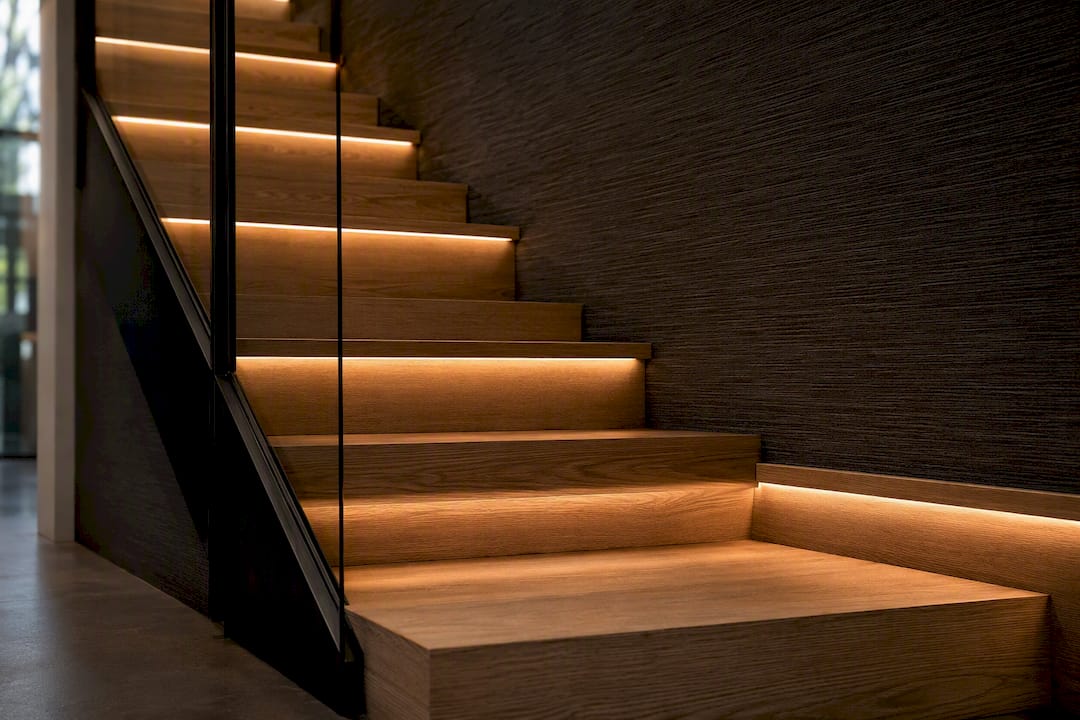
Linear LED strips, often installed under the nosing of each tread or along a stringer, create a continuous ribbon of glow rather than individual points of light. Designers gravitate toward these for the sculptural effect, though Houzz notes that linear step lighting and illuminated handrails require more complex detailing and installation than a simple sconce swap. You’re routing a channel, hiding a driver, and coordinating with whoever builds or refinishes your stairs.
Illuminated handrails and newel post lighting round out the list as statement pieces rather than workhorses. They look striking, especially on open-riser or floating staircases, but they’re best treated as a decorative accent layered on top of sconces and step lights, not a substitute for either.
Here’s how the four options stack up for a typical residential project:
- Wall sconces — moderate installation complexity, strong design impact, works in nearly any retrofit.
- Step/riser lights — low to moderate complexity if wired during construction, more involved to retrofit into finished treads.
- Linear LED channels — highest installation complexity, biggest visual payoff, best suited to new builds or full stair renovations.
- Illuminated handrails — moderate to high complexity depending on railing material, purely supplemental.
Pro Tip: *If you’re renovating an existing staircase and don’t want to open up walls for wiring, start with sconces on a retrofit-friendly junction box, then add battery-powered step lights later.
How High Should You Mount Staircase Wall Sconces?
Mount staircase wall sconces at a consistent height above each adjacent tread, typically recommended to be between about five and five and a half feet, rather than measuring from the floor level. This distinction trips up more homeowners than any other measurement on this list. Because a staircase rises continuously, a sconce measured from the ground floor will sit at the wrong height by the time you reach the fourth or fifth step. Measure from the tread nearest each fixture so every sconce sits at the same relative height as you climb, which also creates a visual rhythm that reads as intentional rather than haphazard.
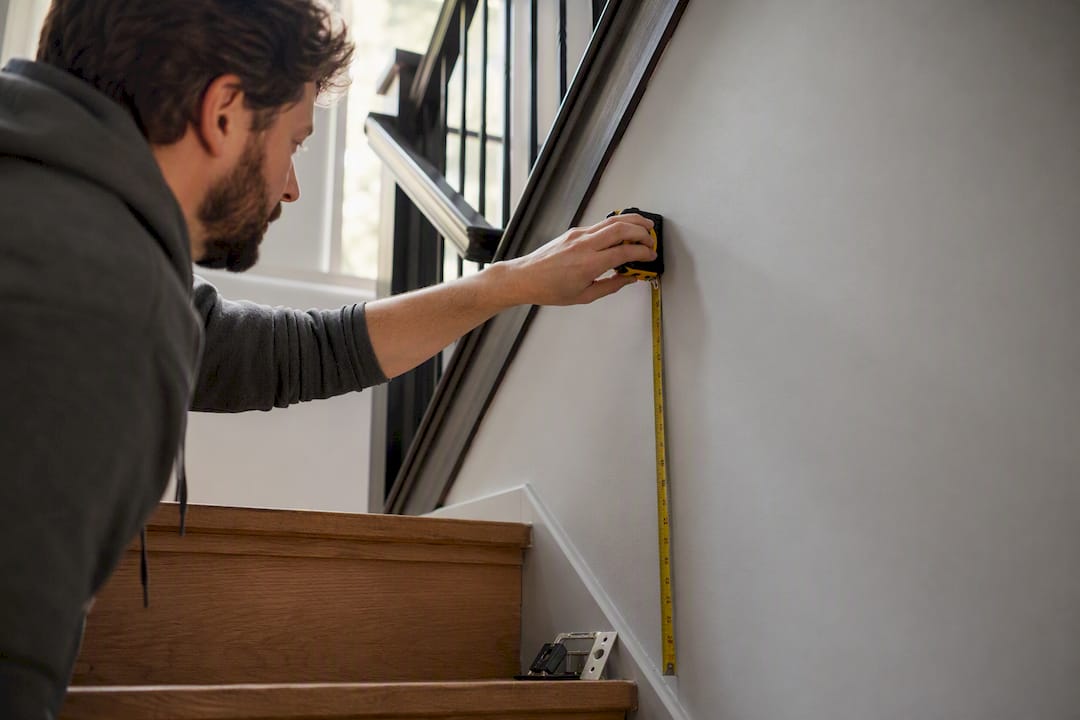
For spacing, plan on one sconce roughly every 3 to 4 treads, adjusting based on the fixture’s lumen output and beam spread. A sconce with a narrow, focused beam needs closer spacing to avoid dark gaps between fixtures; a wider beam angle can stretch coverage further. The goal is overlap, not isolated pools of light with shadowy gaps in between.
How much light does a staircase actually need? The International Residential Code sets a bare minimum of about 1 foot-candle measured at the tread surface, which is the legal floor, not a comfort target. For a staircase that feels genuinely easy to navigate, aim for 5 to 15 foot-candles at tread level. In practical terms, that usually means fixtures in the 100 to 400 lumen range per sconce, depending on spacing and ceiling height, dialed down with a dimmer for evening use.
A few placement details change how that light actually performs on the wall:
- Shielded or downward-facing sconces cut glare far more effectively than open, bare-bulb designs.
- A frosted or etched glass diffuser softens hot spots without sacrificing much output.
- Matte and brushed finishes scatter light more gently than polished chrome or glossy black, which can create distracting reflections on a stairwell wall.
Get the height and spacing right, and the code minimum becomes irrelevant. You’ll be well above it without trying.
Choosing a Fixture Style That Fits Your Staircase
Your staircase already has a personality, whether that’s the clean lines of a contemporary build or the millwork detail of a traditional center hall. The lighting should agree with it rather than fight it.
- Contemporary and minimalist staircases pair well with slim up-down sconces or fully recessed step lights that disappear into the wall, letting the architecture do the talking.
- Industrial staircases with metal railings or exposed brick suit exposed-bulb or cage-style sconces, though a shielded version of the same aesthetic will control glare better on a frequently used stair.
- Traditional staircases call for sconces with visible detailing, such as a candle-inspired arm or a decorative backplate, mounted at the same 60 to 66 inch height as any modern equivalent.
- Transitional spaces often land best with a simple, symmetrical sconce that reads as classic without looking ornate.
Scale matters as much as style. A sconce that looks proportionate on a wide stairwell wall can overwhelm a narrow one, so measure your wall width and ceiling height before falling for a large statement fixture. As a rough guide, keep the fixture width under a third of the available wall space between the stair stringer and any adjacent trim.
Choose a statement sconce when the staircase itself is a focal point in your home. Choose a subtler recessed or linear option when you want the lighting to support the architecture without competing with a chandelier, art wall, or dramatic railing already doing that job.
Smart Controls for Safer, More Convenient Stairs
A staircase gets used at every hour of the day, which means the right control strategy matters almost as much as the fixture itself.
- Dimming for scenes: set a “night mode” around 10 to 20% brightness for late-night trips, and a brighter “guest mode” near full output for entertaining or daytime cleaning.
- Motion sensors: mount them near the top and bottom landings rather than mid-flight, and set sensitivity conservatively so a passing pet doesn’t trigger a full lighting cycle every few minutes.
- Smart bulbs and hubs vs. traditional hardwired dimmers: smart bulbs offer scheduling and app control but depend on Wi-Fi and firmware updates; a hardwired dimmer switch is simpler, more reliable long term, and doesn’t fail during a network outage.
PacLights recommends pairing motion sensors and dimming with diffused, shielded fixtures as a combined safety and efficiency strategy, and that combination is worth prioritizing over any single smart feature on its own.
Pro Tip: Bring in a licensed electrician for the final wiring and code review, especially if you’re adding switches or sensors to an existing circuit. Staircase electrical work sits in a high-traffic area, and it’s not the place to improvise.
What to Expect During Installation or a Retrofit
Hardwired sconces give you permanent placement, full dimming compatibility, and no batteries to replace, but they require an electrician to run wire and set a junction box at the correct height. Battery or plug-in step lights skip that labor entirely, trading some design polish and dimming flexibility for a same-day install.
Linear LED channel installs are the most involved option on this list. You’re typically cutting a groove into the tread nosing, hiding a driver somewhere accessible for future service, and coordinating timing with whoever is building or refinishing the stairs, since the carpentry usually has to happen before the wiring goes in.
If a full retrofit isn’t realistic right now, surface-mounted step lights and magnetic or rechargeable stair pucks are genuinely useful stopgaps. Retailers like Lights Canada and marketplace listings on sites like Amazon.ca both carry motion-sensor and rechargeable versions that stick or clip on without any wiring.
- Exterior or covered outdoor stairs need fixtures rated for moisture exposure; check the IP rating before you buy, not after installation.
- LED drivers for linear systems should be placed somewhere serviceable, since a failed driver years down the line shouldn’t mean tearing open a wall.
- Budget for occasional bulb or driver replacement even with LED, since integrated fixtures sometimes require replacing the whole unit rather than a single bulb.
Fixtures From Montreal Lighting & Hardware Built for Stair Use
A few in-stock fixtures at Montreal Lighting & Hardware map directly onto the guidance above, which makes the shopping part of this project a lot less overwhelming.
- The Sonneman Stiletto LED wall sconce is a slim up-down design that fits the 60 to 66 inch mounting height without dominating a narrow stairwell wall, and it’s dimmer-compatible for night mode.
- The Sabon LED wall sconce uses a shielded design that controls glare on a stairwell where sightlines are close and constant.
- The Crystorama Sloane one-light wall mount suits traditional and transitional staircases that want visible detailing without excess bulk.
- The Crystorama Sylvan two-light wall mount offers more scale and output for wider stairwells or double-height entry stairs.
Montreal Lighting & Hardware backs these picks with showroom access, one-on-one design help, and trade pricing for designers and contractors managing a full renovation.
Why Measurements Matter More Than Inspiration Photos
Most staircase lighting guides lead with mood boards, and that’s backwards. A gorgeous sconce mounted at the wrong height creates uneven shadows that actually make a staircase harder to read at night, which defeats the purpose before the design conversation even starts.
The conventional advice to “add a statement fixture” skips the part that actually protects your household: consistent tread-level illumination. We’d argue the mounting height and spacing decisions deserve to come first, with style layered on top once the safety math checks out. That’s also the order that saves you money, since it’s far cheaper to pick a compatible fixture for a well-planned electrical layout than to relocate wiring after the fact.
If you take one thing from this guide, prioritize the tape measure over the catalog. Count your treads, measure your riser height, and figure out your spacing before you fall in love with a particular sconce. The right fixture is the one that fits the plan, not the other way around.
— Montreal Lighting & Hardware
Get the Right Fixtures for Your Staircase Project
Montreal Lighting & Hardware carries the specific sconces and wall mounts referenced throughout this guide, already sized and styled for stair use, so you’re not left guessing whether a fixture built for a living room will work on a stairwell.

Where a big-box retailer gives you a wall of options with no context, Montreal Lighting & Hardware pairs its in-stock catalog with showroom access and design guidance, so you can confirm scale, beam angle, and dimming compatibility before you buy rather than after installation. Design professionals and trade clients also get access to trade pricing, which matters if you’re outfitting more than one stairwell or landing.
Start by browsing the Montreal Lighting & Hardware catalog for in-stock sconces and wall mounts, or reach out to the showroom team to confirm the right fixture and mounting plan for your specific staircase.
Sources
Mounting height and illuminance guidance draw from the Portfolio Staircase Lighting Guide and PacLights. Browse in-stock fixtures and support options at Montreal Lighting & Hardware.
- Portfolio Staircase Lighting Guide: How to Light Your Stairs Safely and Beautifully
- 8 great ways to light up stairs — Houzz
- Lights For Staircase Wall: The Do’s and Don’ts in Lighting - PacLights
Recommended
- Bedroom Lighting Ideas That Set the Mood, Layer by Layer – Montreal Lighting & Hardware
- Small Bathroom Lighting: Space-Saving Layered Ideas – Montreal Lighting & Hardware
- Stiletto LED Wall Sconce | Sonneman – Montreal Lighting & Hardware
- Stiletto LED Wall Sconce | Sonneman – Montreal Lighting & Hardware
