


The single highest-impact move for any entryway is layering warm light at 2700 to 3000K, choosing a fixture scaled correctly to your space, and putting it all on a dimmer. Get those three things right and almost any entryway lighting ideas you pull from a magazine will translate into your own home.
Here’s what to do this week:
- Set every bulb near your front door to warm white for a welcoming glow, not a clinical one.
- Add one task light, like a console lamp or wall sconce, at eye level.
- Choose a fixture sized to your entry (more on the exact formula below).
- Install a dimmer switch or motion sensor so the mood shifts with the time of day.
Montreal Lighting & Hardware sees these three moves fix more flat, forgettable entries than any single “statement fixture” purchase ever does.
Key Takeaways
Great entryway lighting comes down to warm color temperature, correctly scaled fixtures, and layered light sources controlled by a dimmer.
| Point | Details |
|---|---|
| Set the right color temperature | Use 2700 to 3000K bulbs with CRI 80+ (90+ for rich wood or bold color) for a welcoming glow. |
| Size your fixture correctly | Add room length and width in feet, use that number in inches as your target diameter. |
| Layer three types of light | Combine ambient overhead, task at the console, and low accent lighting for evening depth. |
| Match mounting height to ceiling | Keep fixtures at least 7 feet above walking paths and drop pendants lower in tall foyers. |
| Choose finish based on budget and durability | Chrome offers a more budget-friendly, resilient plating; brushed nickel costs more upfront but resists tarnishing longer. |
| Shop with sizing and dimming in mind | Montreal Lighting & Hardware offers curated fixtures, trade pricing, and support for getting scale and warmth right. |
Table of Contents
- The Three Design Principles Behind Great Entryway Lighting
- Entryway Lighting Ideas for Small, Narrow, and Tall Spaces
- How to Layer Ambient, Task, and Accent Light
- How Big Should Your Entryway Light Fixture Be?
- What Color Temperature and CRI Work Best for Entryways?
- Entryway Lighting Trends Worth Watching in 2026
- What Should You Check Before Buying an Entryway Fixture?
- How Often Should You Replace Entryway Light Bulbs?
- Is Your Entryway Lighting Actually Safe?
- Where to Find Fixtures That Match These Ideas
- Frequently Asked Questions
- Sources
The Three Design Principles Behind Great Entryway Lighting
Every entry hall that photographs well and feels good to walk through follows the same three rules.
Warmth and color temperature. Warm white bulbs in the typical warm range read as homey and inviting, while cooler bulbs tend to feel closer to a hospital lobby than a home. Pair that warmth with a bulb rated CRI 80 or higher (aim for 90+ if you have rich wood tones or bold paint you want rendered accurately), since color rendering index measures how true colors look under a given light source.
Scale and proportion. A fixture that’s too small for the space reads as an afterthought; one that’s too large overwhelms the sightline from the front door. There’s a simple formula for getting this right, which we’ll walk through in the sizing section below.
Statement versus subtle. Pick one hero fixture and let it do the talking. Coordinate its finish with hardware visible from the same sightline rather than fighting it with three competing metals.
Pro Tip: If your entry feels flat no matter what overhead fixture you install, the fix usually isn’t a bigger chandelier. It’s adding one eye-level light, a sconce or table lamp, since a single overhead source almost always reads as harsh and one-dimensional.
Entryway Lighting Ideas for Small, Narrow, and Tall Spaces
The right approach changes dramatically depending on your ceiling height and footprint. Here’s what tends to work for each layout, based on the styled examples designers return to again and again.
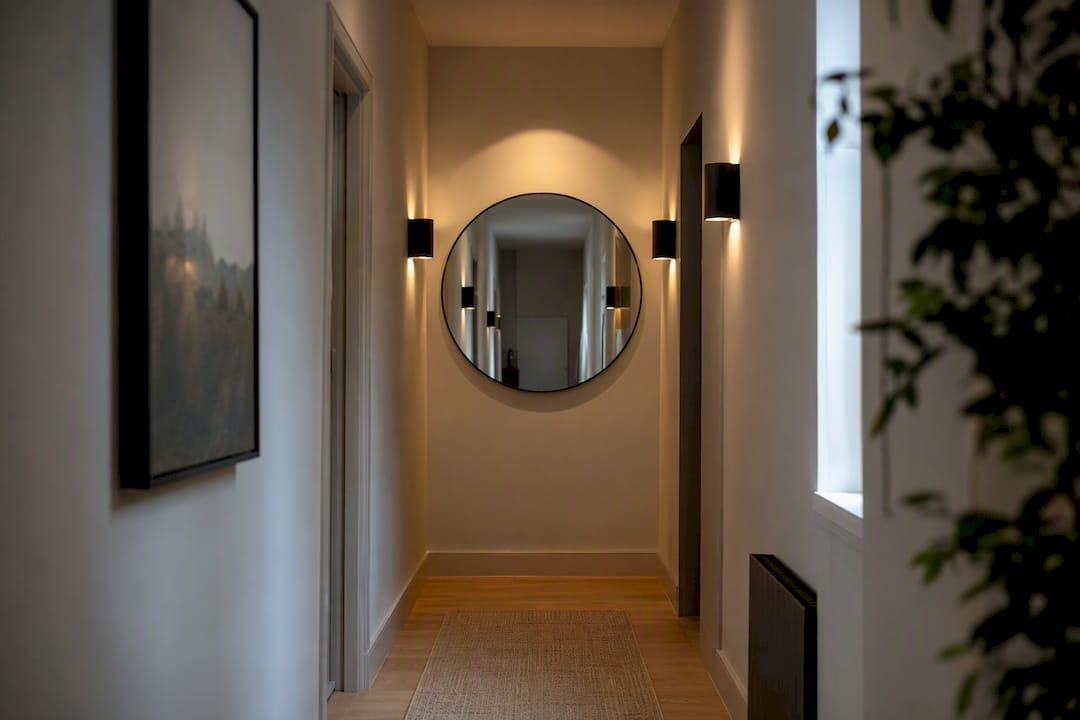
Small or low-ceilinged entries. Flush or semi-flush mounts keep the visual weight low without crowding an 8-foot ceiling, and a small single pendant works if your ceiling allows a few inches of drop. A mirror opposite the fixture bounces light back into the room and makes a tight foyer feel bigger. Stick to warm brass or matte black in a single finish so the small space doesn’t feel busy.
Narrow hallway entries. Skip the oversized pendant, which will block the sightline down a tight corridor. Wall sconces spaced evenly at eye level, combined with a recessed run for continuous ambient light, keep the hallway glowing without anything hanging into the walking path.
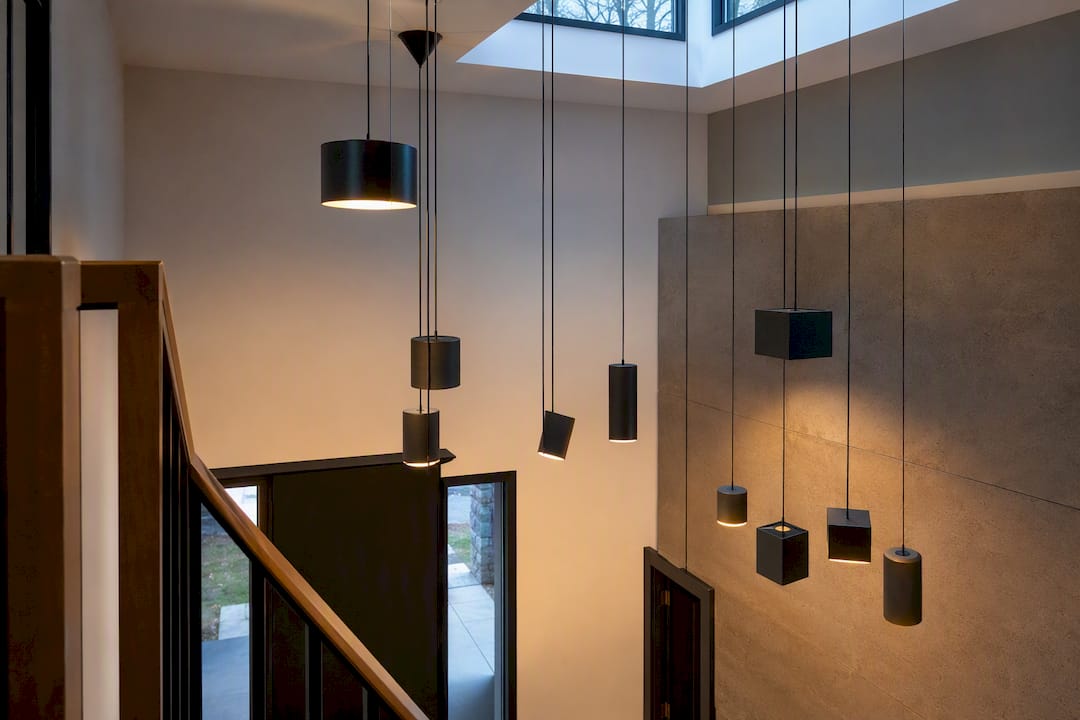
High or two-story foyers. This is where multi-tier chandeliers or a cluster of pendants hung at varying heights create real drama. Grouping pendants at different drop lengths creates a gallery-like rhythm that reads dramatically from the street, especially through sidelights or a transom window. The trade off is knowing when scale becomes overstatement. A chandelier like the Hulton Six Light Chandelier fills a double-height space without disappearing into it.
Open-plan entries visible from the living room. Coordinate the entry fixture’s finish and scale with whatever hangs in the adjoining space, since your entry light becomes a connective element the eye reads on its way through the house.
How to Layer Ambient, Task, and Accent Light
The three-layer method is the difference between an entry that feels flat and one that feels finished: ambient overhead for general light, task lighting at the surface for function, and low accent lighting for evening warmth.
- Start with ambient: a flush mount, semi-flush, or pendant handles the base layer.
- Add task: a console lamp or sconces flanking a mirror give you light to actually find your keys.
- Finish with accent: picture lights, puck lights under a bench, or a small lamp on a timer add depth once the sun goes down.
If you’re renting or don’t want to touch wiring, plug-in sconces, rechargeable battery fixtures, and smart bulbs on a schedule deliver the same layered effect. Cord covers keep a plug-in pendant looking intentional rather than improvised.
How Big Should Your Entryway Light Fixture Be?
Fixture sizing has an actual formula, and it takes the guesswork out completely.
The rule: add your entry’s length and width in feet, then use that number in inches as your target fixture diameter. A 6 by 8 foot entry (14 total) points you toward a fixture roughly 14 inches across. For a two-story foyer, scale that number up, since a fixture sized for a single-story ceiling will look lost floating in a taller volume.
Mounting height rules:
- Keep the bottom of any fixture at least 7 feet above the floor in a walking path.
- On an 8-foot ceiling, pendants should hang with their base near that 7-foot mark to stay clear of foot traffic while still reading as a fixture, not a hazard.
- In taller rooms, drop the pendant lower to fill the vertical space and add drama, since the same fixture height that feels generous at 8 feet will look stranded at 16.
- On a stairwell, check clearance at every step, not just the bottom landing, since the sightline changes as you climb.
Lumen targets run roughly 1,500 to 3,000 lumens total for a small entry, and scale up from there for medium and large spaces. Treat these as a starting range to adjust, not a fixed code requirement.
What Color Temperature and CRI Work Best for Entryways?
Warm white in the 2700 to 3000K range is the answer, paired with a CRI of 80 or higher. That combination flatters skin tones and wood finishes the moment you walk through the door, which matters more in an entry than almost anywhere else in the house since it sets the tone for every room beyond it.
- Target CRI 90+ if your entry has rich stained wood, patterned wallpaper, or artwork you want rendered accurately.
- For exposed bulbs (open sconces, unshaded pendants), a globe or vintage Edison-style LED adds character without sacrificing efficiency.
- LED sources last longer and run cooler than incandescent, which matters in a fixture you’ll likely leave on for hours at a time.
- Pairing your fixture with a dimmer gives you flexibility between a bright welcome-home setting and a low evening glow, but confirm the dimmer is rated for LED. Standard incandescent dimmers often cause flickering or buzzing on LED bulbs.
- Add a motion sensor if your hands are usually full of groceries or a kid’s backpack when you walk in.
Entryway Lighting Trends Worth Watching in 2026
Sculptural pendants and chandeliers with organic, hand-formed shapes are showing up everywhere, alongside warm metal finishes like brass and rose gold replacing the cooler chrome and nickel that dominated the last decade. Designers are also showing restraint with mixed metals, picking one dominant finish and one quiet accent rather than three competing tones.
Layered low-level accent lighting keeps appearing in styled foyers, and compact urban entries are leaning into smaller statement pieces scaled for tighter square footage rather than skipping drama altogether.
None of this matters if you ignore the fundamentals. A sculptural pendant still needs to hit the right diameter for your space and the right color temperature for your bulbs, or the trend just becomes a expensive mistake hanging in your hallway.
What Should You Check Before Buying an Entryway Fixture?
Run through this list before you check out:
- Confirm your ceiling height and calculate fixture diameter using the length-plus-width formula.
- Check the bulb base and LED driver compatibility before ordering, especially on vintage-style fixtures.
- Verify the listed CRI and color temperature match what you’re after (2700 to 3000K, CRI 80+).
- Buy a dimmer rated specifically for LED loads, not a legacy incandescent dimmer.
On finish: chrome tends to be the more budget-friendly option and comes with a highly resilient plating that holds up to daily handling. Brushed nickel usually costs a bit more upfront but resists tarnishing exceptionally well over years of use, which matters in an entry exposed to changing humidity from the front door.
Pro Tip: When you’re unsure which finish to pick, match it across your entry, stair rail, and hallway fixtures. Limiting yourself to two repeated metal accents keeps a home feeling pulled together instead of assembled piecemeal. Also ask about shipping lead times and return policies before you buy. Trade professionals get exclusive pricing, which is worth asking about even for a single fixture.
How Often Should You Replace Entryway Light Bulbs?
Most LED bulbs rated for entryway use last many thousands of hours, which at typical daily use translates to several years before replacement is needed. That said, a few habits keep your entry looking its best in the meantime.
Wipe down glass shades and metal finishes every few months. Entryways collect more dust and handling than almost any other fixture in the house, since it’s the first thing touched with outdoor hands and the last thing seen on the way out.
Check bulb color consistency across multi-light fixtures. A chandelier with five bulbs at 2700K and one leftover 4000K bulb from an old pack will look mismatched the moment it’s on, so keep a spare box of the correct temperature on hand. Write the color temperature on the box with a marker if you tend to mix up spares.
Test your dimmer periodically, especially after any bulb swap. LED and dimmer compatibility issues (flickering, humming, or a limited dimming range) usually show up within the first few uses, so catch it early rather than living with a buzzing fixture for a year.
For fixtures in stairwells or over tall entries, factor bulb access into your maintenance plan before you buy. A gorgeous chandelier that requires a ladder and a second person to hold it steady is a fixture you’ll dread maintaining. Some multi-tier designs use a pulley or drop-down chain specifically so bulb changes don’t require scaffolding.
Finally, clean any exterior-facing glass or lantern-style fixtures near the door separately from interior ones, since they collect pollen, rain residue, and insects that interior fixtures never see.
Is Your Entryway Lighting Actually Safe?
A dim entry isn’t just an aesthetic miss. It’s a genuine safety and security gap.
Inside the door: Make sure your entry light is bright enough to see stairs, thresholds, and uneven flooring transitions the moment you walk in, especially if anyone in your household has limited mobility or vision changes. A single warm overhead fixture combined with a task light at a console usually solves this without needing anything harsh or overly bright.
At the door itself: Outdoor fixtures flanking your entrance do double duty. They help you find your keys and see who’s on the other side of the door before you open it, and a well-lit entry is a basic deterrent that makes a home look occupied and cared for. A fixture like the Glacier One Light Outdoor Wall Mount handles that exterior coverage while still coordinating in finish with your interior pieces.
Wiring and installation: Any hardwired fixture near an entry, especially one exposed to exterior weather at a covered porch, should be installed to local electrical code. If you’re not confident working with wiring, a licensed electrician is worth the cost, particularly for anything involving a new switch or dimmer circuit.
Motion sensors matter here too. Beyond convenience, a motion-activated exterior light means you’re never fumbling for a switch in the dark with your hands full, and it means the light turns on automatically if someone approaches your door after dark.
Smart controls add a layer of security most homeowners overlook. A smart bulb or switch on a schedule can make your entry (and by extension your whole home) look lived-in even when you’re away, which is a small, low-effort habit with a real payoff.
Publisher’s quick perspective
Years of fielding trade orders and finish questions taught us this: readers second-guess dimmer compatibility far more than they should, and undersize their fixture far more often than they oversize it. Talk to us about finish and dimming before you order.
Where to Find Fixtures That Match These Ideas
There are plenty of places to browse entryway fixtures, but sorting through generic marketplace listings for the right scale, finish, and bulb compatibility eats up an afternoon fast. Montreal Lighting & Hardware carries designer lines like Savoy House and Maxim specifically curated for the sizing and warmth rules covered above, so you’re not guessing whether a pendant will actually fit your 8-foot ceiling or run too cool for a welcoming glow.

Browse the full range of pendants, chandeliers, and sconces organized by style and scale, or start with a specific piece like the low-profile Hulton Two Light Ceiling Mount built for exactly the low-ceiling entries described above. If your entry door and hardware are due for a refresh too, current interior door trends pair naturally with a finish update on your lighting. Design professionals get access to trade pricing and dedicated support, and every order ships fast with a straightforward return process if a fixture doesn’t fit once it’s in hand. Head to the site, filter by finish and ceiling type, and get a fixture on its way to your door this week.
Frequently Asked Questions
What is the best color temperature for entryway lighting? Warm white between 2700K and 3000K is the standard recommendation for entry halls, since it feels welcoming rather than clinical the moment you walk through the door.
How do I know what size light fixture I need for my entryway? Add your entry’s length and width in feet, then use that sum in inches as your target fixture diameter. A 7 by 9 foot entry points toward a roughly 16-inch fixture.
Should I put my entryway light on a dimmer? Yes. A dimmer rated for LED gives you flexibility between a bright welcome setting and a soft evening glow, and it’s one of the simplest upgrades for entry hall lighting.
What’s the difference between a chandelier and a pendant for an entryway? Chandeliers generally suit taller, two-story foyers where multiple light sources fill vertical space, while a single pendant works better for mid-height ceilings without overwhelming the sightline.
Is chrome or brushed nickel better for entryway fixtures? Chrome is typically more budget-friendly and holds up well thanks to resilient plating. Brushed nickel usually costs slightly more upfront but resists tarnishing better over time, so the choice comes down to budget versus long-term finish durability.
Sources
- Entryway Lighting Ideas That Match Your Home’s Style | HGTV
- Entryway Lighting Ideas: A Three Layer Guide
- Entryway Lighting That Makes a First Impression: Ideas & Fixture Guide – Amicolight
- Entryway Light Fixtures: Complete Guide for Homeowners - D and G Flooring
Recommended
- Best Bathroom Vanity Lights for Canadian Homeowners – Montreal Lighting & Hardware
- Andover One Light Outdoor Lantern Post | Crystorama – Montreal Lighting & Hardware
- Capsule Two Light Outdoor Wall Mount | Crystorama – Montreal Lighting & Hardware
- Capsule One Light Outdoor Wall Mount | Crystorama – Montreal Lighting & Hardware
