


Yes, mixed-metal lighting works when you pick a clear hierarchy, keep fixture shapes consistent, and control the light that shows off the metals. That’s the whole idea in one sentence, and everything else in this guide is just the “how.” Three rules get you there every time.
- Choose one dominant metal or dominant texture. Let it lead in your largest fixtures, then let everything else support it.
- Repeat every finish you introduce at least twice. A single brass accent in a room full of nickel looks like a mistake; two brass touches look like a decision.
- Control the light with a Color Rendering Index (CRI) of 90+ and the right Kelvin temperature. Warm bulbs flatter brass, cool bulbs flatter chrome, and the wrong choice can wash out the exact contrast you worked to create.
Think of a kitchen where brushed nickel pendants hang above an island, while black hardware anchors the cabinets and a single brass faucet warms up the sink. Or a living room where a bronze floor lamp echoes the finish on a nearby picture frame. Neither pairing happened by accident. At Montreal Lighting & Hardware, we see homeowners get nervous about “breaking the rules” of matching metals, but the real rule was never about matching. It’s about repetition and restraint.
Key Takeaways
Mixed-metal lighting succeeds when one finish dominates, shapes stay consistent across fixtures, and CRI 90+ bulbs at the right Kelvin range reveal each metal’s true color.
| Point | Details |
|---|---|
| Pick a leader | Choose one dominant metal or texture and let it cover the largest share of visible finish. |
| Repeat contrasting finishes | Use any secondary or accent finish in at least two spots so it reads as intentional. |
| Match shapes, not just colors | Fixtures with related silhouettes stay cohesive even with different finishes. |
| Get the light right | Use CRI 90+ bulbs, warm 2700K to 3000K for brass, cool 3500K to 4000K for chrome. |
| Shop with a plan | Montreal Lighting & Hardware offers finish samples, trade pricing, and a broad catalog to build your scheme from one source. |
Table of Contents
- What Makes Mixed Metals Lighting Actually Work?
- How Do You Mix Metals Room by Room?
- How Should Bulb Color Temperature and CRI Affect Your Choices?
- What Should You Check Before Buying Mixed-Metal Fixtures?
- What Are the Most Common Mixed-Metal Mistakes?
- How Do Different Metal Finishes Age Over Time?
- How Do Wood, Glass, and Fabric Work With Mixed Metals?
- How Do You Match Mixed Metals to Your Design Style?
- How Do You Blend New Lighting With Existing Décor?
- Why Most Mixed-Metal Advice Misses the Point
- How Montreal Lighting & Hardware Helps You Get the Mix Right
- Ready to Plan Your Mixed-Metal Lighting?
- Frequently Asked Questions
- Sources
What Makes Mixed Metals Lighting Actually Work?
The visual logic behind successful metal mixing comes down to four things: which finish leads, whether shapes agree with each other, how texture behaves under light, and how much of each finish appears in the room.
Dominant metal versus dominant texture is the first decision to make, and it depends on your existing hardware. If your home already leans heavily toward one finish, brass door hardware throughout, for instance, let that metal dominate your lighting too, and treat a second finish as an accent. If your hardware is more of a mixed bag already, choose a dominant texture instead of a dominant color. A room full of matte finishes, whether matte black, matte bronze, or brushed brass, reads as cohesive even when the actual metal tones vary quite a bit.
Shape consistency does more heavy lifting than most people expect. Matching fixture profiles, say, three pendants with the same drum silhouette in three different finishes, lets the eye register the fixtures as a family before it even registers the finish differences. Designers point to this as one of the most reliable ways to keep a mixed-metal lighting scheme cohesive instead of scattered. A simple test: picture your fixtures side by side, stripped of finish. If the silhouettes still feel related, you’re in good shape.
Texture and sheen change how each metal behaves once light hits it. A polished chrome sconce throws sharp, cool reflections, while a matte bronze fixture absorbs more light and reads warmer and quieter. Pairing a glossy finish with a matte one can work beautifully, but pairing two glossy finishes side by side tends to compete for attention rather than complement each other.
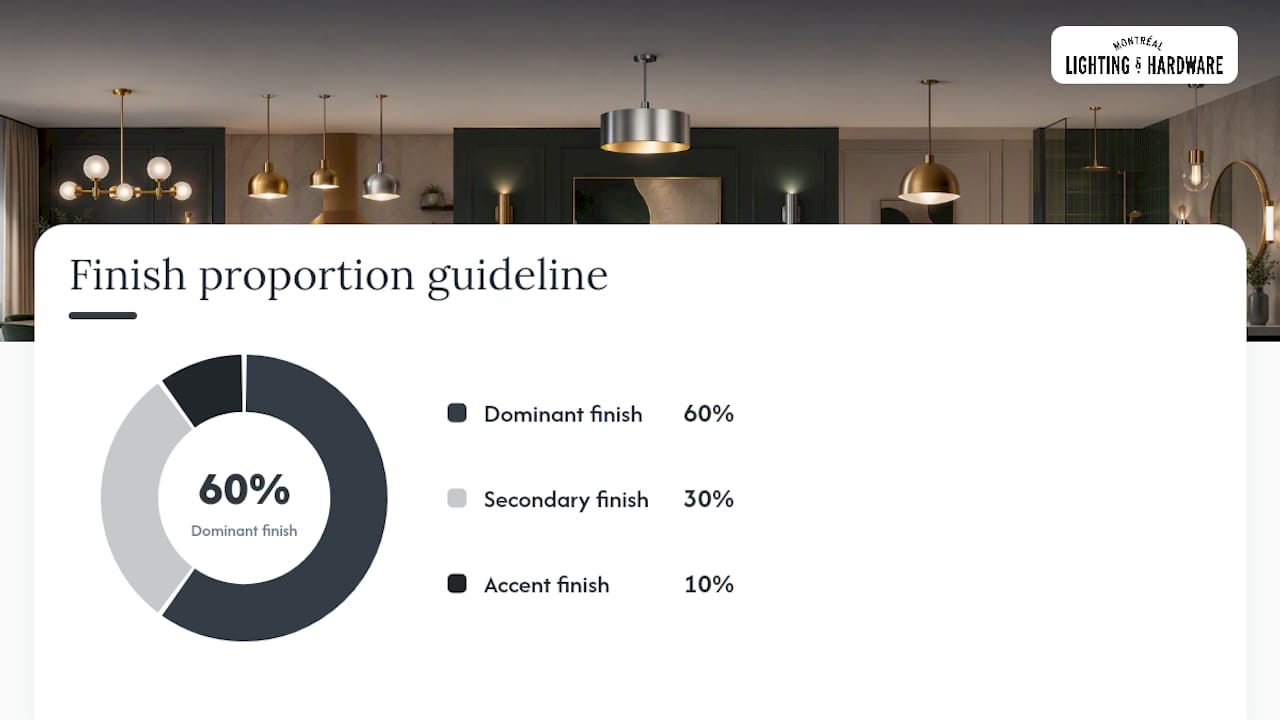
Hierarchy and repetition tie it all together. A useful starting ratio: let your dominant finish cover roughly 60% of your visible metal, a secondary finish take about 30%, and a third accent finish take the remaining 10%. That accent finish only reads as intentional if it shows up more than once in the room.
- Pick your dominant finish based on existing hardware or your desired texture.
- Choose a secondary finish and commit to using it in at least two fixtures or hardware pieces.
- Reserve a third finish, if you use one at all, for small, repeated accents only.
- Check silhouettes across all fixtures before you check finishes.
Pro Tip: Before buying anything, lay out photos of your intended fixtures side by side on your phone. Turn them to grayscale. If the shapes still look like they belong together, the finishes will too.
How Do You Mix Metals Room by Room?
Design principles only matter once you apply them to an actual kitchen, bathroom, or living room, and each of those spaces comes with its own practical constraints.
Kitchen
Your kitchen lighting should talk to your appliances and cabinet hardware, not just your countertops. If you have stainless steel appliances and black cabinet pulls, a matte black pendant over the island keeps things grounded, while brushed nickel under-cabinet lighting picks up the stainless tone. For task lighting where color accuracy actually matters, at the stove or over a prep area, aim for CRI 90+ bulbs around 3000K, warm enough to feel comfortable but clear enough to show true food colors.
- Pair matte black pendants with brass cabinet hardware for warm contrast.
- Repeat brushed nickel between appliances and a secondary light fixture, like a sconce near a coffee bar.
- Avoid three or more competing finishes on one wall of cabinetry.
Bathroom
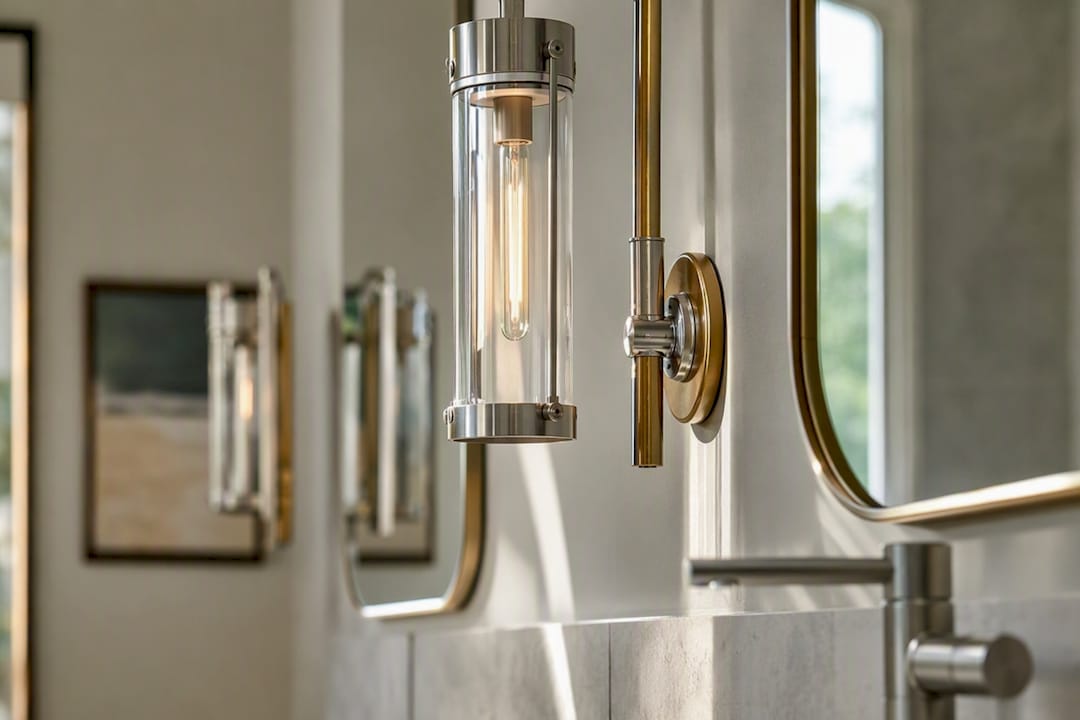
Bathrooms punish the wrong metal choice fast because moisture accelerates tarnish and pitting on lower-quality finishes. Coordinate your vanity lighting with your faucet finish first. That’s the pairing your eye catches every morning. A brass and silver lamp style vanity fixture next to a chrome faucet works when the two finishes share a similar sheen, both polished or both brushed. Avoid unlacquered brass or raw copper directly above a sink or shower where constant humidity will speed up patina, unless you actually want that aged look.
Living and dining rooms
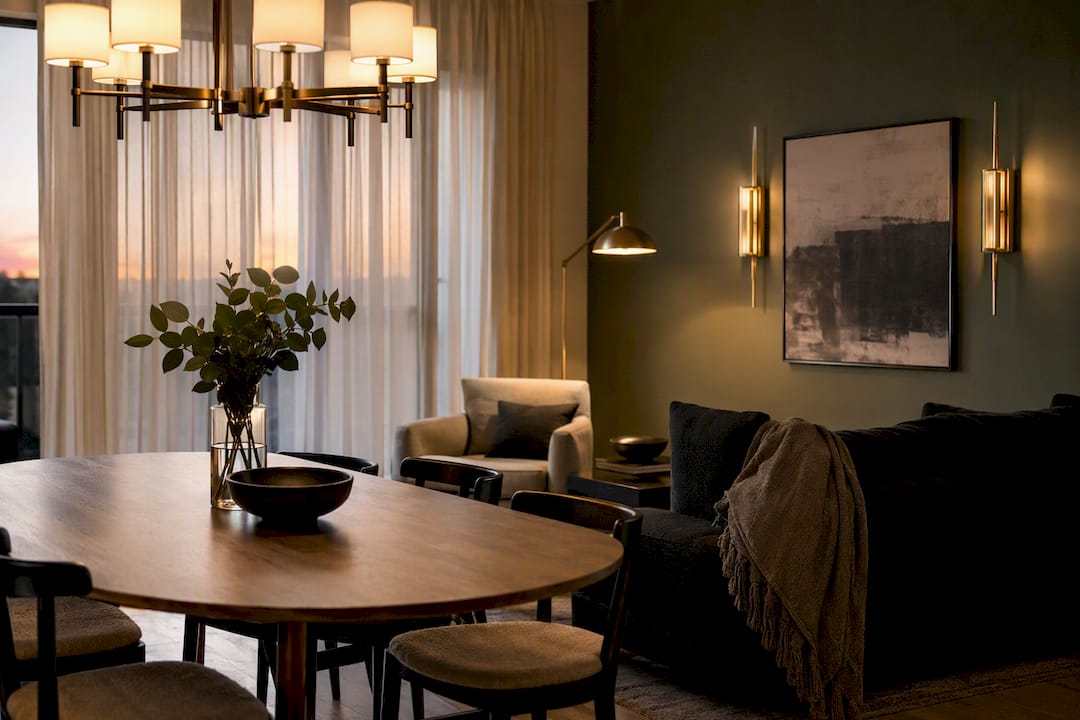
These rooms give you room to layer: ambient light from a central fixture, task light from a floor or table lamp, and accent light from wall sconces or picture lights. Use this layering to your advantage by repeating your secondary finish across all three types. If your dining chandelier is bronze with brass accents, echo that brass in a nearby console lamp and again in a picture frame or mirror.
Bedroom, foyer, and outdoor transitions
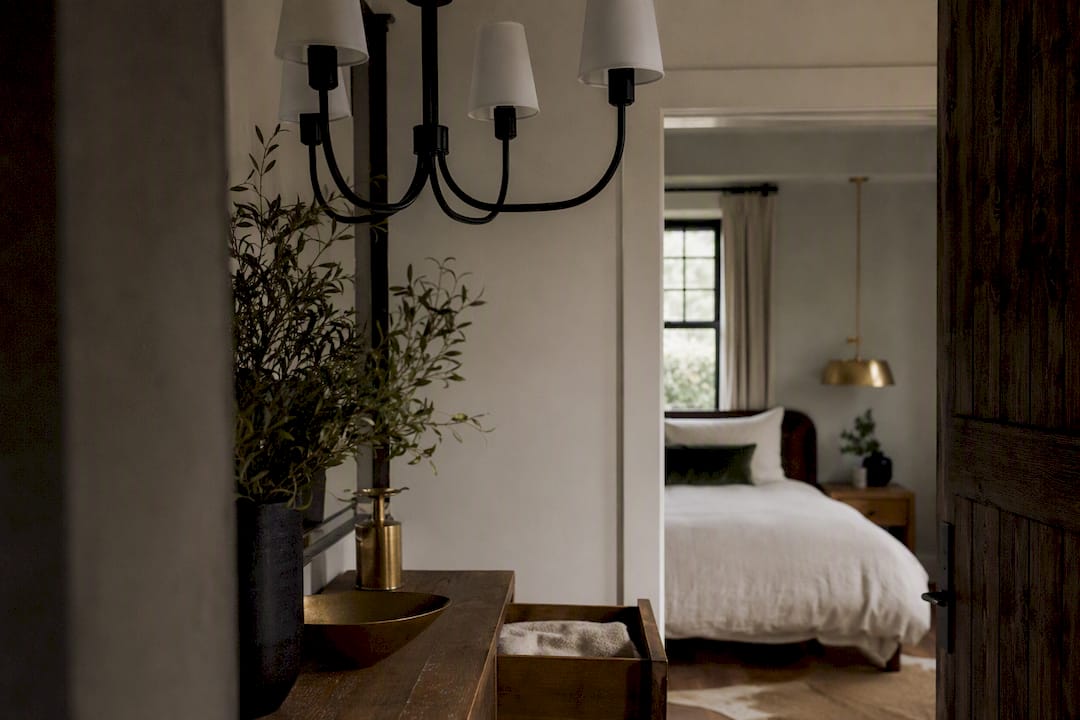
A foyer chandelier or bedroom pendant can serve as your one bold, dominant-finish statement piece, with small accents elsewhere (a lamp base, a mirror frame) repeating a secondary metal. When you move outdoors, from an entry sconce to a porch fixture, keep at least one finish consistent so the transition doesn’t feel abrupt from the street.
How Should Bulb Color Temperature and CRI Affect Your Choices?
CRI measures how accurately a bulb renders true color on a 0 to 100 scale, and it’s the single most overlooked factor in whether mixed metals actually look intentional or muddy. A bulb with poor CRI can make brass look dull yellow and nickel look flat gray, erasing the exact contrast you designed for.
Bulbs with a CRI of 90 or higher are the standard recommendation for showing true metal tones, and Kelvin temperature matters just as much. Warm bulbs in the 2700K to 3000K range flatter brass, bronze, and copper, bringing out their golden undertones. Cooler bulbs in the 3500K to 4000K range suit chrome and polished nickel, sharpening their silvery clarity. Put a cool bulb over a brass fixture, though, and it can wash out the warmth that made you choose brass in the first place.
- Use CRI 90+ bulbs anywhere metal finish is meant to be noticed, kitchens, vanities, and living areas.
- Choose 2700K to 3000K for rooms dominated by brass, bronze, or copper.
- Choose 3500K to 4000K for rooms dominated by chrome or polished nickel.
- Consider tunable white systems when warm and cool metals share the same open space.
Matte finishes are more forgiving of imperfect lighting because they scatter light rather than reflecting it directly. Polished finishes are less forgiving. A slightly off Kelvin temperature shows up immediately on a glossy chrome sconce in a way it never would on a brushed bronze one.
Tunable white LED systems let you shift a room’s color temperature throughout the day, favoring brass in the evening and chrome in daylight hours, but they need compatible drivers and controllers. That’s a wiring project worth handing to a licensed electrician rather than a weekend DIY task.
What Should You Check Before Buying Mixed-Metal Fixtures?
A little homework before checkout saves you from a return shipment or, worse, a finish that never looks right no matter how you light it.
- Measure your space and note ceiling height, wall width, and existing fixture placement.
- Photograph your current fixtures and hardware together on a neutral background. This same composition test that designers use works just as well for you at home.
- Request finish samples or swatches, and confirm stock and shipping timelines wherever you’re ordering from.
- Confirm the bulb type, CRI rating, Kelvin temperature, and dimmer or tunable-white compatibility before you commit to a purchase.
- Plan to repeat your chosen secondary finish in at least two spots, then test it under your actual bulb once it’s installed.
Pro Tip: Order one sample fixture or finish swatch before committing to a full set. Photos and screens shift undertones more than people expect, and brass under your bathroom’s actual light might look nothing like it did on your laptop screen.
What Are the Most Common Mixed-Metal Mistakes?
Most mixed-metal schemes fail for one of four predictable reasons, and every one of them has a simple fix.
- Using too many finishes at equal weight. Cap yourself at two or three finishes total, and if you introduce a third, keep it subordinate and used sparingly.
- Mismatched fixture shapes. If your pendant is a sleek cylinder and your sconce is an ornate scroll, no finish combination will make them feel related. Choose fixtures that share a scale or profile instead.
- A lone accent finish that never repeats. One copper switch plate in an otherwise nickel room looks unintentional. Repeating that contrasting finish in at least one more spot fixes it instantly.
- Ignoring how a finish ages. Living finishes like unlacquered brass and raw copper develop patina over time, which can be a beautiful thing or a maintenance headache depending on your tolerance for change.
Mixing metals remains one of the more durable trends in lighting design precisely because it rewards a little planning and punishes none at all when you skip it.
How Do Different Metal Finishes Age Over Time?
Every finish ages differently, and knowing which one you’re buying changes how much upkeep you’re signing up for. Unlacquered brass and raw copper are “living finishes,” meaning they oxidize and darken with exposure to air and moisture, developing a patina that many homeowners actually seek out for its warmth and character. Lacquered brass, by contrast, keeps its bright shine for years because a protective coating blocks that natural oxidation.
Chrome and polished nickel resist tarnish well but show fingerprints and water spots more visibly than matte finishes. A quick wipe with a microfiber cloth handles most of that. Bronze and oil-rubbed finishes tend to develop a deeper, richer color over time as the living finish reacts to handling and light exposure, especially on frequently touched pieces like door hardware or sconce arms.
For low-maintenance rooms, bathrooms and kitchens especially, lacquered or powder-coated finishes hold their original appearance with just occasional dusting and a damp cloth. If you love the idea of a fixture that changes character over the years, an unlacquered brass pendant or a raw copper sconce rewards patience instead of upkeep.
How Do Wood, Glass, and Fabric Work With Mixed Metals?
Metal finishes rarely stand alone in a room, and the materials around them do a lot to soften or sharpen the mix. Wood tones, especially warm oak or walnut, pair naturally with brass and bronze because both carry golden undertones. Pairing wood with cooler metals like chrome or brushed nickel creates a more deliberate, contemporary contrast instead.
Glass shades, whether clear, frosted, or seeded, add a neutral buffer between two contrasting metal fixtures in the same sightline. A frosted glass pendant between a brass chandelier and a nickel sconce gives the eye a visual pause rather than a direct clash. Fabric shades soften a room’s overall light quality and mute the sheen of polished metals underneath them, which makes fabric a useful tool when you’re mixing a glossy finish with a matte one and want to bridge the gap.
The safest approach treats wood, glass, and fabric as connective tissue rather than competing elements. Let them echo whichever metal finish is dominant in the room, and use them to soften transitions between contrasting accents.
How Do You Match Mixed Metals to Your Design Style?
Your design style should decide how bold your metal contrast gets, not the other way around. Industrial style lighting leans into contrast on purpose, pairing raw black iron with warm copper or brass for a look that feels intentionally rugged rather than accidentally mismatched. Modern farmhouse style tends to favor matte black paired with warm wood tones and a single brass accent, kept deliberately understated.
Contemporary mixed metals schemes often favor cooler pairings, brushed nickel with polished chrome, or matte black with brushed gold, for a cleaner, more architectural feel. Traditional and transitional interiors tend to be more forgiving of brass and bronze combinations, since those finishes have a long design history together.
Whatever your style, coordinating door and cabinet hardware finishes with your lighting choices early in the process saves you from redoing decisions later. Your style doesn’t dictate one “correct” metal combination. It just narrows your options to a palette that already feels coherent within that aesthetic.
How Do You Blend New Lighting With Existing Décor?
Most homeowners aren’t starting from a blank room. You’re working around cabinet hardware, faucets, and furniture finishes that are already in place, so any new lighting has to negotiate with what’s already there.
Start by identifying which existing finish appears most often in your hardware and fixtures. That’s likely your unofficial dominant metal already, whether you planned it or not. New lighting should either match that dominant finish or introduce a secondary one that you’re willing to repeat elsewhere in the room. Do light fixtures need to match your existing hardware exactly? Not exactly, but they do need to relate to it, either through shared finish, shared texture, or a similar level of shine.
If you’re mixing brass and black hardware that’s already installed, a new pendant in one of those two finishes will feel far more grounded than introducing a third metal that has no anchor point elsewhere in the room. When in doubt, bring a hardware sample or a photo of your existing finishes with you when shopping for new lighting, so you’re matching against the real thing rather than memory.
Why Most Mixed-Metal Advice Misses the Point
Most advice on this topic treats finish selection as the hard part. It isn’t. The hard part is repetition, and almost nobody talks about it enough. Homeowners pick a beautiful brass pendant and a beautiful nickel faucet, put them in the same room, and wonder why it looks off. The answer is rarely the finishes themselves. It’s that neither one shows up anywhere else in the space to anchor it.
We’d also push back on the idea that matching metals is the “safe” choice and mixing is the “bold” one. In practice, an all-matching room often looks flatter and more generic than a well-planned mix. The real risk isn’t mixing metals. It’s mixing them without a plan for hierarchy, shape, or light.
If you take one thing from this guide, prioritize the CRI and Kelvin decision before you fall in love with a finish. A gorgeous brass fixture under the wrong bulb will never look the way it did in the showroom.
How Montreal Lighting & Hardware Helps You Get the Mix Right
Montreal Lighting & Hardware carries pendants, sconces, and chandeliers across the finish range this guide covers, brass, black, bronze, nickel, and chrome, from designer lines including Savoy House and Maxim. That breadth means you can find a dominant fixture and its repeating secondary finish from the same collection, which keeps shapes and proportions consistent without hunting across a dozen brands.
- Request finish samples before committing to a full fixture order.
- Ask the trade team about pricing if you’re a designer or contractor managing a client project.
- Visit the showroom to see how a matte black finish actually reads next to a brushed brass one under real light.
- Take advantage of fast shipping when a project timeline is tight.
Getting mixed metals right usually comes down to seeing the actual finish under real light before you buy, not guessing from a product photo.
Ready to Plan Your Mixed-Metal Lighting?
Once you know your dominant finish and your CRI and Kelvin targets, the fastest path forward is browsing fixtures that already fit that plan rather than piecing one together from scattered sources. Montreal Lighting & Hardware’s catalog is organized so you can shop by finish and fixture type in one place, with trade pricing available if you’re working on a client project.

- Browse the full lighting and hardware collection by finish, style, and room.
- Request a finish sample or swatch before your next fixture order ships.
- Reach out to the trade team for project pricing if you’re a designer or contractor.
Pro Tip: Request your finish sample in the same room and at the same time of day you’ll actually use the fixture. Morning light and evening light change how brass and nickel read more than most people expect.
A statement piece like the Hulton Two Light Ceiling Mount makes a strong dominant fixture in a foyer or dining room, giving you a clear finish to repeat in smaller accents throughout the space. Start there, or start with a swatch. Either way, the plan comes before the purchase.
Frequently Asked Questions
Do light fixtures need to match throughout a home? No. Fixtures need to relate to each other through shared shape, finish repetition, or similar sheen, but identical matching isn’t required and often looks less interesting than a planned mix.
How many metal finishes should I use in one room? Two or three is the practical ceiling. Beyond that, a room starts to feel cluttered rather than curated, even if each individual finish looks good on its own.
Can I mix brass and black hardware with my lighting? Yes, and it’s one of the most common pairings in current interior design. Just make sure whichever finish you choose for your lighting connects back to one of those two hardware tones.
What Kelvin temperature works best for mixed metals? Warm bulbs around 2700K to 3000K suit brass, bronze, and copper, while cooler bulbs around 3500K to 4000K suit chrome and nickel. Tunable white systems let you adjust when a room holds both.
Does CRI actually matter for how metal looks? Yes. A CRI of 90 or higher renders true color accurately, which is the difference between brass looking warm and rich versus dull and yellow under a poor-quality bulb.
Sources
Recommended
- Top Lighting Stores in Canada: Editor Picks – Montreal Lighting & Hardware
- Best Bathroom Vanity Lights for Canadian Homeowners – Montreal Lighting & Hardware
- Hulton Two Light Ceiling Mount | Crystorama – Montreal Lighting & Hardware
- Metro Two Light Wall Mount | Crystorama – Montreal Lighting & Hardware
